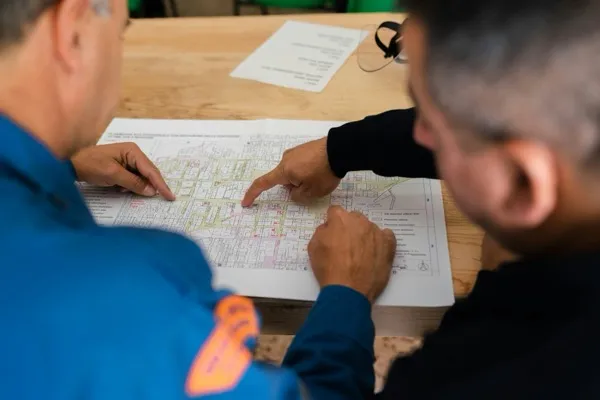

Your QC manager submitted the report. The non-conformance was documented. And three days later the crew poured over it anyway.
That's not a checklist problem. That's an authority problem.
Every construction firm has a quality control plan. Most have software to manage it. The firms with persistent quality control in construction failures have something in common: they've tried to solve a people problem with a process tool. Quality programs fail not because the documentation is missing, but because the person executing it lacks the authority, qualifications, or management backing to make it stick. Before upgrading your QC platform or redesigning your inspection workflow, ask a more basic question: have you answered the staffing question first? This article gives you the diagnostic framework to find out— and a sequenced path to fix it.
Three structural failures explain why documented QC programs consistently underperform. None of them appear in a QC plan template.
The Cost That Drives This Question
Construction rework and conflict resolution costs the U.S. industry an estimated $177 billion annually1. On a typical project, studies consistently find 5–15% of the total budget goes to preventable errors— the Construction Industry Institute places direct rework at 5%2, while the Chartered Quality Institute finds that major projects lose an average of 12% of their value3.
That range is real. The floor isn't the number to plan around.
| Cost Benchmark | Source |
|---|---|
| 5% of project budget (direct rework) | Construction Industry Institute2 |
| 12% of project value (major projects) | Chartered Quality Institute3 |
| $177B annually (rework + conflict resolution) | Industry analyst estimate1 |
Industry research attributes roughly 54% of construction defects to human factors— unskilled workers, insufficient supervision, inadequate training— not failed documentation1. When more than half of your quality failures trace to people, a better checklist isn't the fix.
The Three-Part People Problem in Construction Quality Control
Construction quality programs fail at three distinct points— none of which appear in a QC plan template: the wrong person in the QC manager role, insufficient authority to stop non-conforming work, and management that disengages when schedule pressure mounts.
Failure Mode 1: The wrong person in the role. The QC manager position requires a bachelor's degree plus five years of construction experience— and that's the floor4. What actually determines whether a QC program works is harder to credential: initiative, communication, the organizational standing to escalate and be heard. Many firms treat the role as administrative. That misclassification is where quality problems start.
Failure Mode 2: The authority gap. This is the clearest mechanistic statement of why QC fails. FTQ360 documents it directly: "When the quality control manager lacks authority or backing to halt deficient work, quality suffers, and problems compound."5 A QC manager who cannot stop non-conforming work is executing a ceremonial role. The three-phase inspection system— preparatory, initial, follow-up— requires someone who can enforce what it finds.
Failure Mode 3: Management disengagement. FTQ360's research identifies five reasons construction QC programs fail6. Four trace back to management behavior: inconsistent execution, no tracking or communication of results to field teams, using QC as a punitive discipline tool, and leadership that backs away from standards the moment a schedule slips. When QC becomes something management does to the field instead of with it, buy-in collapses.
How the Labor Shortage Makes This Structurally Worse
92% of construction firms report difficulty filling open positions. 57% say available candidates lack the required skills or credentials7. The workforce shortage isn't just a productivity problem— it's a direct quality problem.
Less seasoned crews extend task durations and raise rework levels directly8. Managers spend more time guiding inexperienced workers, which means less time for the planning and coordination that prevents defects instead of fixing them. The shortage doesn't just slow projects down; it creates the conditions where non-conforming work gets through.
| Workforce Data Point | Quality Implication |
|---|---|
| 92% of firms struggle to hire7 | QC roles compete for the same scarce talent pool |
| 57% of candidates lack credentials7 | Field crews arrive under-qualified; rework follows |
| 499K additional workers needed in 20269 | No near-term relief; quality pressure compounds |
| ~41% of workforce retires by 20319 | Quality knowledge walks out with experienced workers |
| 68% industry-wide turnover9 | Standards rebuilt from scratch on every project rotation |
The turnover number is the one that keeps experienced QC managers up at night. Autodesk's Digital Builder puts it plainly: "Quality control procedures on a well-run project often reflect the habits of one experienced superintendent. Move that superintendent, and the standard moves with them."10 An industry running approximately 68% annual turnover— 73% in skilled trades per NCCER data— is an industry rebuilding its quality knowledge base constantly. Even a well-documented QC plan struggles when the person who knew how to execute it is no longer there.
Process Is Necessary. It Is Not Sufficient.
QC documentation matters. A three-phase inspection system— preparatory, initial, follow-up— gives a qualified QC manager a framework to execute against. That framework is widely adopted across commercial and government construction projects, and it works. The problem is what happens when there is no qualified QC manager executing it.
As Autodesk notes: "Punch lists alone won't dictate your success outcomes, especially if your team's roles and responsibilities aren't clearly defined."10 Documentation without clear ownership produces documentation. It doesn't produce quality.
Most firms buy a new QC software package when what they actually need is a decision about who owns quality and whether that person has the authority to stop work. The right sequence:
- Staff the right person— credentials, communication, initiative, organizational standing
- Give them explicit halt-work authority— communicated from project start, not assumed
- Build management backing— consistent, not conditional on schedule comfort
- Then optimize the process and add tools— after the foundation is in place
The sequence doesn't change based on firm size, project type, or contract structure. Tools built on top of a staffing gap amplify the gap, not the quality.
Where AI and Technology Fit— After the People Question
75% of construction companies reported using AI in 202411. The firms getting the most from those investments have qualified people deciding what the AI is documenting and what to do with what it finds.
Site documentation platforms give a QC manager visibility across an entire job site at once— a scale that used to require three people walking the site. Inspection management tools cut the administrative load of the three-phase inspection system enough that a single QC manager can cover projects that previously required a team. AI-powered monitoring can flag non-conformances in real time. These tools are genuinely valuable.
But they share a limitation: visibility tools show you what's happening. They don't tell you what to do about it. Recognizing a non-conformance, deciding whether to halt work, escalating to leadership when a superintendent pushes back— that judgment requires a qualified human with the authority and backing to act on what the technology surfaces.
The right framing for AI implementation for construction firms: technology reduces the cost of data collection, which means a well-staffed QC function can cover more ground with less administrative burden. That's the value proposition. It doesn't answer the staffing question; it multiplies the effectiveness of a firm that already has.
What Staffing for Quality Actually Means
Staffing for quality means three things: a QC manager with the right qualifications, explicit authority to halt non-conforming work, and management backing that doesn't evaporate under schedule pressure.
Qualifications beyond credentials. The floor is a bachelor's degree plus five years of construction experience4. The ceiling is what actually matters: initiative, communication, the organizational standing to escalate and be heard. As Knack puts it: "Making sure that your staff is qualified, capable and systems oriented is crucial to success for quality management."12
Explicit halt-work authority. This is a management decision, not a hiring decision. It must be communicated from project start— not assumed, not implied by org chart position. Knack again: "Successful contractors establish from project start that quality control has the authority and management support to perform its function, even when production schedules are aggressive."13 A QC manager who cannot stop non-conforming work is in a ceremonial role regardless of their credentials.
Institutionalizing the knowledge. Document standards in ways that survive personnel changes. Pair experienced QC managers with developing talent. Treat quality knowledge as firm intellectual property, not individual expertise. That's the practical antidote to the "move the superintendent, move the standard" problem.
Treating the QC manager as a technical authority— not an administrative function— sends a signal through the firm that quality is a genuine operational priority. Firms that build an AI-ready organization this way tend to approach technology the same way: the tool serves a person with standing to act on what it finds.
Frequently Asked Questions
What causes most construction quality problems?
Human factors— unskilled workers, insufficient supervision, and inadequate training— are attributed to roughly 54% of construction defects1. Even well-documented QC programs fail when the person running quality lacks the authority or qualifications to enforce standards. The failure is structural: a QC manager without halt-work authority cannot function as the role is designed5.
How much does construction rework cost?
Studies consistently find that rework represents 5–15% of total project costs. The Construction Industry Institute places direct rework at 5%2, while the Chartered Quality Institute finds 12% on major projects3. The U.S. industry pays an estimated $177 billion annually in rework and conflict resolution costs1.
What does a construction QC manager do?
A construction quality control manager executes three-phase inspections (preparatory, initial, follow-up), maintains daily inspection reports, manages the submittal process, and enforces compliance— including halting non-conforming work4. The authority to stop work is essential; without it, the role cannot function as intended5.
Why do QC programs fail in construction?
Five primary reasons: inconsistent execution, no tracking or feedback loop to field teams, using QC as a punitive discipline tool rather than an improvement system, upper management disengaging under schedule pressure, and failure to give QC managers the authority they need6. Most of these are management failures, not process failures.
How does the construction labor shortage affect quality?
92% of construction firms struggle to fill open positions, and 57% say candidates lack required skills or credentials7. Less experienced crews raise rework levels directly8, and an industry-wide 68% turnover rate means quality standards tied to individual expertise must be rebuilt from scratch constantly9.
The QC Plan Is the Scaffold. It Doesn't Build Anything.
Every construction firm has a QC plan. The firms that produce consistent quality have answered a prior question: who is running this, what authority do they have, and does management back them up when it matters?
The construction labor market makes that question harder to answer every year. Finding and retaining qualified QC personnel with both the technical credentials and the organizational standing to enforce standards isn't a simple operational fix. It requires treating the QC manager role as a respected technical authority— not an administrative one.
Audit your QC program for people gaps before process gaps. Look at who runs quality, what authority they actually have, and what happened the last time they tried to stop work under schedule pressure. The answer to that last question tells you more about your program than any documentation review.
If auditing the people question reveals gaps that are hard to fill with current staff or structure, that's a conversation worth having. The tool only works when the right person is running it— and building that person into your organization is where most firms find the clearest starting point. Whether you're weighing consultant versus in-house options or ready to build an AI strategy for your firm, the logic is the same.
No matter the question, people are the answer.
References
- BuildCheck.ai, "19 Construction Rework Statistics That Reveal the True Cost of Preventable Errors" (2024)— https://buildcheck.ai/insights-case-studies/construction-rework-statistics
- Construction Industry Institute (CII), "Costs of Quality Deviations in Design and Construction" (2024)— https://www.construction-institute.org/costs-of-quality-deviations-in-design-and-construction-0864a5c00166655fd368112d394d7620
- OpenSpace, "Quality Control in Construction: Processes & Best Practices" (2024)— https://www.openspace.ai/blog/quality-control-in-construction-projects/
- Procore Technologies, "Construction Quality Control Manager: Mastering the Role" (2024)— https://www.procore.com/library/construction-quality-control-manager
- FTQ360, "Who Is Responsible for Quality Control in Construction?" (2024)— https://blog.ftq360.com/blog/inspector-vs-responsible-party-general-contractors
- FTQ360, "5 Reasons Your QC Program is Failing and How To Fix It Today" (2024)— https://blog.ftq360.com/blog/are-you-sabotaging-your-construction-quality-programs-success-5-reasons-qc-measures-fail
- AGC and NCCER, "AGC/NCCER 2025 Craft Workforce Survey" (2025)— https://www.nccer.org/research/2025-workforce-survey-agc-nccer/
- CMiC Global, "The Impact of Skilled Labor Shortages on Productivity in Construction" (2024)— https://cmicglobal.com/resources/article/The-Impact-of-Skilled-Labor-Shortages-on-Productivity-in-Construction
- NCCER, "2025 State of the Construction Workforce Shortage Infographic" (2025)— https://www.nccer.org/newsroom/2025-state-of-the-construction-workforce-shortage-infographic/
- Autodesk, "Construction Quality Management 101— Digital Builder" (2024)— https://www.autodesk.com/blogs/construction/construction-quality-management/
- Dan Cumberland Labs, "AI Site Inspection in Construction: 3 Tools for 2026" (2026)— https://dancumberlandlabs.com/blog/ai-site-inspection-construction/
- Knack, "Quality Control in Construction: Strategies for Project Success" (2024)— https://www.knack.com/blog/quality-control-in-construction/
- Knack, "Quality Control in Construction: Strategies for Project Success" (2024)— https://www.knack.com/blog/quality-control-in-construction/