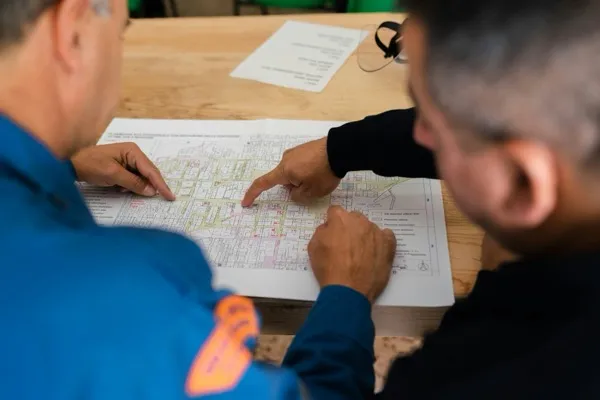

Your site prep crew hit abandoned concrete footings on day three. Four feet below grade, nothing on any drawing, not in the geotech report. The superintendent logged it, the GC issued a change order, the project absorbed the cost. Six months later, your design team made the same grading assumption on a comparable site.
That's not bad luck. That's a missing path.
Site preparation contractors carry field knowledge that design teams need. But in most AEC firms, there's no system to get that knowledge from the field back to the people making design decisions— on this project or the next one. Building that path is practical, tiered, and cheaper than a single rework event.
What Site Preparation Contractors Discover Before Anyone Else
Site preparation contractors— the firms that clear land, grade and excavate, compact soil, manage erosion control, and prep utilities— are the first trade on site and the last to be consulted on design. They encounter what's actually there: not what the geotech report predicted, but what the soil, subsurface, and topography turned out to be.
Their work encompasses the foundational scope that precedes all vertical construction— land clearing, rough and fine grading, excavation, drainage installation, and utility rough-in prep14. On most projects, they mobilize before any other trade. They move the most earth, encounter the most unknowns, and complete their scope before structural work begins.
What they typically find that wasn't in the design documents— and that no subsequent trade will encounter before the site prep scope is already underway:
- Subsurface water tables higher than the geotech report assumed
- Buried construction debris, abandoned utilities, and legacy concrete remnants
- Soil horizons that compact differently than the design spec predicted
- Drainage patterns that diverge from grading assumptions
- Contaminated soil layers requiring remediation— at approximately $140 per cubic yard, per TraceAir8
Many experienced site prep contractors now run pre-mobilization test pits even when a geotech report exists, because practitioners have learned what the drawings often miss11. Site work has been called "10% of the budget, but 100% of the headaches" for exactly this reason8.
This discovery happens early— before other trades, before RFIs stack up, before the schedule compresses. It's the most actionable intelligence window on a project. The question isn't whether site preparation contractors make valuable discoveries. It's whether that knowledge survives scope completion.
Why That Knowledge Disappears at Scope Completion
The gap between what site preparation contractors learn on site and what design teams know isn't a communication problem. It's a structural one.
Carnegie Mellon University's Department of Civil and Environmental Engineering frames it plainly: "In the traditional construction system, design is carried out by the consultant and construction by the contractor, with rare communication between both parties before construction begins."7 You can't read the label from inside the bottle— design teams are working from documents, and the field knowledge is outside with the contractor who just completed scope and moved on.
Site prep contractors are specialty subcontractors. In design-bid-build delivery, they have no contractual relationship with the design team— only with the GC or owner. After scope completion, their knowledge leaves with them. There's no debrief requirement, no documentation standard, and no one whose job it is to create a routing mechanism.
The cost of that gap shows up in the numbers. A 2025 peer-reviewed study in Engineering, Technology & Applied Science Research found that design changes contribute to 56.5% of construction cost overruns and 40% of project delays1. Up to 70% of projects experience rework due to design inconsistencies or errors1. The Construction Industry Institute puts rework at 5–15% of project budget3; the 2026 Autodesk/FMI report puts it as high as 20%4. On average, nationwide construction projects exceed budget by at least 16%5.
And what those numbers don't capture is the institutional cost— the repeat version of the same problem, on the next project, with the same design assumptions.
Not every design change traces to a site prep discovery. But a meaningful share of recurring surprises— soil conditions, drainage behavior, buried legacy infrastructure— are preventable if previous site prep field experience feeds back into future design assumptions.
| Without a Feedback Path | With a Feedback Path |
|---|---|
| Knowledge leaves with the subcontractor at scope completion | Field observations documented and routed at scope completion |
| Design team repeats the same assumptions on similar sites | Design team adjusts assumptions based on what prior crews found |
| Institutional learning happens informally, if at all | Firm builds a searchable record of actual site conditions |
| Change orders absorb the cost of repeated surprises | Contingency allocation gradually shrinks as known-unknowns reduce |
The fix isn't to restructure the construction industry. It's to build a path inside the existing structure.
What a Formal Feedback Path Actually Looks Like
A feedback path from site preparation contractors to design teams doesn't require a new contract structure, a new software platform, or a new hire. It requires three things: a structured debrief at scope completion, a documentation format the GC or owner controls, and a protocol for routing observations to the design team before the next project's design assumptions are locked.
This is not a constructability review. Constructability reviews— performed at conceptual, schematic, and detailed design milestones per industry practice10— happen during design to surface buildability issues before they become field problems. A feedback path captures what actually happened in the field and routes it back to design for the next project. The goal is institutional learning— what AEC practitioners often call lessons learned— not current-project remediation. That distinction matters for how you build the system.
Most AEC firms already have a documentation tool. What they're missing is a decision about who owns the site prep contractor's field knowledge and where it goes at scope completion. The tool is irrelevant until that decision is made.
Foundational research from the 1970s–1990s— the original Early Contractor Involvement studies— shows that engaging contractors during design rather than after it produces approximately 10% reduction in construction time and 7% in project cost2. The direction of effect is well-established even if the exact magnitudes reflect an earlier era of construction. A feedback path applies this logic in reverse: route what contractors discovered after construction back to inform future design.
The implementation tiers:
| Tier | Method | Who Drives It | When | What Gets Captured | Where It Goes |
|---|---|---|---|---|---|
| 1— Manual | Post-scope debrief meeting | GC PM or owner PM | Immediately at scope completion | Verbal field observations, structured questions | Written notes routed to EOR and civil engineer |
| 2— Template | Structured site observation log | Site prep superintendent | During mobilization and execution | Geotech gaps, drainage deviations, buried discoveries | Project artifact; GC routes at scope completion |
| 3— Digital/AI | Drone photogrammetry + AI documentation platforms | GC tech team or owner | Continuous during site work | As-built surface models, deviation flags, searchable records | Current project design team + institutional knowledge base |
Don't underestimate Tier 1. A 60-minute debrief that's consistently executed is worth more than an elaborate digital system that nobody uses. Start where your firm can actually execute.
Tier 3 is where the economics change dramatically— and where AI makes systematic feedback viable at any firm size. Tier 3 requires either an owner who mandates technology capture in the spec or a GC with an established drone program— it's most accessible on projects above $5M site work scope or with progressive owner clients.
Who owns the path depends on delivery model. In design-build or CM-at-risk, the GC or CM holds both the contractor relationship and the design relationship— they're the natural owner. In design-bid-build, the owner's PM must drive it. There's no one else in a position to require documentation from a specialty subcontractor AND route it to the design team.
Where AI Changes the Economics of Capturing Field Knowledge
The barrier to systematic site prep contractor feedback has never been knowledge— it's been documentation cost. Recording field conditions accurately takes time. AI tools have changed that calculation.
Drone photogrammetry platforms generate as-built surface models that show exactly how site conditions deviated from design assumptions— automatically, in formats any design team member can open. Per DroneDeploy's published construction benchmarks, drone surveying reduces documentation time by up to 80%12. A week of site work that would take days to document manually produces a complete as-built record in hours.
Autodesk's 2026 AI construction review reports field-caught design errors dropping 50–75% on projects using high-coordination documentation platforms6. The AI isn't replacing the site prep contractor's judgment— it's creating a retrievable, routable record of what that judgment encountered.
Platforms like Procore, TraceAir, and OpenSpace create searchable records that survive project closeout. An AEC firm that systematically captures site prep field observations builds an institutional knowledge base: future design teams can query past conditions on similar site types before design assumptions are locked. That's not theoretical— that's AI workflow automation applied to a workflow your firm is already doing manually.
For how AEC firms recover superintendent time with AI, the same documentation tools that reduce rework also free field leadership from manual logging, reporting, and condition tracking.
Tools with specific functions in the feedback path:
- Drone platforms (DroneDeploy, TraceAir): As-built surface capture— conditions vs. design intent, automatically
- AI documentation tools (OpenSpace, Autodesk Construction Cloud): Deviation flagging in real time, creating routable records
- Project management platforms (Procore, Fieldwire): Storage and routing— connects field observations to design team workflows
Identifying which tools fit your delivery model and workflow, connecting them to your design review process, and building the routing logic— those decisions are where a structured AI implementation engagement creates disproportionate value. The cost of that engagement is a fraction of a single rework event.
The technology is ready. The harder question is organizational: who makes this happen, and how do you start without creating resistance?
How to Start Without Creating Friction
The fastest path to a working feedback path is a single pilot: one project, one site prep contractor, one structured debrief. No software required. No new contract language. Run it manually, document what you learn, and route it to the design team for the next comparable project.
Five questions for your first post-scope debrief:
- What did you find that wasn't in the geotech report?
- What would you change about the grading plan if you were giving input before it was drawn?
- What did the drainage actually do versus what the drawings assumed?
- Were there any buried obstacles or soil conditions that changed your work scope?
- What would you tell the design team for the next project on this site type?
Document the answers. Route them. That's the feedback path at Tier 1. The interesting thing happens when you run it a second time and see what carried forward.
An AIA survey cited by PlanRadar found that 94% of practitioners already believe early contractor involvement contributes to project success9. The pilot converts belief into practice.
But the business case only holds if the debrief actually happens— not as an afterthought, but as a formal scope completion step. Once the feedback path proves its value, contract language reinforces it. Add a simple specification requirement for structured site observation documentation. Pre-construction contingency allowances of 10–20% for unforeseen conditions are standard in site work contracts13. A functioning feedback path gradually reduces what those contingencies need to cover— that's the business case for making the requirement permanent.
CII research shows that projects with the highest front-end planning scores consistently show rework cost below 3%3. A documented feedback path is front-end planning for future projects. The decision framework for when AI investment is worth it applies directly here: the question isn't whether a feedback path costs something to implement, it's whether it costs more than the rework it prevents.
For building AI adoption in construction teams, a site prep feedback path is often the right first implementation— low friction, high ROI, visible wins within the first project cycle.
FAQ
What does a site preparation contractor do?
Site preparation contractors clear land, grade and excavate, compact soil, manage erosion control, and prep utilities— all before vertical construction begins14. They are the first trade on site and typically complete their scope before structural work starts. Their work establishes the physical conditions every subsequent trade depends on.
Why is site work the riskiest phase of construction?
Subsurface conditions can't be fully predicted from surface investigation or standard geotechnical reports. Contaminated soil, abandoned underground structures, unexpected rock, and drainage behavior that deviates from design assumptions are common discoveries— and contaminated soil removal alone runs approximately $140 per cubic yard8. Site work carries disproportionate schedule and cost risk relative to its budget share.
What is Early Contractor Involvement (ECI)?
Early Contractor Involvement (ECI) is the practice of engaging contractors during design— not after it— so their field expertise informs design assumptions before they're locked. Foundational research from the 1970s–1990s shows ECI produces approximately 10% reduction in construction time and 7% in project cost2. A feedback path applies the same logic retroactively: what contractors discovered goes back into future design rather than staying in a superintendent's daily log. The direction of effect is clear; the implementation question is who builds the routing mechanism.
How much does poor design-contractor coordination cost?
Design errors contribute to 56.5% of construction cost overruns and 40% of project delays according to a 2025 peer-reviewed study1. Rework costs between 5% and 20% of total project budget depending on front-end planning quality3,4. Nationwide, construction projects exceed budget by at least 16% on average5. Not all of that traces to site prep coordination gaps. But the fraction that does— soil conditions, drainage behavior, buried legacy infrastructure that surprised a crew last year and will surprise the next one— is preventable without restructuring how your firm works. That's the part worth owning.
How can AI help site prep contractors communicate with design teams?
Drone surveys reduce documentation time by up to 80%, generating as-built surface models that show exactly how site conditions differed from design assumptions12. AI tools flag field deviations from design intent in real time, reducing field-caught design errors 50–75% on high-complexity projects6. Platforms like Procore and OpenSpace create searchable records that survive project closeout and feed institutional knowledge for future design cycles.
Conclusion
The knowledge site preparation contractors carry off site is not a mystery. It's a recoverable asset— if the firm builds a path to capture it.
That path starts with a conversation. A 60-minute debrief, five structured questions, a written record routed to the EOR. No new software, no new contract language. Just a decision about who owns that knowledge and where it goes.
The cost of building that feedback path is measured in hours. The cost of a missing one is measured in change orders and rework budgets on the next project where the same soil conditions surprise the same design team.
Digital tools have eliminated the documentation burden that used to make systematic capture impractical. The implementation decision is now organizational, not technical.
If mapping the feedback path from your site work subs to your design review process is where you need help, that's exactly the kind of workflow a structured AI implementation engagement addresses— connecting field knowledge to design systems in a way that compounds value across projects.
Your design team is already working from what they know. The question is whether what your site prep contractors discover ever makes it back to them.
By Dan Cumberland— AI implementation consultant for AEC firms
References
- Engineering, Technology & Applied Science Research, "Impact of Change Orders on Cost Overruns and Delays in Large-Scale Construction Projects" (2025)— https://etasr.com/index.php/ETASR/article/view/9449
- Wikipedia / foundational ECI research (1970s–1990s), "Early contractor involvement"— https://en.wikipedia.org/wiki/Early_contractor_involvement
- Construction Industry Institute (CII) via InspectMind AI, "Construction Rework Cost: 5-15% of Budget (CII Research)" (2024)— https://www.inspectmind.ai/resources/articles/true-cost-construction-rework
- Autodesk / FMI via ReworkCost.com, "Cost of Rework in Construction 2026: 4-12% of Project Cost" (2026)— https://reworkcost.com/cost-of-rework-in-construction
- Autodesk, "6 Causes of Construction Cost Overruns & How to Prevent Them"— https://www.autodesk.com/blogs/construction/cost-overruns-construction/
- Autodesk / StartUs Insights, "2026 AI Construction Trends: 25+ Experts Share Insights" (2026)— https://www.autodesk.com/blogs/construction/2026-ai-trends-25-experts-share-insights/
- Carnegie Mellon University, Dept. of Civil and Environmental Engineering, "Project Management for Construction: The Design and Construction Process"— https://www.cmu.edu/cee/projects/PMbook/03_The_Design_And_Construction_Process.html
- TraceAir, "Why Site Work Is the Riskiest Phase of Construction"— https://www.traceair.net/whats-new/why-site-work-is-the-riskiest-phase-of-construction
- American Institute of Architects (AIA) via PlanRadar, "Bridging the gap: Enhancing collaboration between architects, engineers, and contractors"— https://www.planradar.com/sg/bridging-the-gap-collaboration-architects-engineers-contractors/
- Procore, "Constructability Explained: Reviewing Designs for Building Risks"— https://www.procore.com/library/constructability
- OPE Plus, "The real reason landscape projects fail: grading, drainage and site prep" (April 2026)— https://ope-plus.com/2026/04/15/the-real-reason-landscape-projects-fail-grading-drainage-and-site-prep/26169/
- DroneDeploy / Impact Aerial, "Construction Drone Documentation: The 2026 Guide to Reality Capture and Site Monitoring" (2026-09-15)— https://www.impactaerial.co.uk/2026/09/15/construction-drone-documentation-the-2026-guide-to-reality-capture-and-site-monitoring/
- LaunchAdvisor, "Excavation Contractor Contracts and Change Orders: Legal Protection (2026)" (2026)— https://www.launchadvisor.co/guides/excavation-contract-change-orders-excavation-site-prep-contractor
- JRG Civils, "Site Preparation Contractors: Essential Civil Engineering" (July 2026)— https://jrgcivils.co.uk/2026/07/24/site-preparation-contractors/