Your proposal calendar is full and your team is already at capacity. Both of those things are true at the same time, and that's exactly the problem.
At 33 hours per RFP and 166 submissions a year1, the average AEC proposal team burns 5,478 hours annually in proposal execution. With a 39% win rate1, roughly 3,340 of those hours go to proposals the firm loses. That's not an emotional problem— it's an arithmetic one. And arithmetic has solutions.
166 RFPs × 33 hours × 61% lose rate ≈ 3,340 hours/year on proposals you don't win
A capacity triage sprint is a 2-4 week process to audit that waste, triage what belongs on the board, write a go/no-go rule the team will actually use, and get one automation running. This piece walks through the four phases.
Why the Capacity Crisis Is Structural
AEC proposal teams face a structural problem, not a performance one. They are under-resourced for the volume they face. Sixty-nine percent of AEC marketing teams have fewer than 10 people— regardless of firm size— while 86% of those same marketers regularly handle every pursuit support task: presentations, project sheets, resumes, qualification packages2.
And volume is climbing. The average organization submitted 166 RFPs in 2025, up from 153 the year before1. For the first time in five years, bandwidth is the number-one challenge for proposal teams— not strategy, not talent, not competition1. Teams are being asked to do more with the same people at the same hours.
The structural root causes, summed:
- Volume growth— 166 RFPs per year means roughly 3.2 per week; most teams can't sustain meaningful quality at that pace
- Small team sizes— fewer than 10 people handling all pursuit support, often with no specialist separation
- Absence of a triage filter— most firms say yes to what they can respond to, not what they should win
That last one is the fixable one. Firms that pass on 40-50% of identified opportunities cluster at the top of win rate rankings5. Incumbent firms win 60-90% of pursuits; cold-pursuit win rates average 15%5. As Salentis notes, "Sustainable teams win more often than exhausted teams."4
The sprint is the intervention that addresses all three root causes in a bounded timeframe.
What a Capacity Triage Sprint Is— and What It Isn't
A capacity triage sprint is a focused, 2-4 week process for AEC firms to audit their proposal pipeline, triage active and upcoming pursuits against objective criteria, identify the highest-ROI automation targets, and put systems in place to prevent capacity collapse from happening again.
Note what it is not.
| Sprint | Process Improvement Project |
|---|---|
| 2-4 weeks | 6-18 months |
| Three concrete deliverables | Ongoing optimization |
| Runs alongside current work | Requires a dedicated team |
| Defined start, defined end | Open-ended |
The sprint produces three things: a triaged pipeline, a go/no-go decision rule the team will actually use, and one automation target identified and ready to implement. Setup for proposal automation tools typically takes 2-4 weeks once the target is defined7.
Who runs it: the BD director or marketing principal leads. Principals join for the triage session. Proposal coordinators contribute to the audit. Each working session is a half day.
AEC firms can't stop work to fix the process. The sprint runs alongside proposal season— not instead of it. That's why a solid AI implementation strategy starts with a bounded diagnostic, not a six-month initiative. The four phases below run in sequence, one half-day at a time.
The Four Phases of a Capacity Triage Sprint
The sprint runs in four phases over 2-4 weeks. Each phase produces a specific output. Together, they move a proposal team from overwhelmed to operating with a clear pipeline and a repeatable triage process.
Phase 1— Audit (Half Day)
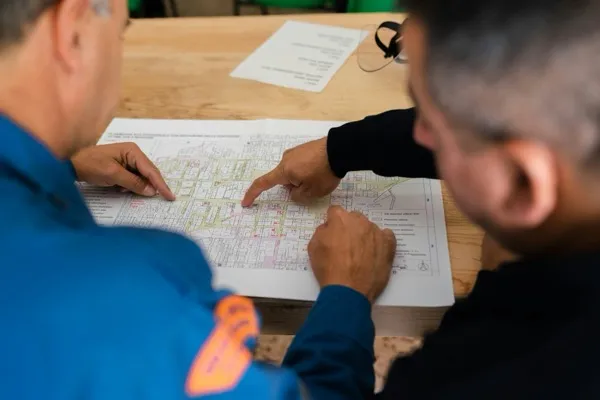
The audit maps current reality before anyone tries to fix it. List every active and in-progress pursuit: client name, RFP name, due date, hours already invested, and a rough probability estimate. Then map team capacity— who is working on what, how many hours per week, which people are at or over their limit.
And identify your top three time sinks in the current proposal process— across AEC firms, these are almost always the same: assembling staff bios, writing project narratives from scratch, and formatting compliance documents. The 33-hours-per-RFP benchmark1— with nine contributors per submission— tells you the time isn't concentrated in one or two people. It's distributed across the team.
Output: A one-page pipeline snapshot and a time-sink shortlist.
Phase 2— Triage (Half Day)
Score every pursuit against four criteria:
- Strategic alignment— Does this client type fit where the firm is going?
- Win probability— Incumbent relationship or cold pursuit?
- Operational capacity— Does the team have the hours to do this well?
- Financial threshold— Is the contract value worth the investment?
Apply a simple label to each pursuit: keep, kill, or borderline. But kill the clear no-gos now. Don't wait. Every no-go decision reclaims hours that fund the rest of the sprint.
For politically sensitive decisions, the scoring criteria do the work— a principal who championed a low-scoring pursuit can see the logic without feeling personally overruled. 81% of high-win-rate teams use formal qualification criteria1, which means the decision becomes structural, not personal.
This is where pursuing low-probability RFPs gets named for what it is: chasing pennies when you could be chasing dollars. The capacity spent on a 15% cold pursuit is capacity not available for an 80% incumbent renewal.
Phase 3— Prioritize (Half Day)
Of the pursuits you're keeping, identify the one or two highest-ROI automation targets. The candidates are almost always bio assembly, project narrative generation, or compliance boilerplate— tasks that (a) take the most hours per proposal, (b) repeat across virtually every RFP, and (c) move from a known input to a predictable output— no creative judgment required.
But the goal is not to automate everything. It's to pick the one process that, if automated, gives the team the most hours back. The selection happens here— before you touch a tool.
"A team cannot articulate how work moves from start to finish— no amount of AI will fix that."— Brian Bowden, Dunaway Engineering, via Zweig Group6
Output: A ranked automation target with the workflow mapped, not just the tool named.
Phase 4— Build (Weeks 2–4)
Set up the automation for the top target. This is not a technology project— it is process documentation plus tool configuration. Document the current state of the workflow, identify where inputs come from, and configure the tool to handle the repetitive steps.
Simultaneously, write your go/no-go decision criteria as a one-page rule. Not a scoring spreadsheet— a rule the team can apply in 15 minutes per RFP. Establish who makes the decision and on what timeline.
Output: A functioning automation for one workflow and a written go/no-go rule.
Most firms skip directly to automation. The sprint reverses that sequence— triage first, tools second. And that reversal is what makes the results stick.
Where AI Recovers the Most Capacity
AI recovers the most proposal capacity in the assembly tasks, not the judgment tasks. Bios, project narratives, compliance boilerplate, and qualification statement formatting are high-volume, highly repetitive, and directly automatable once the process is documented. In practice, those are the four categories where time comes back fastest.
What automates well:
- Staff bio population from a maintained database
- Project sheet assembly from CRM or OpenAsset data
- Compliance and boilerplate text pulled from an approved library
- Fee calculation checks from structured input
What doesn't— and shouldn't:
- Differentiated win themes unique to this client relationship
- Executive summaries that make a strategic argument
- Client relationship narrative that comes from knowing the room
- Strategic positioning that requires firm judgment
Only 27% of AEC firms currently use AI for automation, problem-solving, or decision-making6— which means the window for competitive differentiation is open. Among those that have adopted it, 46% report saving 500-1,000 hours annually8. Dunaway Engineering, a Texas-based engineering firm, recovered approximately 10,000 employee hours through intentional AI implementation6— the equivalent of five full-time employees freed from repetitive work for a year. Firms that move now aren't just catching up— they're setting the pace.
The firms not seeing results are the ones that jumped to tools before documenting the workflow. As the AEC AI roadmap for mid-market firms puts it: start with your messiest, most time-consuming workflows— not your most complex engineering challenges. The sprint's Phase 3 is the prerequisite. For a broader look at which AI workflow automation approaches work for professional services firms, that piece covers tool selection and sequencing in depth.
The sprint's value isn't only the hours you recover in weeks two through four. It's the system you build to keep the crisis from returning.
After the Sprint— Keeping Capacity From Collapsing Again
The sprint delivers three things. What determines whether those three things stick is not the sprint itself— it's three behaviors that have to hold after it ends.
The go/no-go rule is the sprint's most fragile output— not because it's wrong, but because it doesn't survive contact with the next proposal season without enforcement.
Here's what keeps it from reverting:
- The go/no-go rule is written and enforced— not advisory; principals follow it even when a favored client submits an RFP that doesn't score well
- Weekly pipeline review— 30 minutes, same time, mandatory; this is how the rule survives contact with the next proposal season
- The automation runs without requiring project management— if it needs babysitting, it won't survive six months
The recurrence pattern for firms that lose ground post-sprint: go/no-go reverts to principal discretion without written criteria. One enthusiastic client conversation overrides the rule. Six months later, the team is back where it started.
The sprint doesn't transform the firm. It builds the floor that prevents collapse. For firms ready to go further, building a structured AEC AI roadmap for mid-market firms extends the automation work into a multi-phase capacity expansion plan. And building an AI-ready team in an AEC firm is its own set of challenges— worth addressing separately once the first automation is running.
If you're not sure which workflows are the right automation targets or where a triage sprint fits in a broader implementation plan, that's exactly the kind of diagnostic an AI implementation partner can run alongside your team.
The most common questions from proposal teams running this for the first time:
FAQ
What is a capacity triage sprint?
A capacity triage sprint is a 2-4 week, bounded process for AEC proposal teams to audit their current pipeline, apply go/no-go criteria to every active pursuit, identify the highest-ROI automation targets, and build a decision rule that prevents the next capacity crisis. It is not a process improvement project— it has a clear start, a clear end, and three concrete deliverables: a triaged pipeline, a written go/no-go rule, and one automation target configured and running.
How long does a capacity triage sprint take?
The sprint runs 2-4 weeks. Three half-day working sessions in the first week cover the audit, triage, and prioritize phases. Weeks two through four are for setting up the automation and finalizing the go/no-go rule— setup for purpose-built proposal tools typically takes 2-4 weeks7. The systems built during the sprint operate indefinitely; the sprint itself is a one-time intervention.
What is the average AEC proposal win rate?
AEC firm hit rates average 37-44% depending on discipline— engineering firms average 44.2%, construction firms average 37.9%— per SMPS Foundation research3. Loopio's 2025 data shows the current average tracking closer to 39%1. Both measure the same underlying metric: proposals submitted versus contracts won.
How much capacity can AI realistically save on proposals?
Firms that automate assembly tasks— bios, project narratives, compliance boilerplate— report 40-50% reductions in proposal preparation time7. Bluebeam's October 2025 report found 46% of AEC AI adopters have saved 500-1,000 hours annually8. Results require defined processes first— automating an undefined workflow does not produce meaningful time savings6.
Closing
At a 40-50% reduction in proposal preparation time7, those 3,340 hours burned on proposals the firm loses become closer to 1,700. That is recoverable capacity— without adding headcount, without a six-month project, without overhauling the firm.
The sprint is not the destination. It's the first clear hour in a long proposal season. Your pipeline is already in motion. The question is whether the next round of RFPs gets filtered through a system— or through the same pattern that got you here.
References
- Loopio, "RFP Statistics: Win Rates, Workload & Capacity" (2025)— https://loopio.com/blog/rfp-statistics-win-rates/
- SMPS, "Key Takeaways From State of A/E/C Marketing Report" (2024)— https://smps.org/2024/10/29/key-takeaways-from-state-of-a-e-c-marketing-report/
- SMPS Foundation / Building Design + Construction, "How Does Your Firm's Hit Rate Stack Up to the AEC Competition?" (2024)— https://www.bdcnetwork.com/home/news/55160633/how-does-your-firms-hit-rate-stack-up-to-the-aec-competition
- Salentis, "Proposal Burnout and Bid Team Stress" (2024)— https://salentis.com/en-us/proposal-burnout-and-bid-team-stress-leadership-strategies-that-improve-retention-and-win-rates/
- Treblehook, "Mastering the Go/No-Go Decision in AEC Projects" (2025)— https://treblehook.com/blog/mastering-the-go-no-go-decision-in-aec-projects/
- Zweig Group, "How AEC Firms Can Use AI to Expand Capacity" (2025)— https://zweiggroup.com/blogs/the-zweig-letter/how-aec-firms-can-use-ai-to-expand-capacity
- Monograph, "Proposal Automation for A&E Firms: Faster Wins" (2025)— https://monograph.com/blog/proposal-automation-ae-firms
- Bluebeam, "New Bluebeam Report Shows Early AI Adopters in AEC Seeing Significant ROI Despite Uneven Adoption" (October 2025)— https://press.bluebeam.com/2025/10/new-bluebeam-report-shows-early-ai-adopters-in-aec-seeing-significant-roi-despite-uneven-adoption/