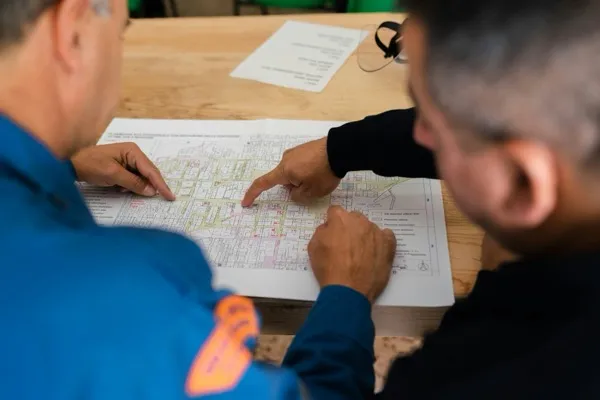
You have a plan. We build it. The systems go live, the team comes along, and the work gets faster because your people can do more, not because you replaced them.
The gap between the plan and the work
You have the strategy. Maybe a deck, maybe a roadmap, maybe a pilot that looked great in the demo. Then it stalls. The deck sits in a drawer. The pilot never spread past the two people who built it. The tool you bought for everyone is paid for and nobody opens it.
This is the most common place to get stuck. Most firms stall between Pilot and Integration — a few experiments running, some leadership awareness, but nothing embedded in how the work actually gets done. At one mid-market engineering firm, the licenses were in place and the training had run, yet only about one in ten people were really using the tools. The software worked. The work hadn't changed, because no one owned the part where it does.
A plan is not a system. The plan tells you what to build. Somebody still has to build it and get people using it.
What implementation looks like with us
We do the work in the plan with you. We pick the highest-value workflow, redesign how it actually runs with AI in it, stand up the tools, and get your team using them in their real work, not in a sandbox.
The team comes along as we go. People who own the workflow are in the room while we build it, so the system fits how they work and they trust it by the time it goes live. Adoption is part of the build, not a memo we send afterward.
"Done" has a definition. The AI step lives in the SOP. Training is on the calendar. That's a Level 3 marker in the maturity model — the point where AI stops being a side project and becomes part of how the firm operates.
The human side
This is where most implementations fail, and it's the part we score equally.
A tool nobody adopts returns nothing. The firms that get a return point AI at the work their people couldn't get to before, so the team can do more than it could last quarter. The work it takes off their plate is usually the stuff they didn't love anyway.
We measure where every person sits on a five-tier ladder — Non-User, Curious, Practitioner, Builder, Architect — and the build moves people up it. Someone who was a Non-User becomes a Practitioner. A Practitioner becomes a Builder who makes their own tools. That's the goal: a team that's harder to replace because they got more capable, not a team that's nervous because a tool showed up.
More on how we bring people along in the AI change management piece.
The methodology: Pacemark
Pacemark is an AI maturity model that scores your firm across six dimensions — Strategy & Leadership, People & Culture, Data Readiness, Workflows & Operations, Technology Infrastructure, and Governance & Ethics — on a five-level scale, from first experiments to firm-wide transformation. That score is your Pacemark Index. The model is built from 97 interviews with operators inside more than 300 companies, cross-checked against eight external benchmarks (MIT CISR, PwC, BCG, Bluebeam, Unanet, Stanford, McKinsey, Accenture).
People & Culture carries the same weight as the technology. Most models score the tech and skip the part that decides whether anyone uses it. The Build stage is where that weighting shows up in the actual work.
Implementation is the work of moving your firm from Level 2 to 3 to 4 — Pilot to Integration to Acceleration. See the model at pacemark.ai, or run the free Signal Scorer to see where your firm stands today.
Free · 8 min
See where your firm stands with AI
25 questions, about 8 minutes, and you'll see your maturity level across six dimensions and the first bottleneck to clear.
Start the assessment →Free assessment
Find out where you are with AI
About 8 minutes, and you'll see your score across six dimensions and where to start, with no email until the end.
Take the assessment →Free · 8 min
Where does your firm actually stand with AI?
Find out in about 8 minutes, with your level across six dimensions and the one thing to fix first, shown right on screen.
See your score →Proof
At Keller, the build started with the people who already do the work. I sat with engineers and staff across the firm to learn how the work actually runs before recommending anything, then handed leadership a prioritized plan and the guidelines to put AI to work responsibly, without cutting the licensed review their projects depend on. One of those engineers, a board treasurer, put it this way:

"The way Dan framed it has stuck with me: AI is like another EI (engineer-in-training). It does real work and saves real time, but a licensed engineer still reviews it and approves it. Dan sat down with many of us across our firm and learned how we actually work before recommending anything. Then he gave us a prioritized plan and the guidelines to adopt it responsibly. It was the right approach for us, and helped us get buy-in on using AI throughout the firm."
Eric Roundy, PE, BCEE
Senior Wastewater Engineer & Board Treasurer, Keller Associates
That's the work: find the people who already make it run, build with them, and the rest of the firm follows.
Read the full engagement: how Keller Associates got its AI roadmap.
Who this is for
This fits architecture, engineering, and construction firms, and professional-services firms, in the $20–100M range, led by a founder or CEO who can make the call — and who already has a plan and wants someone to build it.
If you're still working out the plan, start on the AI strategy consultant page. If you want a single tool installed with no one bringing your team along, I'm not your consultant.
Engineering or construction firm? Start at our E&C page— same method, your language.
Questions
What do you actually build?
The working version of your plan — redesigned workflows with AI in them, the tools that run them, and the team trained to use them. We start with the one project that pays off first, then move to the next.
How long does it take?
The first build is weeks, not quarters. We scope it against the plan so you know the timeline and the cost before we start, and you see something working early.
How do you handle adoption and training?
Adoption is built in, not added on. The people who own the work help design the system, training goes on the calendar, and the AI step gets written into the SOP. We measure where your team sits on the tier ladder and track them moving up it.
Is this a hand-off or a retainer?
Either. We can build the system, hand it over, and step out. Most firms keep us on a Retainer as the work spreads to the next project and the next team, because that's where the gains compound.
Do I need the roadmap first?
If you already have a plan, we can start from it. If you don't, the AI strategy consultant engagement builds one first. We don't build from nothing — the plan tells us what to build and in what order.
Ready to build it?
Book a 20-minute call. We'll talk through your plan, where it's getting stuck, and whether the Build is the right next step.