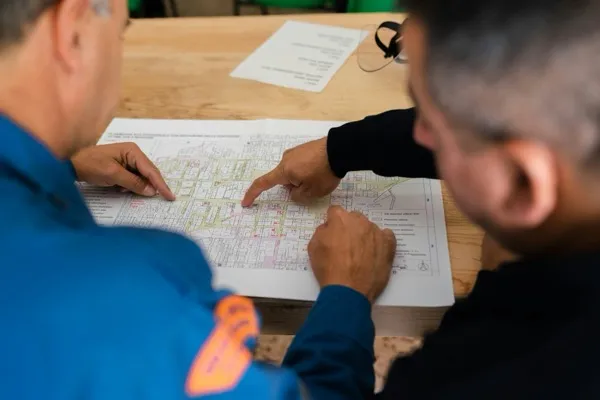
The walk-through meaning in construction is specific: a structured inspection where one party walks another through a work product, room by room, before signing off. Pre-drywall. Final. Punch-list. Each one happens at a milestone because the client deserves to see the work before they accept it.
Borrow the word.
Your new client also deserves a walk-through of how you deliver, especially the part where AI tools sit inside your process. The kickoff meeting is the right milestone. Seven slides is the right length. This piece is the seven slides.
If you are running a $20M to $100M architecture, engineering, or construction firm and you have not figured out what to say when a client asks "are you using AI on this?"— you are not alone. Bluebeam's 2025 AEC Technology Outlook reports only 27% of AEC firms currently use AI in their work. Of the ones that do, 94% plan to increase that investment in 2026. The wave is already cresting. Your clients will ask. The firms that have a clean answer will earn the trust first.
Walk-Through Meaning In Construction (And Why We're Stealing The Word)
Three kinds of walk-throughs run on AEC jobs.
- Pre-drywall walk-through. The construction manager confirms framing, mechanical, electrical, and plumbing are installed before drywall covers the bones. Per Sposen Homes' guide, this is the moment to verify selections match the contract.
- Final walk-through. After construction, before closing. Hope Home Inspections calls it "your last best chance to catch construction defects or unfinished work."
- Punch-list walk-through. Everything that didn't pass final, documented, dated, and owned.
Each happens because the client cannot evaluate the work from the outside. They need someone who built it to show them what is there. A project kickoff meeting, per Procore, exists for the same reason on the front end: confirm goals, introduce the team, review scope.
The AI side of your delivery is the same shape of problem. Your client doesn't know which steps in your process use AI, which don't, where their data goes, or who is accountable. You have to show them. The kickoff meeting is when. The seven slides below are the script.
Why You Need This Walk-Through Now
The case comes from three numbers.
Adoption is uneven but accelerating. Bluebeam's 27% is mirrored by AIA's 2025 research, which found only 8% of architecture firms have implemented AI, with another 20% in process and 35% considering it. ASCE confirmed in December 2025 that AEC lags other industries. Most of your competitors have not had this conversation with their clients yet either.
The concern is already there. In the same AIA survey, 90% of architects cited "lack of transparency" as a concern about AI— and that is the people inside the profession. Your clients sit one ring out.
The trust window closes fast. Harvard Business Review's January 2026 piece on AI trust puts it plainly: trust requires transparency calibrated to the audience, and the timing of the disclosure matters as much as the content. The kickoff is your moment.
The alternative is the client finding out from a junior staffer six months in, or from a competitor pitching them on "we don't use AI on your project." Both are losing positions.
The 7 Slides
Slide 1: What We Mean By "AI-Enabled Delivery"
The first slide defines terms. Most clients hear "AI" and picture a chatbot drawing their building. Replace that picture with a working definition: AI is a set of tools your team uses inside your existing process, not a system that produces deliverables on its own.
McKinsey's 2025 research on AI in the workplace frames this as "superagency": AI works in partnership with workers, accelerating output while the worker remains the agent. AI amplifies the people you hired. It does not replace them.
Script line for the principal:
"When we say 'AI-enabled,' we mean our team uses AI tools inside our process. Not 'we send your project to an AI.' Not 'an algorithm makes the call.' Our people still do the work. The tools just help them do it faster and catch more before it gets to you."
Put the words "tool" and "team" on the slide. Skip "leveraging," "harnessing," and any other word that sounds like a vendor pitch.
Slide 2: The Licensed Engineer Still Stamps
This is the slide that lets the client exhale.
The professional liability question is the one your client is afraid to ask. Answer it first. AIA Trust, the liability arm of the American Institute of Architects, is unambiguous: "Professional liability for AI-assisted design rests squarely on the licensed architect— regardless of tool involvement." Underwriters are tightening policies to exclude "undocumented AI workflows." State licensing boards are clarifying that delegation to AI does not absolve responsibility.
The PE stamp does not move. The licensed architect's seal does not move. Your firm's name on the deliverable does not move.
Fourscore Business Law writes that disclosure is typically not legally required when AI assists professionals under human oversight, but failing to disclose can damage trust if the client learns of it later. This slide exists not because the law requires it, but because the relationship does.
Script line:
"Every drawing, every report, every recommendation we send you has been reviewed and signed by a licensed professional on our team. That has not changed. AI tools do not stamp anything. We do."
Slide 3: Where AI Shows Up In Your Project
Now make it concrete. Generic AI talk loses the client. Five specific places, in plain English, lands.
The list will vary by firm. Here are five that translate across architecture, engineering, and construction:
- Drawing markup and review automation. Catches dimensioning and coordination issues before a senior reviews.
- Document parsing for specs and submittals. Pulls compliance items out of long documents in minutes.
- Code and regulation checking. Flags departures from current code editions.
- Schedule and scope analysis. Surfaces float, dependencies, and likely change-order pressure points.
- Research acceleration. Compiles precedent, product spec, and historical project data faster.
Monograph's 2025 research reports AEC adopters see 25-40% efficiency gains. Bluebeam's data is more specific: 46% of early adopters reclaim 500-1,000 hours annually and 68% save at least $50,000. Cite the range, not the upper bound.
Script line:
"Here are the five places AI shows up on your project. No surprises. If we add anything in the next six months, we'll tell you before it touches your file."
The last sentence matters. It promises the next conversation.
Slide 4: How We Handle Your Data
Data is the slide where firms either build trust or break it. Do not skip it because it feels uncomfortable.
The slide should answer four questions your client is already thinking:
- Where does our project data go? On your firm's servers, in vetted vendor environments, or both. Name the categories.
- What gets retained? How long does data stay in tool logs, in prompt histories, in vendor systems.
- Will our data train an AI model? Most enterprise tools support opt-outs. Confirm yours are on. If they aren't, say so.
- What contracts cover this? Your firm's standard NDA, vendor DPAs, and any client-specific addendum.
MIT Sloan's research on AI disclosures is direct: disclosures work best when they are calibrated to the audience and embedded inside a broader trust framework. Translation: don't dump a 40-page DPA on the table. Put the four answers above on one slide. Offer the documentation if they want it.
Script line:
"Your project data stays under the same protections every other piece of your file gets. Here are the four things we want you to know about how AI fits inside that. If we change any of these answers, we'll tell you first."
Slide 5: What This Changes For You
The pivot from defense to value. Slides 1-4 answered worry. Slides 5 and 6 explain what the client gets.
What changes:
- Faster first drafts. Mid-level engineers, designers, and project staff can produce stronger early deliverables. McKinsey's 2025 research found AI productivity gains are most pronounced among less-experienced workers— exactly the population doing 70% of the drafting on your project.
- More iteration cycles inside the same fee. The hours your team gets back become hours they can spend refining.
- Better-prepared review meetings. Issue lists arrive earlier. Coordination conflicts surface before they become rework.
- Less rework downstream. Caught earlier means fixed cheaper.
The honest part of this slide: results are a range, not a promise. Monograph's 25-40% is what adopters see, not a guarantee. Use the number to size the conversation. Don't quote it as your commitment.
Script line:
"What this means for you is faster early drafts, more chances to iterate, and fewer surprises in the late stages. We're not promising a percentage. We are committing to keeping the gains in the work we hand you, not just inside our shop."
Slide 6: What This Doesn't Change
This is the slide the client will remember. Read it slowly when you present.
What does not change:
- Senior judgment. Stamping, review, and final calls remain with your most experienced people.
- Accountability. Your firm's name on the deliverable means the same thing it always has.
- The team they signed up to work with. The same project manager, the same principal-in-charge, the same engineer-of-record.
- The conversations. Site visits, design reviews, owner meetings. AI does not change the room.
Fielding Jezreel learned this from the outside. After a decade of federal grant writing, he spent 2024 testing where AI moved his work and where it stalled out. His conclusion was a sentence: neither one alone— him or the AI— was as strong as the two together. His expertise was the input. The AI was the multiplier. Without the expertise, the AI produced confident garbage.
The AEC parallel is direct. Your senior engineers' design judgment, your architects' aesthetic instinct, your superintendents' field intuition— those are the inputs. AI tools that surface patterns earlier are the multipliers. Take the senior out of the loop and the tools produce nothing your firm should put a stamp on.
Script line:
"AI changes how fast our team gets to a good draft. It does not change who reviews it, who signs it, or who you call when something is wrong. Those answers are exactly what they were when you hired us."
Slide 7: What You Can Ask Us, Anytime
The seventh slide is the open door. This is the slide most firms forget.
Three things go on it:
- The standing invitation. Any AI-related question, any time during the project, gets answered the same week.
- Sample questions clients tend to bring up. "What tool did you use for that schedule analysis?" "Did AI write any of that report?" "Is our data still on your servers if we leave you?"
- The next check-in. At the 25%, 50%, and 75% milestones, your team will revisit anything that has changed in the AI side of the work.
HBR's research on customer trust in AI treats this as the single most underestimated lever: trust grows when the client knows the door stays open after the initial conversation.
Script line:
"If anything ever feels off about how we are using AI on your project, ask. We would rather have that question over coffee than in a deposition. We will check in at our normal milestones anyway, but the door is always open before then."
That is your seventh slide.
When (And How Often) To Use This Walk-Through
Three moments call for it:
- New client kickoff. Mandatory. Same status as scope review and schedule review.
- Mid-engagement, when something changes. You add a tool, retire a tool, change vendors, or shift how data is handled. Update the deck, send the relevant slide, schedule fifteen minutes if it merits.
- Annual refresh. At minimum once a year, walk through the deck with active clients. This is also when you update the slides for tools your firm has added or dropped.
The construction analogy holds. Pre-drywall happens because cabinetry shouldn't go up over bad MEP. Final happens because keys shouldn't change hands over unfinished work. Your AI walk-through happens at the same kind of moments— before the relationship moves forward, the client should see what is behind the wall.
Frequently Asked Questions
What does walk-through mean in construction?
A walk-through in construction is a structured inspection where one party walks another through a work product or jobsite at a project milestone. Common types include pre-drywall, final, and punch-list walk-throughs. Each exists because the client cannot evaluate the work from the outside and needs the builder to show what is there.
Should AEC firms tell new clients they use AI?
Yes, proactively, in the kickoff meeting, in language matched to the client's sophistication. Per Fourscore Business Law, disclosure is typically not legally required when AI assists professionals under human oversight, but failing to disclose can damage trust if the client learns of it later from a third party.
Does AI change professional liability for engineers and architects?
No. AIA Trust confirms professional liability for AI-assisted design rests with the licensed architect or engineer, regardless of tool involvement. AI does not stamp drawings, and delegation to AI does not absolve professional responsibility.
Who owns the work product when AI is used in delivery?
The firm owns the deliverable. Standard scope-of-services and contract language continue to apply. AI tools are inside the firm's process; they are not co-authors of the work.
How often should we update our AI walk-through?
At minimum once a year, plus any time the firm adds or retires a tool, changes a vendor, or changes how project data is handled.
What is AI-enabled delivery?
AI-enabled delivery is professional services delivery where AI tools are used inside the firm's process to accelerate drafts, parse documents, check work, or surface patterns— with all final review and accountability resting on the licensed professional.
Where To Take This Next
The seven slides are the conversation. The harder work sits on either side of it: deciding which AI tools your firm uses, training mid-level staff to use them well, and keeping the firm-side documentation honest.
If you are mapping the bigger picture, our AI implementation guide for founders covers the framework. For the firm-level roadmap, the AEC AI Roadmap walks through how mid-market AEC firms sequence the work. If you are deciding whether Microsoft Copilot is enough, The Copilot Trap for AEC is the prior conversation. If your engineering team keeps stalling out, Why Engineering Firms Struggle with AI Adoption names the patterns.
The clients who are asking are giving you the easier version of this conversation. The harder version is the one where they didn't ask and someone else told them first.