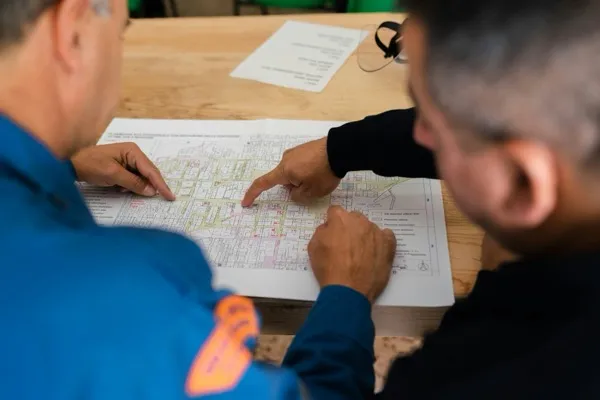

The earned value spreadsheet on the conference table works fine as a spreadsheet. It's the wrong kind of artifact for the conversation that's about to happen, and that's the same problem in every project review meeting in the country.
Owner's rep on one side. Project manager on the other. Both honest. Both with the same job number on the same screen. Different percent-complete numbers, off by twelve points on a $48M structure. Neither side is lying. Neither side trusts the other's spreadsheet.
This scene plays out somewhere right now. By the time someone calls it out, the conversation has already broken in a familiar way: the PM defends his methodology, the owner's rep doubles the document request, and a project review turns into a forensic exercise. Most firms reach for a better template. That's the wrong fix, because the template was never the problem.
Two honest parties with different information will arrive at different numbers. That's not dishonesty. That's the principal-agent problem in a project review meeting.
The Misdiagnosis: Reporting Problem vs. Trust Problem
The monthly earned value reconciliation isn't a reporting failure. It's a trust artifact— the place where a structural information asymmetry between owner (principal) and contractor (agent) becomes visible every 30 days.
The principal-agent problem describes any relationship where one party (the principal) hires another (the agent) to act on their behalf and cannot directly observe what the agent is doing or knowing. In construction, the contractor is the only source of the field data the owner needs to evaluate the project. Verification requires a second source. A better spreadsheet template does not produce one.
Academic research backs this up. A 2022 study in Project Leadership and Society described the dynamic as "opportunism games" that reduce to a prisoner's dilemma even between honest parties1. A 2025 paper in the Journal of Asian Architecture and Building Engineering went further: trust between owner and contractor reduces information asymmetry and lowers supervision cost, functioning as a substitute for exhaustive verification2.
The most-cited industry survey on the scale of this gap is KPMG's 2015 Global Construction Survey. It found only 31% of owners reported a high level of trust in their contractors; 60% reported moderate trust; 9% reported low trust3. Sixty-nine percent named poor contractor performance as the single biggest cause of project underperformance4. KPMG's Kevin Max framed it bluntly: "There's a sense that the contractors have the upper hand and will use whatever means are necessary to optimize their advantage."5
The KPMG data is dated. The underlying conditions are not. A 2021 Autodesk and FMI study estimated bad data cost the global construction industry $1.85 trillion in 20206. Conditions persist because the system shape persists.
An owner who doesn't trust a contractor's spreadsheet isn't paranoid. The contractor is the only source of the numbers on the spreadsheet. Verification requires a second source, and a better template doesn't produce one.
Three reasons the spreadsheet fix fails:
- The template is single-author by design; tightening the rules around it doesn't change who's typing
- Process discipline can produce a cleaner spreadsheet, and a cleaner spreadsheet is still the same kind of artifact
- The owner gains nothing they can independently verify
If the spreadsheet is a trust artifact, the question is structural: what would a trust architecture include that the spreadsheet doesn't?
Why Every Excel-Based EVM Patch Fails the Same Way
A spreadsheet-based EVM workflow fails as a trust instrument for four structural reasons: no role-scoped visibility, no state-based workflow, no immutable audit trail, no real-time signal. These aren't bugs to patch. They're properties the artifact doesn't have and can't acquire.
- Single-author artifact. One person types it. The same person defends it. There's no role boundary between author and reviewer because the file format has no concept of role.
- No state model. The file has no notion of "draft," "shared," or "approved." It is whatever it says it is at the moment someone opens it.
- No audit trail. Changes overwrite history. The May 1 version is gone after May 2 unless someone manually archived it, and even then the trail is voluntary.
- Real-time signal absent by design. Monthly cadence is structural to the medium. By the time the numbers are reconciled, the period they describe is already closed.
The standards bodies have already named this gap. ANSI/EIA-748 defines 32 guidelines that an Earned Value Management System must satisfy across organization, planning, accounting, analysis, and revisions7. Compliance is required for U.S. Department of Defense cost or incentive contracts at or above $50 million8. AACE International Recommended Practice 82R-13 translates the EIA-748 criteria into implementation guidance for engineering and construction firms9. None of these can be satisfied by a single-author file.
Construction CFOs widely report that their WIP reports are produced too late, reconciled too often, and trusted too little. By the time margin fade shows up in the report, the project is already underwater.10
The cost of all this is real. PlanRadar's 2025 analysis found that 52% of construction rework is caused by poor project data and miscommunication11.
If those are the four properties the spreadsheet doesn't have, the question becomes: where does a project information system get them from? The vocabulary already exists. It just lives in a different industry.
Trust Architecture: Borrowing the Discipline From Zero Trust
Trust architecture is a borrowed term. NIST Special Publication 800-207, published in August 2020, codified the principle for cybersecurity: never trust, always verify. Identity-bound access. Least privilege. Audit every transaction.12
Zero trust isn't a posture of suspicion. It's a discipline of verification, a system that no longer requires participants to vouch for each other because the system itself records what happened.
NIST built it for network security. The principles aren't network-specific. They describe properties of any system where information is contested:
- Never trust, always verify. No subject is granted access on the basis of identity alone; every transaction is evaluated.
- Identity-bound. Every action is attributable to a named principal with a defined role.
- Least privilege. Access is scoped to what the role needs.
- Continuous audit. Every transaction is time-stamped and recoverable.
This is an AEC project-controls article, not an IT article. It's using IT's vocabulary because IT solved this first. Apply those four principles to AEC project reporting and you get a trust architecture: a four-component model. Each component has a current AEC analogue. Each component is the property a spreadsheet lacks.
Trust Architecture for AEC: The Four-Component Model
Trust architecture for AEC project reporting is the combination of four properties: identity-bound access, state-bound information, immutable audit trail, and real-time signal. Each property maps to a current standard or practice in the industry. Together, they replace the contractor's spreadsheet as the source of project truth. Building this is a strategic AI engagement decision before it is a tools decision.
| Component | What it does | AEC analogue (existing standard) | What Excel can't do |
|---|---|---|---|
| 1. Identity-bound access | Every action is attributable to a named, role-scoped person | RBAC in Procore, ACC, e-Builder; ISO 19650 actor model | One file, one author, no role boundaries |
| 2. State-bound information | Data exists in defined states (draft → shared → approved) with gated transitions | ISO 19650 CDE four states: WIP / Shared / Published / Archived | No concept of state; the file is whatever it says |
| 3. Immutable audit trail | Every change is time-stamped, attributable, and recoverable | NIST SP 800-207 audit tenet; CDE published-state version control | Save-over destroys history |
| 4. Real-time signal | The owner sees current status without asking the contractor | Modern AEC dashboards; real-time cost/schedule integration | Monthly cadence by design |
Identity-bound access answers a simple question: who touched this number, and what role were they in when they touched it? ISO 19650 specifies an actor model with defined roles and information requirements per role13. In practical terms, every change to the project record is attributable to a named person operating in a defined role. This is also where AI governance lives. If your firm is evaluating AI agents to summarize project status, the first question is whether the agent has an identity inside your system, scoped to a role. Anything less is shadow IT in a suit.
State-bound information is where ISO 19650's Common Data Environment does the most work. The standard specifies four information states: Work In Progress, Shared, Published, Archived13. Each transition between states is a gated approval. That's a trust protocol, encoded as a workflow.
Immutable audit trail is the property most readers underestimate. A Procore customer described it directly: "We can reference timestamps and photos when there's a difference of opinion. That's helped us avoid rework by catching the conflict early."14 An audit trail that nobody can rewrite is a substitute for trust because the record of what happened is no longer up for negotiation.
Real-time signal is the most-sold and least-sufficient piece. Real-time data without identity, role-scoped visibility, and an immutable audit trail is just faster mistrust. Trust architecture is the four together; any single component, real-time included, is incomplete on its own.
This maps onto an existing ANSI/EIA-748–compliant EVMS more cleanly than it might first appear. An integrated EVMS already requires identity, state, and audit through the 32 criteria, and AACE RP 82R-13 is the AEC-facing translation of those requirements9. The shift the industry has been slow to make is from "EVMS as a planning compliance exercise" to "EVMS as the trust architecture the owner can see into."
Once the architecture is in place, AI becomes a meaningful amplifier. Without it, AI is something else entirely.
The AI Honesty: Why AI Makes This Worse Without the Architecture
AI agents make the trust problem worse when the underlying architecture is missing, and materially better when it's in place. The variable isn't the model. It's whether the data the AI is summarizing has identity, state, and audit behind it.
An AI agent generating a slick owner report on top of fragmented, single-author field data is a faster path to a wrong shared belief. The AI didn't lie. The input was never verifiable to start with.
The research is consistent. A 2025 paper in AI and Ethics studied trust factors in intelligent built-environment systems and found that inconsistent data ownership, manual updates, and outdated information reduce trust in AI outputs15. AI effectiveness in AEC depends on data consistency across BIM, scheduling, and financial systems, not on the model's reasoning ability. AEC adoption has been slow precisely because of this: the architecture has to come first.
Procore's Agent Builder entered open beta in 2025, letting users build custom AI agents for RFIs, jobsite reporting, and document search16. These are exactly the workflows where good architecture compounds and bad architecture amplifies. Just because it's easy to put AI on top of a broken process doesn't mean it's good.
The asymmetric outcome is direct. Trust architecture in place, AI accelerates verification. Trust architecture absent, AI accelerates the wrong shared belief. Good architecture, faster trust. Bad architecture, faster slop.
The Question to Ask Your Project Controls Function This Quarter
The question worth asking this quarter is not "can we automate EVM?" It is: "What do we owe the owner that they can verify without asking us?"
The right answer is never a better template. It is an architecture: identity, state, audit, real-time, that makes the monthly conversation unnecessary because the information has already arrived.
Practically, this is a decision framework shaped audit, not a software purchase. Walk through current project information flow against the four components. Identify which component is most absent in your stack right now. Most firms find that real-time signal is the most-sold and most-implemented piece, and that identity, state, or audit is where the gap lives. Treat the missing component as the first investment. Sequence beats heroics.
If mapping this against your current toolchain feels like the kind of work that needs a partner, that's the work Dan Cumberland Labs does, building trust architecture for firms whose EVM has outgrown its spreadsheet.
The question to carry into your next executive offsite is the same one.
What do we owe the owner that they can verify without asking us?
Frequently Asked Questions
What is trust architecture in construction project reporting?
Trust architecture is a system-level approach to project information that combines four properties: identity-bound access, state-bound information, immutable audit trail, and real-time signal. Together, these properties let owners and contractors verify project status without negotiating it. The term borrows from NIST Special Publication 800-207 (Zero Trust Architecture) and applies the same discipline to AEC project controls, mapping naturally onto ISO 19650's Common Data Environment.
Why does an earned value spreadsheet fail as a trust instrument?
An earned value spreadsheet is a single-author document of contested numbers with no role-scoped visibility, no state-based workflow, and no immutable audit trail. It can be accurate and still untrustworthy because the owner cannot independently verify it without re-doing the work. The structural answer is a system that verifies by design, not a better template. Process discipline applied to a single-author file produces a cleaner single-author file.
How much trust do construction owners have in their contractors?
The most-cited industry survey on this question, KPMG's 2015 Global Construction Survey, found that only 31% of owners reported a high level of trust in their contractors. 60% reported moderate trust; 9% reported low trust. 69% named poor contractor performance as the single biggest cause of project underperformance. The data is dated, and underlying conditions persist: Autodesk and FMI estimated bad data cost the global construction industry $1.85 trillion in 2020.
Does ANSI/EIA-748 require an integrated EVMS?
Yes. ANSI/EIA-748 defines 32 guidelines for an Earned Value Management System spanning organization, planning, accounting, analysis, and revisions. Compliance is required for U.S. Department of Defense cost or incentive contracts valued at or greater than $50 million. AACE Recommended Practice 82R-13 translates the standard into implementation guidance for engineering and construction firms.
Does AI fix the trust problem in construction reporting?
AI fixes the trust problem only when trust architecture is already in place. AI on top of fragmented, single-author project data accelerates whatever is underneath, including wrong answers. Research published in 2025 found that inconsistent data ownership and manual updates reduce trust in AI outputs in built-environment systems. The architecture is the precondition; AI is the amplifier.
References
- ScienceDirect (Project Leadership and Society), "Overcoming the Principal-Agent Problem: The Need for Alignment of Tools and Methods in Collaborative Project Delivery" (2022) — https://www.sciencedirect.com/science/article/pii/S0263786322001016
- Journal of Asian Architecture and Building Engineering (Taylor & Francis), "Exploring the Relationship Between Governance Mechanisms and Contractor Behaviors: Insights from Fairness Perception" (2025) — https://www.tandfonline.com/doi/full/10.1080/13467581.2025.2493799
- KPMG International, "Climbing the Curve: 2015 Global Construction Survey" (2015) — https://assets.kpmg.com/content/dam/kpmg/pdf/2015/05/construction-survey-201502.pdf
- KPMG International, "Climbing the Curve: 2015 Global Construction Survey" (2015) — https://assets.kpmg.com/content/dam/kpmg/pdf/2015/05/construction-survey-201502.pdf
- Construction Dive (quoting Kevin Max, KPMG), "Is Lack of Trust Between Owners, Contractors Plaguing Construction Industry?" (2015) — https://www.constructiondive.com/news/is-lack-of-trust-between-owners-contractors-plaguing-construction-industry/396994/
- Autodesk + FMI Corporation, "Study from Autodesk and FMI Finds Better Data Strategies Could Save the Global Construction Industry $1.85 Trillion" (2021) — https://www.prnewswire.com/news-releases/study-from-autodesk-and-fmi-finds-better-data-strategies-could-save-the-global-construction-industry-1-85-trillion-301376278.html
- SAE International, "EIA748D: Earned Value Management Systems" (2019) — https://www.sae.org/standards/eia748d-earned-value-management-systems
- AcqNotes (summarizing FAR 52.234-3/4 and DFAR 252.234-7001/7002), "NDIA EIA 748 Earned Value Management" — https://acqnotes.com/acqnote/tasks/ansi-eia-748-earned-value-management
- AACE International, "Recommended Practice 82R-13: Earned Value Management (EVM) Overview and Recommended Practices" (2017) — https://cdn.fs.pathlms.com/P19l3K1DRMefg1StnS8l
- ChainLink CFO / CFBS, "The Complete Guide to WIP Reporting for Contractors" (2025) — https://www.wip-insights.com/learn/guides/complete-wip-guide
- PlanRadar, "Cost of Rework in Construction: Causes, Data & Prevention" (2025) — https://www.planradar.com/us/cost-of-rework-construction/
- National Institute of Standards and Technology, "Special Publication 800-207: Zero Trust Architecture" (2020) — https://nvlpubs.nist.gov/nistpubs/specialpublications/NIST.SP.800-207.pdf
- UK BIM Framework / ISO, "Information Management According to BS EN ISO 19650 — Guidance Part C: Facilitating the Common Data Environment" (2020) — https://ukbimframework.org/wp-content/uploads/2020/09/Guidance-Part-C_Facilitating-the-common-data-environment-workflow-and-technical-solutions_Edition-1.pdf
- Procore Technologies, "The Single Source of Truth: Taking Projects from Chaos to Clarity" (current) — https://www.procore.com/library/single-source-of-truth-specialty-contractors
- Springer Nature (AI and Ethics), "Factors Influencing Human Trust in Intelligent Built Environment Systems" (2025) — https://link.springer.com/article/10.1007/s43681-025-00813-6
- Procore Technologies, "How AI Agents Are Changing Construction" (2025) — https://www.procore.com/library/ai-agents-construction