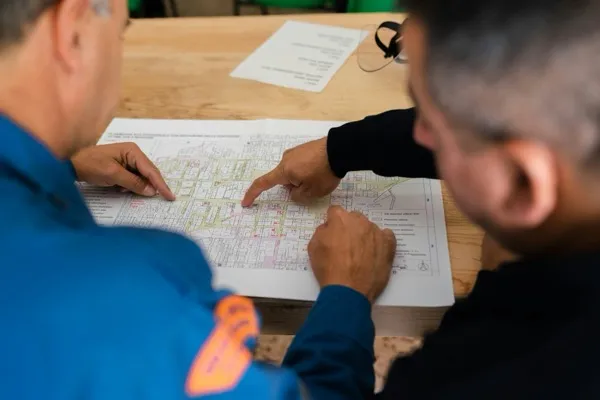

The moment looks harmless. A field engineer opens last project's PDF (a geotechnical investigation report, a CMT testing summary) and starts overtyping the client name and project number. It's faster than starting from scratch. The structure's already there. But so is everything else from the previous project: the boring log coordinates, the compaction test values, the laboratory identification numbers, the regulatory citations that applied to a different site under different specifications.
This is how quality engineering services fail— not from bad engineers, but from a structural workflow habit no one's examined.
Rework accounts for up to 12% of total construction project costs1, and documentation failures are a direct contributor. This article is for QC/QA managers and firm principals at AEC firms who already have quality systems in place— and still wonder why the reports occasionally come back wrong. We'll examine the specific mechanism behind report reuse, where it creates the highest risk, what it costs, what quality engineering services look like when they're built to prevent it— and four diagnostic questions for evaluating any provider, including your own team.
What Quality Engineering Services Cover
Quality engineering services are professional services that apply engineering methodology to ensure projects meet defined quality standards through inspection, testing, documentation, and compliance— covering everything from construction materials testing (CMT) and geotechnical reporting to quality management plan development and non-conformance documentation. These are the services that determine whether a project's documentation is defensible. And that defensibility depends entirely on whether the reports reflect current project data.
Quality engineering is commonly defined as "the discipline of engineering concerned with the principles and practice of product and service quality assurance and control"2. In AEC and construction contexts, the practical scope is more specific. Quality engineering services in this industry typically include:
- Construction materials testing (CMT): Lab and field testing of concrete, asphalt, compacted soil, and structural materials during construction
- Geotechnical investigation and reporting: Subsurface exploration, boring logs, soil classification, bearing capacity analysis, and groundwater observations
- On-site inspection: Verification of materials, workmanship, and installation against project specifications
- Non-conformance documentation: Identification, recording, and disposition of items that fail to meet requirements
- Quality management plan (QMP) development: The governing framework for how quality will be maintained across the project
- Compliance auditing: Verification against ASTM, AASHTO, and applicable regulatory standards
Sitemate's guidance on quality report formats confirms that quality reports document specific quality processes or outcomes— including inspection test plans, quality communications plans, and non-conformance reports3. And ISO 9001:2015, which governs how organizations manage documented information within a quality management system, requires in Clause 7.5 that documented information be controlled for "adequacy and fitness for use"4. The standard is unambiguous: quality reports must reflect current project conditions, not prior project data.
The distinction matters: a quality management system (QMS) is the governing framework; individual quality reports are its outputs. When the outputs don't accurately reflect current conditions, the system is intact on paper but compromised in practice.
The challenge isn't understanding what quality engineering services should deliver. It's recognizing when the workflow that produces those deliverables is undermining them.
The "Last One" Problem — How Report Reuse Creates Quality Drift
Reusing a quality report from a prior project introduces a specific kind of risk. Geotechnical, environmental, and CMT reports are project-specific by definition— site conditions, codes, client specs, testing standards, and project parties all differ from job to job. When a field engineer opens the previous project's PDF and starts editing, the new report inherits those prior specifics as invisible contamination.
"You can't read the label from inside the bottle." Firms that rely on artifact reuse often don't see the drift accumulating— because the workflow feels productive. Every prior report was correct for its project. Every edit looks reasonable in isolation. But the contamination is structural, not incidental.
The failure mechanism has three distinct pathways:
- Data contamination: Prior site conditions survive in the body of the report. Boring log coordinates, laboratory sample identifications, test result tables, and soil classification narratives reflect a different site. These errors persist in appendices, headers, and embedded tables— anywhere a visual scan might miss them.
- Regulatory staleness: ASTM and AASHTO standards update. Local building codes revise. Agency-specific specifications change between projects. A report produced by overtyping last year's version may cite superseded test methods or outdated reference standards without anyone catching it.
- Entity errors: Client name, project number, contract specifications, and approval signatures from the prior project survive in headers, footers, cover pages, and transmittal blocks. In a legal or regulatory dispute, a report carrying another project's entity information is essentially useless as documentation.
FHWA's guidance document on quality assurance in geotechnical reporting (GEC 014, 2016— current federal standard) establishes that geotechnical reports must be project-specific5. This isn't a best practice— it's a standard of care requirement for federally funded infrastructure. ISO 9001:2015 Clause 7.5 reinforces this obligation universally: documented information must be controlled for adequacy and fitness for use4.
There's a critical distinction between a template (a blank format ready for current data) and an artifact (a populated report from a previous project). The "just reuse the last one" habit treats artifacts as templates. Just because it's easy doesn't mean it's good— and in quality engineering, that gap is where defensibility problems originate.
Newforma's research6 confirms that disconnected tools and weak version control create approval delays, rework, and field teams working from the wrong documents. Report reuse is among the most prevalent forms of version control failure in quality engineering workflows. And this happens without anyone flagging it.
These aren't theoretical risks— they carry documented financial and regulatory consequences.
What Poor Quality Documentation Costs
Rework accounts for up to 12% of total construction project costs1, according to a PlanRadar survey of 2,500+ construction professionals across 17 countries— and bad data or inaccurate information is responsible for 14 to 22% of that rework1. That means documentation quality failures are directly eating into project margins on virtually every job.
The math on a $20M project: 12% rework exposure equals $2.4M in potential rework costs. If bad data drives 14–22% of that rework, documentation failures alone represent $336K–$528K in potential losses on a single project. These figures don't require unusual circumstances— they're the industry average. Documentation quality failures aren't marginal risk. They're budget-scale risk on every project.
| The Cost of Documentation Failures in AEC | |
|---|---|
| Rework as % of total project costs | Up to 12% |
| Rework caused by bad data or inaccurate information | 14–22% |
| AEC firms missing deadlines from scattered or stale information | 77% |
| Rework cost reduction from documentation digitization | 50%+ |
For related context on how documentation failures compound into broader project costs, see our analysis of hidden costs in AI implementation projects.
According to Aldoa's analysis of ASTM standards for geotechnical and materials testing7, "your work is only as defensible as your compliance with ASTM and AASHTO standards." Non-compliance leads to rejected data, retesting costs, payment delays, and legal exposure. A quality report populated from a prior project's artifact isn't just incomplete— it's a liability instrument.
According to Newforma6, 77% of AEC firms miss deadlines because project information is scattered, hard to find, or out of date. That's not an edge case. It's the default state for firms that haven't systematically addressed documentation workflow. And PlanRadar's data1 shows that digitizing documentation practices reduces rework costs by more than 50%— which frames the improvement opportunity in financial terms the rest of the firm can act on.
Understanding the cost is one thing. Knowing where quality reports are most vulnerable to degradation is where the practical work begins.
Where Quality Reports Break Down Most Often
Not all quality reports carry equal risk from template reuse. Geotechnical investigation reports, CMT testing reports, and environmental assessment reports are the highest-risk category because they carry site-specific field data, project-unique test results, and regulatory citations that are technically meaningless when transferred to a different project.
"There isn't a single QA/QC report which will solve all of your quality needs— reports should be tailored to project risk, scope, schedule, and budget"3. That's precisely why artifact reuse is structurally incompatible with project-specific reporting requirements. The three highest-risk report types:
- Geotechnical investigation reports: Boring logs, soil classification data, bearing capacity calculations, and groundwater observations are tied to specific borings at specific locations. FHWA guidance (GEC 014)5 requires fresh generation per project. There is no version of a "mostly correct" geotechnical report transferred from another site— and a contaminated geotechnical report doesn't become a documentation problem, it becomes a standard-of-care liability.
- CMT testing reports: Concrete mix designs, compaction test results, aggregate gradations, and concrete cylinder break data are project-specific by nature— they reflect this project's materials and this project's field conditions. Carried forward, these values don't just misrepresent the actual record: they create a documented record of conditions that never existed on this project.
- Environmental assessment reports: Baseline conditions, sensitive species documentation, applicable permits, and regulatory citations are site-specific and date-sensitive. Projects in different jurisdictions face entirely different regulatory frameworks— and a report carrying the wrong permits in an agency review isn't revised. It's rejected.
The version control problem compounds this. Without QC software that enforces current-version checklist use8, outdated checklists circulate— causing teams to miss new specification requirements or code updates that post-date the original artifact. And this happens without anyone flagging it.
Non-conformance reports carry a separate risk. They must reference actual current-project conditions to be defensible in dispute resolution. An NCR carried forward from a previous project doesn't just create a documentation gap— it creates a factual record of conditions that did not exist on this project.
Fixing the problem doesn't require replacing your quality engineering team. It requires changing where the data enters the report.
What Good Quality Engineering Services Look Like — Including AI
Quality engineering services built for accuracy treat the report as a live output of current field and lab data— not as an edited artifact from the previous project. The difference is structural: reports are populated from structured, validated data captured in the field, rather than built by overtyping a prior PDF.
As Aldoa describes9: "Instead of treating the report as something built after the work is done, the report becomes a live output of the data you collect." This isn't a technology claim— it's a workflow description. The structural fix requires version-controlled blank templates (not populated artifacts), field data flowing directly into those templates, and validation at capture rather than at report production.
| Before | After |
|---|---|
| Open prior project PDF | Open version-controlled blank template |
| Overtype client name, project number | Field data populates directly from current capture |
| Edit narrative around prior test results | Tables, test values, boring data populate from this project only |
| Engineer reviews the final document | Engineer reviews flagged exceptions, applies professional judgment |
| Submit — with invisible contamination risk | Submit — with traceable data lineage |
Vertical AI— domain-trained models built on engineering report corpora— trained on thousands of geotechnical, CMT, and environmental reports can auto-populate standard narrative sections, tables, and test result summaries from structured field data9— reducing the time between data capture and deliverable submission. For firms building toward this capability, this is where ai implementation services connect directly to documentation quality: the AI component amplifies what the QE engineer already knows how to do, rather than replacing the judgment that makes the work defensible.
The World Quality Report 2025 (Capgemini/OpenText)— which primarily surveys technology-sector quality engineering organizations— found that 89% of organizations are piloting or deploying Gen AI-augmented QE workflows, while only 15% have achieved enterprise-scale deployment10. The data is directional rather than AEC-specific, but the gap between intention and execution reflects a real pattern. Firms that build the structural workflow foundation first— fresh data flows, version-controlled templates— are the ones positioned to use vertical AI effectively when they deploy it.
The caveat matters: AI amplifies the engineer's expertise. It takes the artifact-editing busywork off the plate. The site-specific judgment, the professional sign-off, the interpretation of anomalous results— those remain with the engineer. For context on measuring the return from these workflow improvements, see our guide on measuring the ROI of quality improvements.
Knowing what good looks like makes it easier to evaluate whether your current quality engineering services— or your own team's workflow— are built on that foundation.
How to Evaluate Quality Engineering Services (Or Your Own Team's Workflow)
When evaluating quality engineering services— whether from an outside provider or your own in-house team— four questions cut through capability claims to actual delivery practices.
- Where does the data for each report originate? From this project's field and lab capture, or from a prior report that's been modified? The answer reveals whether the workflow is structured for accuracy or structured for speed.
- How are report templates maintained? Blank and version-controlled, or as copies of the last completed report? A firm that can't describe its template governance has structural exposure it probably hasn't examined.
- What's your process for verifying that applicable ASTM, AASHTO, and regulatory citations are current for this project? This question distinguishes firms with active standards management from firms coasting on last year's document.
- If a report were challenged in a dispute, could you trace every value and narrative section back to project-specific source data? "Your work is only as defensible as your compliance with ASTM and AASHTO standards"7— and defensibility requires traceable data lineage, not overtyped artifacts.
These questions apply equally to your own team's workflow. The most common source of documentation quality failure isn't an outside provider— it's the in-house habit that never got examined because the reports kept getting submitted on time.
ISO 9001 Clause 7.5's standard for documented information— "adequacy and fitness for use"4— and FHWA's project-specific documentation requirements for geotechnical work5 together establish the regulatory floor. The diagnostic questions above are how you check whether your operations are clearing it.
For firms thinking about the broader compliance and governance considerations as AI tools enter their quality workflows, our analysis of ai governance and risk management covers the oversight framework.
Most firms can run the diagnostic questions in-house. But when mapping the workflow changes to active project delivery becomes the bottleneck, that's the specific problem Dan Cumberland Labs helps AEC organizations solve— without overhauling what's already working.
Frequently Asked Questions
What is quality engineering?
Quality engineering is the discipline of engineering concerned with the principles and practice of product and service quality assurance and control2. It encompasses creating and implementing quality management systems, auditing for compliance with standards such as ISO 9001 and ASTM, and ensuring that testing, inspection, and documentation processes meet defined quality requirements.
What do quality engineering services include in construction?
In AEC and construction contexts, quality engineering services include construction materials testing (CMT), geotechnical investigation and reporting, on-site inspection, non-conformance documentation, quality management plan development, and compliance auditing against ASTM, AASHTO, and applicable regulatory standards5.
How much does poor quality cost in construction?
According to PlanRadar's 2025 global construction survey of 2,500+ professionals, rework accounts for up to 12% of total project costs1. Bad data or inaccurate information causes 14–22% of all rework— making documentation quality a direct driver of project margin1.
Why are quality reports project-specific?
Geotechnical, CMT, and environmental quality reports contain site conditions, test results, regulatory citations, and project specifications unique to a single project. FHWA guidance for geotechnical reporting (GEC 014)5 and ISO 9001 Clause 7.54 both require that documented information be controlled for adequacy and fitness for use— meaning it must reflect current project data, not prior project conditions.
Conclusion
The "just reuse the last one" habit is invisible until it produces a defensibility problem that isn't. By the time a quality report's contamination shows up— in rework, in a dispute, in a failed compliance audit— the window for a clean fix has already passed.
The problem is structural, not attitudinal. It's about where data enters the report. Version-controlled blank templates, field data flowing directly into those templates, and AI tools that populate from validated data rather than from prior artifacts are the path forward. The four diagnostic questions above are where that work starts.
Quality engineering services that build reports from current data— not prior artifacts— aren't doing something advanced. They're doing the job correctly.
If you ran the four diagnostic questions against your own team's workflow and didn't like the answers, that's where we start. We work with AEC firms to build practical documentation systems and AI-enabled workflows— without overhauling what's already working.
References
- PlanRadar, "Cost of Rework in Construction: Causes, Data & Prevention" (2025) — https://www.planradar.com/us/cost-of-rework-construction/
- Wikipedia contributors, "Quality Engineering" (2025) — https://en.wikipedia.org/wiki/Quality_engineering
- Sitemate, "Quality Report Format: Here's the Right Format for Your Quality Reports" (2024) — https://sitemate.com/resources/articles/quality/quality-report-format/
- International Organization for Standardization, "ISO 9001:2015 — Quality Management Systems — Requirements" (2015) — https://www.iso.org/standard/62085.html
- Federal Highway Administration, "Assuring Quality in Geotechnical Reporting Documents — GEC 014" (2016, current federal standard) — https://www.fhwa.dot.gov/engineering/geotech/pubs/hif17016.pdf
- Newforma, "Why 77% of AECO Firms Miss Deadlines — And What You Can Do About It" (2024) — https://www.newforma.com/why-77-of-aeco-firms-miss-deadlines-and-what-you-can-do-about-it/
- Aldoa, "ASTM Standards Explained for Geotechnical & Materials Testing" (2025) — https://www.aldoa.com/blog/astm-standards-for-geotechnical-construction-materials-testing
- HQTS Group, "Why Quality Control in Construction Is Important" (2024) — https://www.hqts.com/why-quality-control-in-construction-is-important/
- Aldoa, "How Vertical AI and AI-Powered Report Writing Are Transforming Engineering" (2025) — https://www.aldoa.com/blog/how-vertical-ai-and-ai-powered-report-writing-are-transforming-engineering
- Capgemini / OpenText, "World Quality Report 2025: AI Adoption Surges in Quality Engineering, but Enterprise-Level Scaling Remains Elusive" (2025) — https://www.prnewswire.com/news-releases/world-quality-report-2025-ai-adoption-surges-in-quality-engineering-but-enterprise-level-scaling-remains-elusive-302614772.html