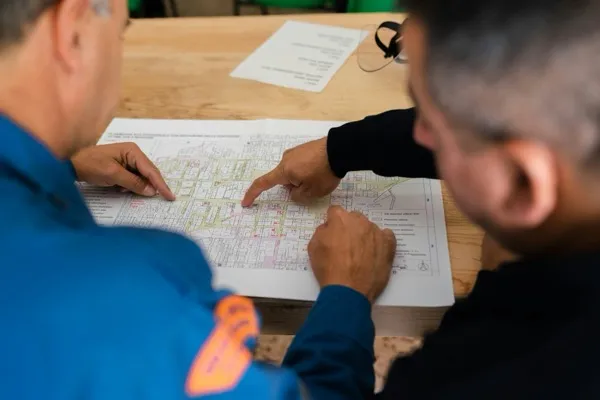

Your sub completed half the punchout items. The other forty haven't moved. You've sent the list twice, and the owner's turnover is two weeks out.
The problem isn't your subcontractors' motivation. It's your format.
A punch list format is a structured document that identifies incomplete or deficient work items at project closeout, specifying what must be corrected before substantial completion is certified. When the format is clear and accountable, teams reach final payment in a median of 23 days after substantial completion. When it isn't, 47 days1.
The reason most punch lists stall isn't subcontractor motivation— it's format design. This guide covers the behavioral root causes, the nine elements that drive compliance, and why digital tools only accelerate a process that's already well-designed.
Why Subcontractors Skip Your List
Subcontractors ignore most punch list formats for three interconnected reasons: they have limited financial incentive to return after initial payment, they often receive incomplete or ambiguous item descriptions, and they're working from fragmented systems where information is scattered across spreadsheets, texts, and verbal instructions.
According to Billd2, in many cases subcontractors have already been paid for their portion of the project, and returning to the site means they're making less profit. That's a structural problem, not a character problem. When you've already moved on to the next job and the punch list items aren't clear, returning isn't obvious.
The three root causes are structural, not motivational:
- Financial disincentive: Payment has been received; every return trip reduces margin
- Information fragmentation: OpenSpace AI3 found that when builders track issues verbally or in separate spreadsheets, by the time the punch walk happens no one has a complete picture
- Ambiguity: "Touch up paint" triggers a call for clarification; "repaint north wall, 2nd floor, Room 214, full coat" does not
Schedule conflicts add a fourth layer. Subs are juggling multiple active sites. A vague item gives them every reason to prioritize the job with clear instructions over yours.
Before fixing the format, it helps to understand exactly what it controls— and what it doesn't.
What a Punch List Format Actually Controls
The distinction between having a format and having a format that drives action matters. Plenty of GCs have a document with columns. What they often don't have is a document structured to remove the friction that makes subs deprioritize it.
A punch list format controls three things: what gets communicated to a subcontractor, whether they know who's responsible, and whether they can take action without asking questions. The AIA G704-2017 framework defines the contractual exhibit— 'the contractor prepares the list and the architect verifies and may amend it'4— but the standard matters less than whether the format answers every question a subcontractor would otherwise have to ask. In plain terms: the punch list is a legal exhibit that formally identifies what's incomplete— and the GC owns its quality.
Many firms use custom templates rather than the AIA framework directly, which is fine. Per Procore5, format quality directly determines closeout speed. It's the behavioral infrastructure.
Understanding what the format controls sets up the next question: what medium are subs actually working from— and does yours match?
Paper, Spreadsheet, or App— What Subs Actually Use
Most GCs have moved past paper, but 46% of firms still identify punch list management as a mobile software gap6— meaning nearly half the industry hasn't fully committed to an app-based format that subcontractors can access in the field.
According to Constructable AI1, 79% of building contractors use software to gather data and handle project information. Software use doesn't automatically equal format discipline. But medium affects whether a sub can physically respond to your list.
| Medium | Field Access | Photo Documentation | Real-Time Status | Sub Notification | Friction Level |
|---|---|---|---|---|---|
| Paper | None | Not possible | Manual only | Personal delivery | Very High |
| Spreadsheet | Limited (not mobile-native) | Separate email | Delayed | Email/text | High |
| App (Procore, Fieldwire) | Full mobile | Inline with item | Real-time | Push notification | Low |
Fieldwire— mobile-first, top-rated on GetApp7— dramatically reduces the "I need to ask" loop by letting subs pin completion photos directly to plan locations. But medium reduces friction; what you put in the format determines whether a sub can act on it.
Whatever medium you're using, the nine fields below are what make any format actionable.
The 9 Elements Every Effective Punch List Format Includes
An effective punch list format includes nine fields: item number, precise location, detailed description, responsible subcontractor, priority level, due date, current status, photo documentation, and a verification sign-off5. Each field removes a reason a subcontractor could delay response.
Punch list creation can be up to 85% faster when using integrated field documentation systems3. But speed only helps if the items are complete enough to act on. Here's what each field does:
| # | Field | Why It Removes Friction |
|---|---|---|
| 1 | Item Number | Prevents confusion on multi-item lists; creates a shared reference point |
| 2 | Precise Location | Building + floor + room + element— not "2nd floor paint" |
| 3 | Detailed Description | What's wrong + what "done" looks like, specifically |
| 4 | Responsible Party | Single named sub, not a trade category ("JB Electrical," not "electrician") |
| 5 | Priority Level | High/Medium/Low signals sequence for the sub's return trip planning |
| 6 | Due Date | Hard date tied to retainage release or owner turnover, not a range |
| 7 | Current Status | New / In Progress / Completed / Verified— subs need to know if GC has seen their work |
| 8 | Photo Documentation | Before + expected state eliminates "that's not my work" disputes |
| 9 | Verification Sign-Off | Who confirms completion closes the loop and authorizes release |
The format works when every field answers a question the subcontractor would otherwise have to ask. If you want a ready-to-use starting point, our construction punch list template has all nine fields built in.
Having all nine fields helps— but when you put the list together matters as much as what's in it.
Rolling Punch Lists— The Format That Prevents Endgame Chaos
A rolling punch list documents and assigns deficiency items throughout construction— not just at the final walkthrough— so the last weeks of the project aren't buried under a backlog that subs have every reason to deprioritize.
Procore's guidance8 puts it plainly: "It's best to use this tool throughout the entire duration of your project." The behavioral argument is direct. When you flag items while subs are still on-site and still on-schedule, the financial disincentive barely exists. They haven't been paid and moved on. They're still there.
Addressing punch items after the fact costs two to five times more than catching the same issue during construction3, due to remobilization, trade coordination, and schedule compression.
| Approach | When Items Are Logged | Sub Status at Flagging | Correction Cost |
|---|---|---|---|
| Traditional | Final walkthrough only | Off-site, partially paid | 2–5x higher |
| Rolling | Throughout construction | On-site, active | Baseline |
A common cadence: 2x/week early in a project, moving to weekly as construction matures. The discipline shift isn't a new concept— teams that try it on one project rarely go back. It's a scheduling commitment, not a new tool.
Rolling punch lists reduce the end-of-project crunch. Digital tools reduce per-item friction. Here's what the data says about the combination.
How Digital Tools and AI Change the Format Equation
Digital punch list platforms reduce creation time by up to 85%3 and cut median closeout from 47 days to 231— but only when the underlying format is clear enough for a subcontractor to act on without clarification.
In my experience, most firms buy a punch list tool when what they actually need is a decision about who owns the format. The software is infrastructure for a process that has to be designed to drive compliance first.
Standard platforms handle coordination— mobile access, status tracking, notifications. AI-enabled platforms add detection— creating items from site walkthroughs automatically. Both need format discipline to deliver results:
| Digital Tools Add | Format Design Must Provide |
|---|---|
| Photo pinning to plan locations | Clear, unambiguous item descriptions |
| Mobile access for field teams | Single responsible party per item |
| Real-time status tracking | Defined completion criteria |
| Push notifications to subs | Hard due dates tied to milestones |
| Automated item creation from photos (AI-enabled platforms only; not standard Procore/Fieldwire) | Prioritization logic subs can act on |
Procore and Fieldwire7 are the most widely adopted platforms for field punch list management. For AI-powered defect detection, SpaceCapture9 uses photo and video walkthroughs to identify deficiencies automatically. In the best implementations, this reduces walkthrough time by 60–80%. One contractor reported reducing closeout from 8 weeks to under 3 weeks after implementation10. These are case study results, not industry averages. Like any AI system, defect detection accuracy improves as the platform is trained on your project documentation standards— plan for a calibration period on initial deployment.
If you're evaluating how AI fits into your broader construction workflows, our guide to AI workflow automation in construction covers which tools map to actual process gaps. For teams navigating digital adoption, how to build AI culture on your team addresses the change management side of the equation.
The firms that see results from these tools are the ones who fixed the format first— the software delivers what the process designs. If you're still evaluating which platform is right for your team, that's the second question. The first is whether your nine elements are in place.
The ROI of a Better Punch List Format
The financial argument for format discipline is straightforward: rework costs 4–10% of total project cost, with some projects reaching 20%1. Late-stage punch items cost 2–5 times more to fix than items caught during construction3. And digital teams close out in 23 days versus 47 days1 for manual teams.
| ROI Factor | Metric |
|---|---|
| Rework cost | 4–10% of project cost (up to 20% on complex projects) |
| Late-item cost escalation | 2–5x versus during-construction fix |
| Closeout time savings | 23 days (digital) vs. 47 days (manual) |
For a $5M project at 5% retainage, those 24 days faster represent real cash sitting on the float. The exact number varies by contract— the direction doesn't.
Format discipline reduces rework by surfacing items earlier, while subs are still on-site and the cost to correct is at its lowest. The 9-element format is the mechanism. The rolling approach is the schedule.
FAQ
What should be included in a punch list format?
An effective punch list format needs nine fields: item number, precise location, detailed description, responsible subcontractor, priority level, due date, current status, photo documentation, and a verification sign-off5. Each field answers a question the subcontractor would otherwise have to ask. Missing even two or three of these creates the ambiguity that stalls closeout.
Why don't subcontractors complete punch lists on time?
Subcontractors are underincentivized after payment, receive unclear item descriptions, and often work from fragmented information spread across texts and spreadsheets2 3. Better format design removes most of those barriers. Schedule conflicts add friction too, but unclear items are what make a sub prioritize a different job site over yours.
What is a rolling punch list?
A rolling punch list documents and assigns deficiency items throughout construction— not just at the final walkthrough— minimizing the end-of-project crunch and catching items while subs are still on-site8. It's a scheduling discipline, not a separate tool. The format is the same; the cadence changes.
How much faster are digital punch lists?
Teams using automated punch list systems close out in a median of 23 days after substantial completion, compared to 47 days for manual teams1. That's more than three weeks of difference in final payment timing— significant for cash flow on any mid-size project.
What does a punch list delay cost?
Late-stage punch items cost 2–5 times more to address than items caught during construction3, due to remobilization, trade coordination, and schedule compression. Rework overall accounts for 4–10% of total project cost1. The math makes format discipline a financial decision, not just a process preference.
The Fix Is Simpler Than Another App
Your closeout problems probably don't need a new platform. They need a format that removes the reasons a subcontractor has to delay. When the format is clear, accountable, and accessible, the software becomes a delivery mechanism instead of a substitute for process design.
Start with the 9 elements. Deploy it as a rolling punch list from early construction— not just at the final walk. Then evaluate whether a platform upgrade makes sense for your team's actual workflow.
If you're working through a broader construction workflow improvement and want to map which process changes have the clearest ROI, an AI implementation strategy for your firm covers the same process-first framework applied to other operational gaps.
References
- Constructable AI, "Construction Punch Lists: Close Out Projects Without the Usual Delays" (2026)— https://constructable.ai/blog/construction-punch-lists-avoid-delays
- Billd, "The Subcontractor's Guide to Construction Punch Lists" (2026)— https://billd.com/blog/construction-punch-lists/
- OpenSpace AI, "Construction Punch Lists: The Ultimate Guide to Project Closeout" (2026)— https://www.openspace.ai/blog/construction-punch-lists-guide-project-closeout/
- FieldPie, "Construction Punch List: Definition, Process, Best Practices" (2026)— https://www.fieldpie.com/blog/construction-punch-list/
- Procore, "Punch List Template Guide" (2026)— https://www.procore.com/library/punch-list-template
- AGC, "2025 Construction Hiring and Business Outlook" (2025)— ⚠️ URL NEEDS UPDATE: Homepage URL only (https://www.agc.org/)——) update to specific report URL before publication
- Construction Perks, "Fieldwire: Mobile-First Jobsite Management" (2026)— https://www.constructionperks.com/software/fieldwire
- Procore, "Construction Punch List Explained" (2026)— https://www.procore.com/library/construction-punch-list-explained
- SpaceCapture, "The End of Manual Punch Lists: How AI Automation Is Transforming Construction Closeout" (2026)— https://spacecapture.ai/blog/end-of-manual-punch-lists
- SpaceCapture, "The End of Manual Punch Lists: How AI Automation Is Transforming Construction Closeout" (2026)— https://spacecapture.ai/blog/end-of-manual-punch-lists