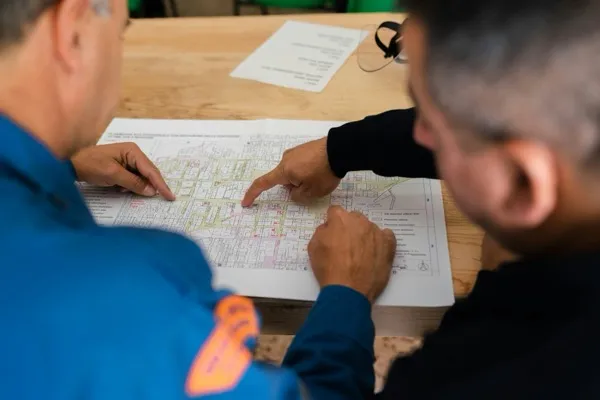

A mechanical engineering expert witness builds a career one case at a time, and in a lot of practices the whole firm rests on exactly one of those careers. That person's name is on every report, the attorneys who send the work call that person rather than the firm, and the firm's rates hold up because of a record that took twenty years to build. Everyone at the firm knows this. Nobody has written down what happens the day that person stops answering.
Most firms treat succession as a retirement question, so nobody plans for it until somebody sets a date and announces they're leaving. The exposure sits on today's docket, in every active retainer that names one expert.
This article covers the five mistakes firms repeat, what they cost at the case level and in the firm's valuation, where noncompete law landed after the FTC abandoned its national ban in September 2025, and the artifacts a managing partner can produce inside ninety days.
The Call No General Counsel Wants to Make
When a mechanical engineering expert witness becomes unavailable in the middle of a case, the entire case strategy can unravel overnight— and the firm that lost the expert almost always discovers, too late, that they skipped succession planning. Federal courts allow substitute experts, but not unlimited ones: under FRCP 16(b) and 37(c), the substitute's testimony is generally limited to the subject matter and theories already disclosed by the original expert7.
It's Tuesday morning. Discovery closes in three weeks. Your firm's lead expert— the one whose name is on every report, whose deposition is already in the record— calls in from a hospital bed. Or hands the GC a resignation letter. Or, in the cases firm leaders rarely talk about until later, simply doesn't show up.
"When an expert suddenly becomes unavailable, the entire case strategy could unravel overnight." — Robinson Bradford & Eaton13
This is the call no general counsel wants to make. It is also, almost without exception, a firm-side failure. The expert did not leave because the system worked. The expert left because the firm let succession become an afterthought, and the gap between "we should plan for this" and "the substitute can't introduce new theories" closes faster than firm leadership thinks.
To understand why this scenario keeps repeating, start with what a mechanical engineering expert witness does— and why the role is structurally hard to replace.
What a Mechanical Engineering Expert Witness Does (and Why Replacement Is Hard)
A mechanical engineering expert witness is a credentialed Professional Engineer (PE)— typically with advanced degrees and active practice— retained to opine on design defects, machinery failures, accident causation, or product liability matters in litigation. Their admissibility is governed by Federal Rule of Evidence 7021 and the Daubert standard, extended to engineering testimony by the Supreme Court's 1999 Kumho Tire decision2.
Mechanical engineering expert witnesses opine on the effects of design defects, improper maintenance, code violations, and mechanical failures on accidents and damages5. In practical terms, that covers cases like industrial machinery injuries, automotive defects, HVAC system failures, manufacturing equipment incidents, and patent disputes10. Each case requires both technical depth and the ability to translate that depth for a jury.
Required qualifications.
- Bachelor's degree in mechanical engineering (Master's or PhD typical for senior experts)5
- Professional Engineer (PE) license— generally required, with state variation (Texas, for example, exempts experts preparing court materials)11
- ABET-accredited program for the underlying degree
- Prior expert testimony and active engineering practice in the field5
Fee benchmarks.
| Service | Mechanical Engineering Average | All-Specialty Average |
|---|---|---|
| Case review | $325/hr | $356/hr |
| Deposition | $375/hr | $448/hr |
| Court testimony | $400/hr | $478/hr |
| Range | $240–$650/hr | — |
Sources: Expert Institute mechanical engineering page5; Expert Institute fee calculator across all specialties (based on more than 100,000 cases)6.
The Daubert qualification bar is high, and that is the easier half of the problem. The harder half is what the founding expert built around it: a track record of prior testimony, attorney trust developed over years of joint engagements, and the tacit expertise that comes from hundreds of cases. In valuation terms, that is personal goodwill— and it does not transfer cleanly when the expert walks.
Now picture the same expert becoming unavailable. The scope problem from Section 1 explains the legal exposure. The next five mistakes explain why firms keep walking into it.
5 Mistakes Firms Make When Their Founding Expert Leaves
Most engineering firms repeat the same five succession mistakes— and SEAK, the leading expert witness training organization, has documented the underlying patterns since at least 20184. Adapted to the firm's perspective, the failures cluster into treating the expert as irreplaceable, waiting for a crisis, confusing personal with enterprise goodwill, skipping mentorship, and ignoring active-matter contingency planning.
Mistake 1: Treating the Founding Expert as Irreplaceable
The most common firm-side mistake is believing the founding expert's reputation is so unique it cannot be transferred— so no successor pipeline ever gets built. SEAK identifies this as the first and most systematic error in expert succession planning.
"Thinking that their skills are so unique they simply cannot be replaced." — SEAK, Mistake #14
The belief is sometimes accurate. Personal goodwill is real, and it is real for a reason: a senior expert's reputation took twenty years to build, and a junior PE on staff cannot inherit that record overnight8. That is a reason to start early. It is not a reason to do nothing. Firms that treat irreplaceability as a fact rather than a problem to manage end up with zero internal candidates the day a transition becomes urgent.
What to do instead: build a 3- to 5-year successor pipeline. Name one or two PEs on staff with the credentials to qualify under Daubert, and run a contract bench of experienced experts who have already co-presented with the founding expert at deposition. Both paths produce the same outcome: a person ready to testify, not a search firm engagement.
Mistake 2: Waiting for a Crisis to Plan
Most engineering firms only start succession planning when the expert has already announced retirement— or worse, after a health event or a competing offer. SEAK describes this as crisis-driven planning— and it is structurally too late: a meaningful transition takes years, not quarters.
"Experts frequently will wait until they are in a crisis (health, disability, age, etc.) before they start to even think about succession/transition planning." — SEAK4
Mid-case substitution risk compounds when there is no transition runway. An attorney client, an insurance carrier, and the firm's own staff all re-evaluate when transitions feel abrupt. The same call that lands in the GC's office is also landing on the desks of the firm's referral sources, and they have their own decisions to make.
What to do instead: succession is a 3-to-5-year process that begins while the founding expert is still at peak practice. The right time to plan is when the founding expert has full discretionary control over which cases to take and which to mentor through— which is to say, the moment when nobody at the firm thinks they need a succession plan.
Mistake 3: Confusing Personal Goodwill with Enterprise Goodwill
When firms value themselves as if their founding expert's reputation belonged to the firm, they discover at exit— or at departure— that most of the value walks out the door. Personal goodwill (reputation, relationships, expertise) follows the individual. Enterprise goodwill (brand, processes, systems) stays with the firm.
"When a business with substantial personal goodwill is sold, revenue often declines because customers follow the departing owner rather than continuing with the new ownership." — Sofer Advisors8
In smaller specialized firms, that gap shows up in valuation as a key person discount9. Imagine an engineering consulting practice where one expert generated 70% of the revenue— in valuation terms, that practice is an annuity riding on one person's calendar. When the calendar empties, the annuity ends.
What to do instead: build enterprise-goodwill systems that can stand on their own. Documented intake processes, report templates that any qualified PE can use, a client-facing identity that is the firm's and not just the expert's, and a training curriculum that turns a new hire into a deposition-ready successor. The point is to make sure the firm has transferable value separate from any single individual— while acknowledging that personal goodwill remains real.
Mistake 4: Skipping Mentorship and Dual-Attended Casework
Tacit knowledge— the judgment, pattern recognition, and instinct an expert builds across hundreds of cases— cannot be captured in documentation alone. Firms that skip dual-attended depositions, joint site inspections, and structured mentorship lose decades of pattern recognition the moment the founding expert walks out.
"Tacit knowledge— the experience, judgment, and pattern recognition earned over time— cannot be captured in documents alone." — Starmind15
The expert-side fear that drives this firm-side failure is well-known: SEAK names it directly as "If I train/mentor an expert he/she will steal all of my clients"4. That fear is sometimes founded. And the response to it determines whether the firm has a successor or just a senior expert. In practice, the firms that handle this well treat mentorship as a contractual obligation tied to compensation, rather than a personal favor the founding expert can choose to grant or withhold.
What to do instead: an 18- to 36-month overlap window where the successor shadows, then leads, with the founding expert as second chair. Dual-attended depositions, joint site inspections, co-authored reports. The shape of the work has to make the transfer normal, not exceptional.
Mistake 5: Failing to Plan for Active Matters
Even firms that handle long-term succession well often have no contingency plan for the cases on the desk today. When the expert dies, falls ill, or accepts a competing role mid-discovery, the firm's exposure is not abstract. It is dollar-quantified across every active retainer.
"When an expert is substituted mid-case, the substitute's testimony is frequently limited to the subject matter and theories already espoused by the former expert." — Chicago Bar Association7
Per FRCP 16(b) and 37(c), courts evaluate substitution on diligence, prejudice, and case schedule7. Substitute scope is limited to the original expert's disclosed theories, which means the firm cannot pivot strategy mid-case. And the Daubert footing has to be re-established— the substitute must qualify under FRE 702 independently, not on the original expert's record12.
What to do instead: maintain an active-matter contingency document for every retained engagement. Each entry names a backup expert qualified under the same Daubert footing, with a current CV on file and a contractual standby commitment. When the call from the opening scenario comes, the firm can answer the next question— "who can step in?"— before the discovery clock burns more days.
These five mistakes connect directly to firm valuation. The next section makes the dollar consequences explicit.
What It Costs When the Expert Leaves
When a founding expert leaves without succession infrastructure, two distinct losses compound: case-level revenue exposure on every active retainer, and firm-level valuation impact through the key person discount that business appraisers apply to specialized service firms. Both are quantifiable, and both are largely preventable.
"A key person discount reflects the potential loss in company value due to the departure of critical employees, especially in smaller, specialized firms." — Equitest9
Two cost layers when an expert leaves:
| Layer | Mechanism | Source |
|---|---|---|
| Case-level | Substitute scope limited to original expert's theories under FRCP 16(b) and 37(c); strategy compromise reduces settlement leverage and per-matter revenue. | Chicago Bar Association7 |
| Firm-level | Key person discount applied via DCF "before and after" modeling; personal goodwill departs with the individual; enterprise valuation falls. | Equitest9; Sofer Advisors8 |
The market context matters here. Forensic engineering is roughly a $5–10 billion global market in 2024 depending on methodology, growing at around 6% CAGR12. Estimates vary across research firms, so use the range as directional rather than precise. What does not vary is the firm-level pattern: in specialized service practices, the largest single risk to enterprise value is concentrated in one or two senior practitioners.
This is also why measurement matters in any AI-augmented succession program. If the firm cannot quantify what it lost— case revenue, valuation, attorney-client trust— the prevention case is hard to make. See measuring AI success for the parallel discipline applied to AI implementations: you cannot prove ROI on something you never measured to begin with.
The financial picture explains the urgency. The legal landscape explains the levers a firm has— including a 2025 federal-rule shift that materially changes retention strategy.
The Legal Landscape (Daubert, FRCP, and the FTC Noncompete Update)
Three legal frameworks govern what happens when a mechanical engineering expert witness leaves. Federal Rule of Evidence 702 and the Daubert standard determine whether a substitute can testify at all12. FRCP 16(b) and 37(c) determine the scope of that testimony7. And after the FTC's September 2025 abandonment of its national noncompete ban, state law alone now governs whether a firm can contractually restrict the departing expert314.
"As a result of the FTC dropping its appeal, the enforceability of non-competes largely falls back to the states." — Sullivan & Cromwell, September 202514
The three frames in plain terms:
- Admissibility (FRE 702 + Daubert + Kumho Tire). The substitute must independently qualify as an expert. The original expert's record does not transfer12.
- Scope (FRCP 16(b) and 37(c)). The substitute's testimony is generally limited to the subject matter and theories already disclosed7. A substitution cannot revise strategy.
- Restraints (FTC + state law, post-September 2025). The FTC's national noncompete ban was enjoined in August 2024 and abandoned by the agency on September 5, 20253. Enforceability of noncompete and non-solicitation agreements now reverts to state law14. California broadly bans noncompetes; many other states permit reasonable, time-limited restrictions.
The firm implication is straightforward. Noncompete enforceability is no longer a federal question, so retention strategy now lives entirely in state law and in non-solicitation language. Firms that built their retention model around the assumed federal ceiling should review every active expert agreement against the post-September-2025 state-law footing.
The legal landscape sets the playing field. The next section is the prevention framework that uses it.
How to Prevent Each Mistake— A Succession Framework
The same five-mistake structure inverts cleanly into a prevention framework: build a successor pipeline, plan for transition over years, separate enterprise systems from personal goodwill, run dual-attended casework as standard practice, and maintain an active-matter contingency document. Each step maps to a specific mistake and a measurable artifact a firm can produce within 90 days.
"Well thought out succession plans often enable expert witnesses to continue working, be more selective in their assignments, and provide income when they do decide to retire." — Steven Babitsky, Esq., SEAK4
The five steps, mapped:
| Mistake | Prevention Step | 90-Day Artifact |
|---|---|---|
| 1. Treating the expert as irreplaceable | Build a successor pipeline (3–5 year horizon) | Named PEs on staff or contract bench with current CVs11 |
| 2. Waiting for a crisis | Run a transition runway (18–36 month overlap) | Calendar of dual-attended depositions and site inspections15 |
| 3. Confusing personal with enterprise goodwill | Separate enterprise systems from personal goodwill | Documented intake, report templates, training curriculum |
| 4. Skipping mentorship | Standardize dual-attended casework | Two-PE rule on every depo, site inspection, and report |
| 5. Ignoring active matters | Maintain active-matter contingency document | Named backup expert per retainer, Daubert-qualified4 |
Each artifact is something a managing partner can produce within a quarter. None of them require a multi-year transformation program. The reason firms skip them is not difficulty. Nobody is accountable for producing them while the founding expert is still at full strength.
If the firm is starting from zero, that is the first signal that succession has been treated as an event rather than a practice. See building AI culture across a firm for the parallel pattern in AI implementations: the firms that treat adoption as a one-time project tend to lose ground to the firms that treat it as a daily discipline.
The five prevention steps are the right shape. What makes them feasible at firm scale is something most engineering practices haven't yet tried— systematizing the part of expertise that lives between an expert's ears.
The AI-Augmented Knowledge Capture Angle
The hardest part of expert witness succession is moving tacit knowledge— judgment, pattern recognition, and instinct— out of one person's head and into a form a successor can use. Documentation alone has never solved this problem15. In our work with founder-led professional services firms, AI-augmented capture changes the math: structured interviews, voice-trained models, and case-history embeddings make it possible to preserve the way an expert thinks, alongside what they wrote.
The honest framing matters here. AI reduces the loss; it does not erase it. Personal goodwill is real, and the founding expert's reputation in front of a particular judge cannot be uploaded. The goal is to make tacit knowledge as transferable as it can be transferred— the difference between a 36-month transition that captures 60% of the expert's reasoning patterns and one that captures 90%.
Three practical applications for engineering firms:
- Case-history embeddings searchable by failure mode. Past depositions, reports, and case notes encoded so a successor can pull "every time we have seen this kind of mechanical failure" in seconds, rather than weeks.
- Reasoning prompts trained on the expert's deposition transcripts. An interview-style tool that surfaces how the founding expert thinks through an opposing expert's report— captured before the expert is unavailable to review it live.
- Intake checklists encoded from years of pattern recognition. The questions the founding expert asks on a first call, formalized into a checklist any qualified PE on staff can run.
This is the firm-side leverage point. See the hidden costs of AI projects for the limit-honest framing— the same discipline that says AI augmentation is not a fix-everything button applies here. The build-vs-buy question for these tools deserves real consideration too: see AI consultant vs. building in-house for a decision framework.
The framework and the AI augmentation are the structural answer. What remains is the answers to the questions firm leaders ask most often.
FAQ
What does a mechanical engineering expert witness do?
A mechanical engineering expert witness analyzes design defects, machinery failures, accident causation, and product liability questions, then testifies to those findings in deposition and at trial5. The role exists to help judges and juries understand technical evidence under Federal Rule of Evidence 7021.
Do mechanical engineering expert witnesses need a PE license?
In most U.S. states, yes— a Professional Engineer (PE) license is generally required for engineers serving as expert witnesses11. Texas exempts experts preparing documents or evidence for court, and other states have variations, so verify the rule in the state where testimony will be given.
What does a mechanical engineering expert witness cost?
Mechanical engineering experts charge an average of $325/hour for case review, $375/hour for deposition, and $400/hour for court testimony, with individual rates ranging from $240 to $650 per hour depending on experience, geography, and specialty5.
What happens to my case if the expert is no longer available?
Federal courts can permit a substitute expert under FRCP 16(b) and 37(c), but the substitute's testimony is generally limited to the subject matter and theories already disclosed by the original expert7. Without a designated backup expert in place, case strategy can collapse before settlement leverage can be recovered13.
Can a firm prevent its expert from leaving with the client list?
As of September 2025, the FTC's federal noncompete ban was abandoned, and enforceability of noncompete and non-solicitation agreements now reverts to state law314. California broadly prohibits them; many other states permit reasonable, time-limited restrictions, so the answer depends on where the firm is located.
Closing— Prevention Is the Practice
The five mistakes are predictable, and the prevention framework is straightforward— but neither becomes real until firm leadership treats succession as part of running the practice, rather than a milestone to schedule when retirement nears. The firms that handle expert transitions well are not the ones with luck. They are the ones that built systems while their founding expert was still at full strength.
Personal goodwill is real, and it is at least partially non-transferable. Both are true. The firm's job is to do the work that makes the transferable portion as large as possible— and to do that work years before it becomes obvious why.
If your firm is starting from zero and a senior expert is within 5 years of departure, an outside implementation partner who helps firms turn tacit expert knowledge into transferable systems can compress the runway. That kind of work tends to be most productive when it begins while the founding expert is still in the room.
References
- Cornell Legal Information Institute, "Federal Rules of Evidence Rule 702: Testimony by Expert Witnesses" (2023) — https://www.law.cornell.edu/rules/fre/rule_702
- Cornell Legal Information Institute, "Daubert Standard — Wex Legal Dictionary" (2024) — https://www.law.cornell.edu/wex/daubert_standard
- Federal Trade Commission, "Noncompete Rule" (2025) — https://www.ftc.gov/legal-library/browse/rules/noncompete-rule
- SEAK, Inc. (Steven Babitsky, Esq.), "The Biggest Mistakes Experts Make in Succession Planning" (2018) — https://www.testifyingtraining.com/the-biggest-mistakes-experts-make-in-succession-planning/
- Expert Institute, "Mechanical Engineering Expert Witnesses" (2024) — https://www.expertinstitute.com/expert-witness/mechanical-engineering/
- Expert Institute, "Expert Witness Fee Calculator" (2024) — https://www.expertinstitute.com/resources/expert-witness-fees/
- Chicago Bar Association, "Seventh Circuit Approaches to Allowing a Substitute Expert: Federal Rules of Civil Procedure 16(b) and 37(c)" (2022) — https://cbaatthebar.chicagobar.org/2022/04/11/seventh-circuit-approaches-to-allowing-a-substitute-expert-federal-rule-of-civil-procedure-16b/
- Sofer Advisors, "Personal vs. Enterprise Goodwill Explained" (2024) — https://soferadvisors.com/insights/blog/personal-goodwill-vs-enterprise-goodwill-tax-divorce-guide-for-atlanta-business-owners/
- Equitest, "The Cost of Losing a Key Person: Understanding the Impact of Key Person Discount on Business Value" (2024) — https://equitest.net/the-cost-of-losing-a-key-person-understanding-the-impact-of-key-person-discount-on-business-value.html
- JurisPro, "Mechanical Engineering Expert Witnesses Directory" (2024) — https://www.jurispro.com/category/mechanical-engineering-s-322
- Patti Engineering, "Professional Engineering (PE) Designation & Forensic Engineering" (2024) — https://www.pattiengineering.com/blog/professional-engineering-designation-forensic-engineering/
- SkyQuest Technology, "Forensic Engineering Services Market Size, Share and Analysis" (2024) — https://www.skyquestt.com/report/forensic-engineering-services-market
- Robinson Bradford & Eaton (RBE Law), "Death of an Expert Witness: What Happens Next?" (2024) — https://rbelaw.com/death-of-an-expert-witness-what-happens-next/
- Sullivan & Cromwell LLP, "FTC Moves to Dismiss Its Appeal of Non-Compete Rule, but Makes Clear Its Intent to Address Illegal Non-Competes in Enforcement Actions" (September 2025) — https://www.sullcrom.com/insights/blogs/2025/September/FTC-Moves-Dismiss-Appeal-Non-Compete-Rule
- Starmind, "When Your Firm's Most Valuable Tacit Knowledge Walks Out the Door" (2024) — https://www.starmind.com/blog/most-valuable-tacit-knowledge