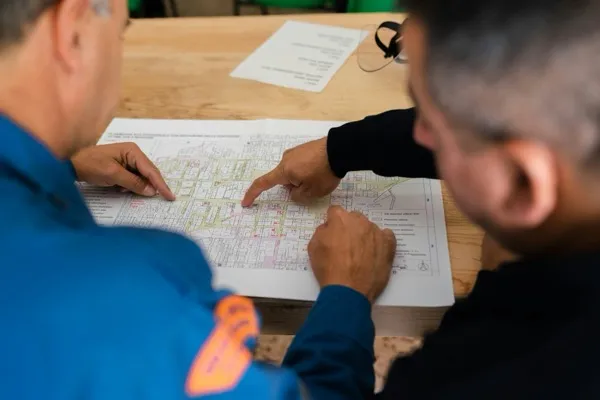

A 250-person civil engineering firm we worked with was entering the same project data into four separate systems: the design platform, the project information management tool, the accounting system, and the client-reporting dashboard. Site-survey data went into Civil 3D, then into the PIM tool, then into the accounting platform, then onto a slide in the client deck. Four people keyed in the same numbers four times.
They had civil engineers and construction engineers staffed on the same projects. Almost nobody in the firm could tell you whether those were different jobs or the same job with different titles.
The conversation in their leadership team kept coming back to a question they couldn't quite name:
- Are these two disciplines?
- Two job titles?
- Two cost centers?
- Or one workflow we've split into four data silos?
That's the question worth answering. The label on the engineer's business card matters less than how many separate systems are storing the same project number. Most firms don't have a civil-versus-construction-engineering problem. They have a four-systems-of-record problem wearing a civil-versus-construction-engineering costume— and bad data may have cost the global construction industry $1.85 trillion in 2020 according to one major industry study8.
Before we get to the operational answer, here's the definitional one— because the literal question matters.
The Direct Answer — No, But Closely Related
No— construction engineering is not the same as civil engineering. Construction engineering is one of nine sub-disciplines that the American Society of Civil Engineers (ASCE) recognizes within civil engineering1, alongside:
- Transportation
- Coastal Engineering
- Structural
- Environmental
- Geotechnical
- Architectural
- Engineering Mechanics
- Utility Engineering and Surveying
Wikipedia2 frames it the same way: construction engineering is a professional sub-discipline of civil engineering that deals with the designing, planning, construction, and operations management of infrastructure. Construction engineering is a professional sub-discipline of civil engineering— a recognized specialization within the broader field.
Civil engineers design what gets built. Construction engineers manage how it gets built. They share a parent discipline, a credentialing path, and most of the underlying coursework. Where the distinction sharpens is at the stamp: design-side work that requires a Professional Engineer license sits more clearly in civil engineering, while execution-side oversight more often sits in construction engineering2.
How They Differ — Training, Licensure, and the Job Itself
Civil engineers and construction engineers diverge in three places: what they study in school, whether they need a PE license, and where on the project lifecycle they spend their time.
Education and accreditation
Both paths are ABET-accredited. ASCE partners with ABET to accredit programs in civil engineering, architectural engineering, construction engineering, and their technology-track counterparts3. ABET accredits BS programs in both civil engineering and construction engineering, with the latter typically housed inside a Civil Engineering department.
A concrete example: the University of New Mexico offers a Bachelor of Science in Construction Engineering, housed within its Department of Civil, Construction and Environmental Engineering4. That structural choice is common across US engineering schools.
The curriculum splits where you'd expect. Civil engineering programs emphasize analytical design work, while construction engineering programs focus on construction procedures, methods, costs, schedules, and personnel management2.
One related note worth flagging: construction management is typically a separate, non-engineering degree path. It sits closer to project management than to engineering, and the engineering coursework is not comparable.
| Civil engineering | Construction engineering | Both | |
|---|---|---|---|
| Primary focus | Design, analysis, planning | Execution, scheduling, on-site management | Engineering judgment |
| Coursework emphasis | Analytical design | Procedures, methods, costs, schedules | Mechanics, materials |
| Accreditation body | ABET (via ASCE) | ABET (via ASCE) | Same |
| PE requirement | Often required (stamping) | Required only for stamping | Eligible for PE |
| Typical work setting | Office, design-side | Field, trailer, execution-side | Mixed by career stage |
| BLS classification | SOC 17-2051 | SOC 17-2051 (same category) | One bucket |
PE licensure — when each role needs it
The PE Civil exam offers five depth modules: Construction, Geotechnical, Structural, Transportation, and Water Resources & Environmental5. The PE Civil exam itself treats construction as a civil engineering sub-discipline— it's one of five depth options.
Whether a construction engineer needs a PE is more nuanced. A construction management position does not necessarily require a PE license, while design-focused civil engineering roles often do2. The PE is required for engineers who stamp designs or sign regulatory submissions. Many construction engineers work in project-management roles where it isn't strictly required.
As of April 2024, NCEES updated specifications for all five PE Civil depth exams, including Construction6. ABET-accredited graduates of either path are eligible to pursue PE licensure.
Where they spend their day
Civil engineers spend more of their day in design, analysis, planning, regulatory review, and drawing sets. Construction engineers spend more of their day in execution, scheduling, cost control, on-site supervision, and managing the build itself. More office-based earlier in career for one; more field-and-trailer-based for the other.
In practice there's significant overlap. Many engineers move between design and construction work over a career. The Bureau of Labor Statistics classifies most construction-engineering work under the same SOC code (17-2051) as civil engineers— they plan, design, and supervise the construction and maintenance of building and infrastructure projects7. For most firms, the two roles are more porous than the org chart suggests.
What the Labor Market Pays
The US Bureau of Labor Statistics reports a median annual wage of $99,590 for civil engineers as of May 2024, with employment projected to grow 5 percent from 2024 to 2034 and about 23,600 openings each year over the decade7.
The headline BLS numbers:
- Median annual wage: $99,590 (May 2024)
- Projected employment growth 2024–2034: 5 percent (faster than average)
- Annual openings: about 23,600 over the decade
Here's the wrinkle. The BLS does not maintain a separate occupational category for "construction engineer"— most construction-engineering work is classified under SOC 17-2051, Civil Engineers7. If you're hiring for either role today, you're competing in the same labor pool— $99,590 median, 5 percent growth, 23,600 openings a year.
The "which pays more" question doesn't have a clean public-data answer. Field-heavy construction-engineering and project-management roles sometimes earn more than design-side civil roles. Design-side roles with PE stamping authority sometimes earn more than execution roles. Without a separate BLS category, the right comparison is role-to-role, not title-to-title. And state PE licensure remains the gate for any engineer offering services directly to the public.
Why the Title Distinction Matters Less Than Firm Leaders Think
Inside a single firm running both civil and construction engineering work, the real productivity problem is data fragmentation— whether the same project information lives in one system or four.
The civil-versus-construction-engineering question is a taxonomy question. The question your operations director is trying to answer is a systems question. Different question. And the math on the systems question is brutal.
Bad project data may have cost the global construction industry $1.85 trillion in 2020, according to the 2021 Autodesk/FMI study of more than 3,900 AEC professionals8. The same study estimated that bad data drove $88.69 billion in rework alone that year— about 14 percent of all rework performed in 20208. Thirty percent of respondents said more than half their project data is "bad" and produces poor decision-making more than half the time8.
That's a vendor-sponsored study with a large sample, and you should weigh it accordingly. Here's the methodologically separate finding that points the same direction:
"Construction is among the least digitized sectors in the world. In the United States, construction comes second to last, and in Europe it is in last position on the index." — McKinsey's Reinventing Construction, 201710
Per McKinsey's Reinventing Construction analysis, labor-productivity growth in construction has averaged only 1 percent per year over two decades, compared with 2.8 percent for the total world economy and 3.6 percent for manufacturing10. That gap shows up inside your firm as the same data, four systems, three people reconciling.
The good news is the early adopters inside AEC are already pulling away. Bluebeam's October 2025 survey of more than 1,000 AEC technology decision-makers found9:
- Only 27 percent of AEC firms currently use AI for automation, problem-solving, or decision-making
- 94 percent of firms already using AI plan to increase their investment
- Nearly half (46 percent) of early adopters have reclaimed between 500 and 1,000 hours on tasks like scheduling, planning, and document analysis
- 84 percent of firms intend to increase overall technology investment in 2026
Civil engineers and construction engineers working on the same project, entering the same data into different systems, is a literal example of the broader pattern. The productivity gap and the data-fragmentation gap are the same gap. The serious AI implementation work inside AEC firms starts with unifying the workflow so the tools have somewhere coherent to act. Which is also why measuring the ROI of digital and AI investments begins with a workflow audit rather than a tool selection.
What Changes When You Treat It as One Workflow
When that 250-person civil firm stopped treating design-side and execution-side work as separate data realities, the change was structural— they built a single source of truth for project information that civil engineers, construction engineers, project managers, and accounting all pulled from.
The shift looked roughly like this:
- One system owns each piece of project data, and the duplicate entries get closed
- Engineers stop entering the same numbers two and three and four times
- The dashboard the client sees reads from the same source as the model the engineers are building in
Once data lives in one place, AI tools can act on it usefully. Document review, schedule analysis, RFI triage, cost forecasting— Bluebeam's 46 percent of early adopters reclaiming 500–1,000 hours9 is what that looks like when the data layer is coherent. McKinsey's analysis suggests digital transformation in construction can produce productivity gains of 14 to 15 percent and cost reductions of 4 to 6 percent10.
The answer for most AEC firms is to stop entering the same project data four times because the design side and the execution side were never asked to share one. AI doesn't solve a data-fragmentation problem. A clear workflow solves it. AI then makes the clear workflow several times faster.
People are the answer here. The workflow change is human and organizational— who owns which data, who hands it off to whom, what gets entered once and read everywhere. AI accelerates a unified workflow. It doesn't substitute for one. That's also why the hidden costs of bolting AI onto a fractured workflow tend to dwarf the cost of doing the unification work properly first, and it's part of why we recommend firms start with a decision framework for where to invest first before any tool gets bought.
FAQ — Civil Engineering and Construction Engineering, Quickly
A few questions come up over and over. Short, sourced answers below.
Is construction engineering a real degree?
Yes. ABET accredits Bachelor of Science programs in construction engineering, typically housed inside Civil Engineering departments3. The University of New Mexico, for instance, offers a BS in Construction Engineering within its Department of Civil, Construction and Environmental Engineering4.
Do construction engineers need a PE license?
Not always. The PE is required for engineers who stamp designs or sign off on regulatory submissions, but many construction engineers work in project-management roles where it isn't strictly required2. For those who pursue licensure, the NCEES PE Civil exam offers a Construction depth option alongside Geotechnical, Structural, Transportation, and Water Resources & Environmental5.
Is construction engineering the same as construction management?
Closely related, but the two are distinct paths. Construction engineering is an ABET-accredited engineering degree with technical depth in materials, mechanics, and design2. Construction management is typically a non-engineering, project-management-focused degree without the same engineering coursework.
Can a civil engineer work as a construction engineer (and vice versa)?
Yes, frequently. The two roles share foundational engineering training, and many engineers move between design and construction work over a career. The Bureau of Labor Statistics classifies most construction-engineering work under the same occupational category as civil engineers (SOC 17-2051)7.
Which pays more — civil engineering or construction engineering?
There is no clean public-data answer because BLS does not maintain a separate "construction engineer" occupational category. The published civil engineering median is $99,590 (May 2024)7. Field-heavy construction-engineering roles and PE-licensed design roles can both earn above the median; the right comparison is role-to-role, not title-to-title.
Where to Take This Next
If your firm employs both civil and construction engineers and you're not sure how many separate systems are holding the same project data, that's the more useful question to ask this week. The real ROI on AI in AEC sits in the workflow you build before you turn the tools on.
We work with $20M–$100M AEC firms on exactly this kind of audit-then-implementation work— mapping where the same project data is being entered more than once, deciding which system owns what, then bringing AI in to act on the unified workflow. Some firms do that work themselves. Others bring in a fractional AI officer who can run the audit and own the roadmap for a few quarters. Either path is fine. The work is worth doing either way.
References
- American Society of Civil Engineers, "About Civil Engineering" — https://www.asce.org/about-civil-engineering
- Wikipedia, "Construction engineering" (2026) — https://en.wikipedia.org/wiki/Construction_engineering
- American Society of Civil Engineers, "Accreditation & ABET" — https://www.asce.org/career-growth/educators/accreditation-and-abet
- University of New Mexico, "Bachelor of Science in Construction Engineering" — https://civil.unm.edu/programs-and-degrees/undergraduate/bachelor-of-science-in-construction-engineering.html
- National Council of Examiners for Engineering and Surveying, "PE Civil Exam" (2024) — https://ncees.org/exams/pe-exam/civil/
- NCEES, "NCEES Updates Specifications for PE Civil Exams" (2023) — https://ncees.org/ncees-updates-specifications-for-pe-civil-exams/
- US Bureau of Labor Statistics, "Civil Engineers — Occupational Outlook Handbook" (2024) — https://www.bls.gov/ooh/architecture-and-engineering/civil-engineers.htm
- Autodesk / FMI Corporation, "Study from Autodesk and FMI Finds Better Data Strategies Could Save the Global Construction Industry $1.85 Trillion" (2021) — https://www.prnewswire.com/news-releases/study-from-autodesk-and-fmi-finds-better-data-strategies-could-save-the-global-construction-industry-1-85-trillion-301376278.html
- Bluebeam, "New Bluebeam Report Shows Early AI Adopters in AEC Seeing Significant ROI Despite Uneven Adoption" (2025) — https://press.bluebeam.com/2025/10/new-bluebeam-report-shows-early-ai-adopters-in-aec-seeing-significant-roi-despite-uneven-adoption/
- McKinsey Global Institute, "Reinventing Construction Through a Productivity Revolution" (2017) — https://www.mckinsey.com/capabilities/operations/our-insights/reinventing-construction-through-a-productivity-revolution