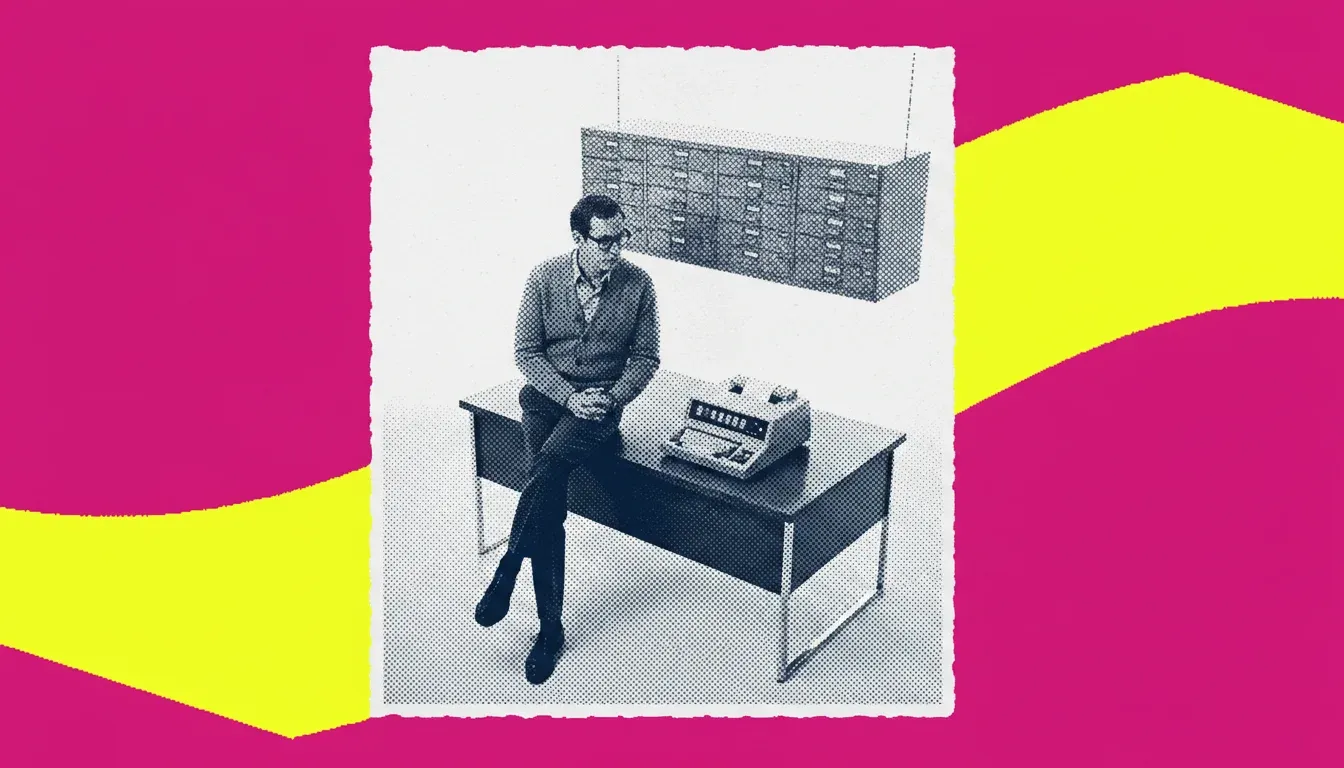
Every established engineering firm has one: the senior person you can ask anything and he just knows. What went wrong on the bridge job in '11, which county reviewer hates that connection detail, why the spec reads the way it does. Thirty years of engineering projects live in his head. He is, functionally, your firm's project archive. He's also a single point of failure no one has backed up.
You know exactly who I mean. He carries the project history— what the client wanted versus what they said, why a detail got done a certain way, what went sideways on the geotech, what you swore you'd never do again, who to call at the agency when a submittal stalls. None of it is written down anywhere you could find it. Some of it isn't written down at all.
There's usually a day everyone realizes this. A junior asks a question, nobody else can answer it, and you watch the whole firm route around one person. Or worse— he's out for a month and a deadline slips. This isn't a complaint about the VP. He's the most valuable asset your firm has. It's a problem the firm has chosen to live with, because for thirty years it felt unsolvable. That choice— to live with it— has a name, and a price. It also, for the first time, has a fix that wasn't on the table the last thirty years.
The Asset That's Also a Liability: Key-Person Dependency
What you have is textbook key-person dependency: when critical project knowledge, client relationships, and technical judgment are concentrated in one or a few individuals, their departure causes outsized disruption. Business valuators have a name for the cost— the key-person discount— and they apply it when they price a firm.
A key-person discount is the valuation penalty buyers attach for owner- or key-person dependency. Shannon Pratt's standard valuation reference puts it commonly around 10% to 25%, and materially larger for small, closely held firms where no one can step into the role5. Read that against your own firm. If the answer to "who replaces him" is a long pause, that discount is already in your enterprise value, waiting for a buyer or a bank to name it.
The cost shows up long before any sale, too. Tacit, experience-based knowledge— the "this smells wrong" that comes from thirty years of mistakes— doesn't transfer in a two-week handoff4. Harvard Business Review reported that managers at Rolls-Royce estimated one veteran systems engineer's retirement would cost the company on the order of $400,000 in the first year alone4. That's one person, one year, inside a company with deep bench strength. A 60-person engineering firm has far less room to absorb it.
Here's the part that should bother you: most firms know all this and do nothing. Succession planning, as the NYU Stern finance professor Aswath Damodaran puts it, is "preached widely, but practiced infrequently"6. Both things are true— he's your most valuable asset and your largest unhedged risk— and most firms treat that as a fact of life rather than something a deliberate AI strategy built around the firm's own knowledge can address. And the math underneath it is moving the wrong way.
The Math Is Getting Worse: The AEC Workforce Squeeze
The AEC workforce is thinning and turning over faster, which means the window to get knowledge out of senior heads is shrinking. In the 47th Annual Deltek Clarity studies (2026), architecture and engineering firms reported staff growth of just 1.2% alongside staff turnover persistently above 13%2. Slow hiring, steady attrition— that's a firm running in place while the senior cohort edges toward retirement.
The prior year was sharper. The 46th Annual Deltek Clarity A&E study (2025) reported staff growth slowing from roughly 7% to under 3%, top-quartile firms seeing turnover near 20%, and more than 40% of firms reporting a reduction in force3. Industry workforce surveys reported by Stambaugh Ness and SmartBrief that year put around 89% of firms struggling to find qualified workers and roughly 41% reporting project delays tied to labor shortages11.
| What the Deltek Clarity studies show | 46th Annual (2025)3 | 47th Annual (2026)2 |
|---|---|---|
| Staff growth | ~7% → under 3% | ~1.2% |
| Staff turnover | Top-quartile near 20% | Persistently above 13% |
| Firms reporting a reduction in force | More than 40% | — |
The durable point isn't any one number. It's the trend: headcount growth is slowing, turnover is sticky, and the people who carry the most undocumented knowledge are closest to the door. The runway is short. So the obvious move is to capture what's in those heads before they leave. Firms have been trying that for thirty years. Here's why it keeps not working.
Why Mentorship, Wikis, and "Lessons Learned" Folders Haven't Fixed This
Lessons-learned databases don't fail because firms don't capture lessons. They fail because no one retrieves or reuses them— the knowledge gets, in the Project Management Institute's words, "lost in a database," buried in inboxes, chats, and people's heads7. Capture was never the bottleneck. Retrieval is.
Walk the standard fixes. Mentorship doesn't scale: one VP, a dozen juniors, a couple of years of overlap if you're lucky— and the judgment part, the "something's off here," doesn't transfer through a structured handoff at all4. Wikis and SharePoint pages go stale because nobody owns them and there's no time on a billable day to feed them. "Lessons learned" folders become graveyards— the lesson gets written down once, then sits where no busy engineer on a deadline will go looking. Sound familiar?
The deeper issue: the archive is technically "there" and practically unreachable. Decades of project knowledge sit in formats and places nobody can search:
- Proposals and RFP responses, scattered across the proposal library and individual drives
- Calc packages and design memos filed under project numbers nobody remembers
- Change orders, redline markups, and submittal logs in Newforma or a PM's inbox
- Project meeting notes and the email thread from 2014 where the real decision got made
- The one folder on the shared drive named after a project number— the one only he can navigate
McKinsey's work on the built environment helps explain the habit: construction-sector firms have historically spent under 1% of revenue on IT— less than a third of what's common in automotive and aerospace1— and it shows in the tooling. Those numbers describe construction sites, not a design firm's back office, but the underinvestment instinct is shared. Decades of project knowledge, and the firm never bought the thing that would let anyone find it. So the hunt ends where it always ends: at one person's desk.
What's new isn't a better way to write things down. It's a way to ask what's already written down— in plain English.
What's Changed: Asking Your Own Archive Questions
What's changed is that you can now point an AI assistant at your firm's own documents— proposals, calc packages, project notes, change orders, the email threads— and ask questions in plain English, getting answers grounded in those files. The technique is called retrieval-augmented generation. The practical upshot: the model is grounded in your documents without retraining, and you update it by adding files, not by rebuilding anything9.
In plain terms, retrieval-augmented generation works by pulling the most relevant documents from a knowledge base at the moment you ask, then handing them to the AI as context— so the answer is grounded in your firm's project history rather than the open internet9. If you want the mechanics, here's how generative AI works; for a principal making a decision, the shape matters more— ask in the flow of work, get the firm's own knowledge pulled to you.
The tooling is already ordinary. A custom GPT has a "Knowledge" feature that lets it draw on uploaded reference files— documentation, guides, project archives8. Claude, Microsoft Copilot, and purpose-built retrieval tools do the same kind of thing. The point is the capability, not the brand.
What it looks like in an engineering firm is the part generic AI content never gets to. Point it across all your engineering projects, and the queries sound like this:
- "What did we learn on projects like this one— what went wrong, what we'd do differently?"
- "Pull the spec language we used for that agency's stormwater requirement."
- "Which reviewer flagged that connection detail last time, and what did we change to clear it?"
- "Find the change-order history on jobs where the geotech came back late."
- "Draft a first pass at this RFP response using our last three wins in this market."
That inverts the failure mode from the last section: the old knowledge base made you go find the knowledge; a retrieval assistant pulls it to you in the flow of work— exactly the thing the wikis and "lessons learned" folders never solved. Your firm's edge was never the cleverness of the tool. It's the judgment sitting in that archive.
Which raises the question every senior person is already asking: if the firm can just ask the archive, what happens to me?
It Doesn't Replace the VP: It Scales His Judgment
No, an AI assistant doesn't replace the VP. It can only surface what's been written down, and the most valuable thing he has is the judgment that was never written down— the pattern recognition, the relationships, the "this smells wrong"4. What AI does is two things: it makes the firm's written memory usable by everyone, and it gives the firm a concrete reason to sit the VP down and capture the unwritten part while he's still here.
That second move is the one firms skip. Make the written archive queryable— that's the capability from the last section. Then deliberately interview the VP: the things he checks every time, the war stories, the "never trust that subconsultant on a fast-track schedule," the reasoning behind the details he insists on. Transcribe it, structure it, feed it into the same retrieval system— the same workflow Dan Cumberland Labs uses to capture a founder's expertise, pointed at a firm instead of a person.
Here's an analogy from a different industry, and I'll flag it as exactly that. Dustin Riechmann, a business consultant, had thousands of hours of his own material— coaching recordings, keynotes, course content— and the complaint everyone with deep expertise has: "people ask me a lot of the same questions all the time." He built an assistant trained on that material so his coaching is available without him in the room. It "saved me a ton of time," he says, and gave "a much more consistent result for the clients." An engineering firm's corpus is different— decades of proposals, calc packages, and project notes instead of one founder's recordings— but the move is the same: one person's accumulated judgment, made available to everyone, all the time.
The second-order effect is the one principals should care about. When his judgment is leverageable across every project— not just the ones he personally touches— he stops being a bottleneck and becomes a firm-builder: more valuable, not redundant. And the key-person discount shrinks, because the answer to "who replaces him" stops being a long pause. People are the answer here, not the AI. AI amplifies human capability. Both are true, and all of it matters.
But that only works if the rollout is done with him. This is where most firms get it backwards.
The Part Everyone Gets Wrong: Doing It With Him, Not To Him
The fastest way to kill a knowledge-capture effort is to make the senior expert feel like he's digging his own grave. If the VP suspects the AI is being built to replace him, he'll do what experts have always done when they feel that— hold back4. Not out of spite. Out of the same rational self-protection anyone shows when the message reads "we want what's in your head so we need less of you." The rollout has to be framed as legacy, and run with him, not at him.
So tell him the true version. This is your judgment, made to count on every project the firm touches— not just the ones you can personally staff. And give him the role that follows: he leads the capture, decides what matters, validates the assistant's answers, becomes the system's editor-in-chief. That's a good late-career job, and it's the opposite of being eased out.
The culture point connects straight to whether anyone uses the thing. "Lessons learned" folders failed for the same reason— no incentive, no payoff in the moment. Built with the team, started where there's an obvious win, the usage becomes self-reinforcing. That's building an AI culture your team uses, and it determines whether the technology earns its keep.
So where does a $20–100 million firm start? Not with a platform program.
Where an Engineering Firm Should Start Without a Moonshot
Start narrow, where the payoff is obvious. For most engineering firms that means making the proposal and RFP archive searchable— so writing a new pursuit starts from the firm's last three wins instead of a blank page. Prove value there before you attempt a firm-wide knowledge base. The wikis failed partly because firms tried to boil the ocean on day one.
The first AI project for an engineering firm's knowledge shouldn't be a platform. It should be one narrow slice with an obvious return: proposal and RFP reuse, or one discipline's lessons-learned, or one office's project archive. Pick the slice where the payoff is fastest and most visible— that's what makes the next slice an easy yes.
Who owns it matters as much as what it is. Not buried in a two-person IT group that's already underwater. A principal— or a fractional AI leader working alongside IT— someone with authority over the workflow, not just the infrastructure. Knowledge capture is a business decision about what the firm chooses to remember, and it needs an owner who can make that call.
Frame the ROI against what this offsets, not against a software line item:
| What the first project offsets | Why it adds up |
|---|---|
| Rework | Construction studies put direct rework cost anywhere from a few percent to double digits of project cost; around 5% is the figure most often cited10 (a construction reference point, not a design-firm metric) |
| Lost or rewritten proposals | Every pursuit started from scratch is a win you already paid for, thrown away |
| Slow onboarding | Months before a new hire knows where the bodies are buried |
| The key-person discount | The 10–25% the market takes off your value for depending on one head5 |
The offsets are large; the first project is small. Use that asymmetry to decide where AI investment pays off— rank the slices, start with the obvious one.
What does it cost? That depends on scope, the state of the archive, and how much of the VP's time you can get— which makes it a conversation, not a price tag. Before you commit, it's worth understanding the real costs of an AI project. And if mapping the right first project to your firm's actual workflows feels like the hard part, that's the work Dan Cumberland Labs does with engineering and AEC firms: an AI strategy audit that produces a ranked list of opportunities and an implementation plan the firm owns— no vendor lock-in, no fish, just teaching the firm how to fish.
One more thing before you greenlight anything— what this won't do.
The Honest Limits
This isn't a plugin, and it isn't magic. A retrieval assistant surfaces what's written down, and that comes with hard limits worth saying out loud before you fund anything:
- It can't recover unwritten knowledge. It retrieves what's in documents. The judgment that was never recorded still walks out the door with the VP4— which is exactly why you capture him while he's here.
- Its outputs need human validation. It can be confidently wrong. An engineer signs the work, not the model8.
- Garbage archive in, garbage answers out. A disorganized, contradictory archive produces unreliable answers, and the AI won't tell you which is which9. Some cleanup and curation is part of the project.
- It's a discipline, not a tool. Real value takes years, and the hardest part is the human and culture side, not the technology.
Just because it's easy to stand one of these up doesn't mean it's good. Making it good— validated, curated, used— is the work.
Which brings us back to the VP.
Frequently Asked Questions
What is key-person dependency in an engineering firm?
It's when critical project knowledge, client relationships, or technical judgment is concentrated in one person, so that person's departure causes outsized disruption— a single point of failure for the firm4. Business valuators recognize the exposure and apply a "key-person discount" to firms that carry it5.
What is a key-person discount?
It's a reduction in a business's appraised value that reflects how dependent the firm is on one or a few individuals— commonly cited around 10% to 25%, and larger for small, closely held firms where no one can step into the role5. The concept originates with Shannon Pratt's standard valuation reference work.
Can AI capture the knowledge in a senior engineer's head?
Only partly. AI can make everything that's written down— proposals, calc packages, project notes, emails— instantly searchable8. It can't replicate tacit judgment4, so the move is to pair AI retrieval over the archive with deliberately interviewing the expert while he's still there.
Why do lessons-learned databases fail?
Because the bottleneck is retrieval and reuse, not capture. Lessons get documented and then never found or applied in the flow of work— they end up, as the Project Management Institute puts it, "lost in a database"7.
What's the first AI project an engineering firm should do for knowledge?
Something narrow with an obvious payoff— usually making the proposal and RFP archive searchable, or one discipline's lessons-learned— before attempting a firm-wide knowledge base7. Prove value on one slice, then expand.
Will AI replace experienced engineers?
No. It makes their judgment leverageable across the firm rather than trapped in one person. A firm that does this well gets smarter when a senior expert retires, not poorer.
The Firm That Gets Smarter When He Leaves
The VP with 5,000 projects in his head isn't a problem to solve. He's the most valuable asset your firm has, and the goal was never to make him replaceable— it's to make his judgment count everywhere, not just where he can personally be. Make the written archive usable. Capture the unwritten part while he's still here. Start narrow. Do it with him. Done that way, the day your best person retires, the firm doesn't get dumber— it gets smarter, because for the first time his judgment scales. AI amplifies human capability. People are the answer here— the AI just makes the answer travel.
References
- McKinsey & Company, "Improving construction productivity" (2024) — https://www.mckinsey.com/capabilities/operations/our-insights/improving-construction-productivity
- Deltek, "The Latest Deltek Clarity Industry Studies Highlight AI Challenges, Talent Strain, and Delivery Capacity Pressures for Project-Based Businesses" (2026) — https://www.prnewswire.com/news-releases/the-latest-deltek-clarity-industry-studies-highlight-ai-challenges-talent-strain-and-delivery-capacity-pressures-for-project-based-businesses-302769095.html
- Deltek, "AI, Talent and Record Profits: What the 46th Annual Deltek Clarity A&E Study Reveals About the Architecture & Engineering Industry" (2025) — https://www.prnewswire.com/news-releases/ai-talent-and-record-profits-what-the-46th-annual-deltek-clarity-ae-study-reveals-about-the-architecture--engineering-industry-302453217.html
- Harvard Business Review (Dorothy Leonard), "What's Lost When Experts Retire" (2014) — https://hbr.org/2014/12/whats-lost-when-experts-retire
- Aswath Damodaran, NYU Stern School of Business, "Difference Makers: Key Person(s) Valuation" (2023) — https://pages.stern.nyu.edu/~adamodar/pdfiles/blog/KeyPerson.pdf
- Aswath Damodaran, "The Difference Makers: Key Person(s) Value!" (2023) — https://aswathdamodaran.substack.com/p/the-difference-makers-key-persons
- Project Management Institute, "Lessons (Really) Learned? How To Retain Project Knowledge And Avoid Recurring Nightmares" — https://www.pmi.org/learning/library/knowledge-management-lessons-learned-10161
- OpenAI, "Retrieval Augmented Generation (RAG) and Semantic Search for GPTs" (OpenAI Help Center, 2024) — https://help.openai.com/en/articles/8868588-retrieval-augmented-generation-rag-and-semantic-search-for-gpts
- IBM, "What is RAG (Retrieval-Augmented Generation)?" (2024) — https://www.ibm.com/think/topics/retrieval-augmented-generation
- Construction Management Association of America / Construction Industry Institute, "The Impact of Rework on Construction & Some Practical Remedies" — https://www.cmaanet.org/sites/default/files/resource/Impact%20of%20Rework%20on%20Construction.pdf
- Stambaugh Ness / SmartBrief, "AEC 2025 Forecast: Navigating Workforce and Market Changes" (2025) — https://www.stambaughness.com/blog/aec-2025-forecast-navigating-workforce-market-changes/