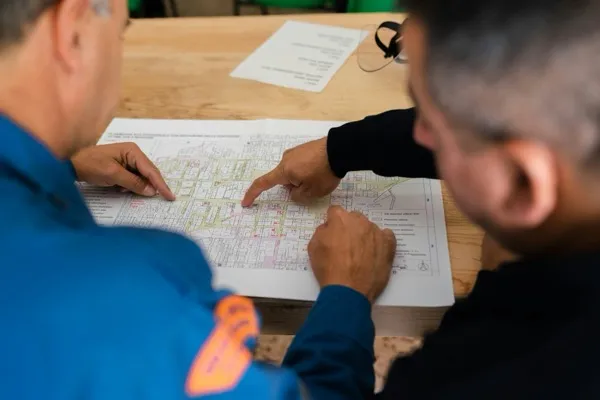

Every project reaches a point where the drawings are done and somebody has to work out how to build the thing— what order the trades show up in, which methods and materials to use, and what it costs to do it that way. Engineering for construction is the discipline that answers those questions. Inside the profession it goes by construction engineering, and it's a civil-engineering specialty with its own degree path and its own license.
People confuse it with its two closest neighbors constantly: civil engineering on one side, construction management on the other. All three show up on the same project. The PE license separates them more cleanly than anything else, and after that it comes down to which phase of the job you own.
This article covers what a construction engineer does day to day, how the role compares with civil engineering and construction management, the education and licensure path, the pressure the discipline is under right now, and where AI is being used in the work today.
What Is Engineering for Construction?
Engineering for construction (more precisely, construction engineering) is a professional sub-discipline of civil engineering that handles the planning, methods, scheduling, cost management, and on-site execution required to turn a design into a finished structure, delivered on time, on budget, and at the required quality.1 Construction engineering is the civil-engineering specialty that turns a design into a built asset.
Its scope is infrastructure in the broadest sense. That means roadways, tunnels, bridges, airports, railroads, facilities, and buildings— the physical things people use every day.1 Where the design disciplines decide what gets built, construction engineering decides how it gets built.
The mandate is simple to state and hard to meet. A construction engineer's single job is to deliver a project on time, on budget, and at the desired quality.1 Three constraints. All three at once. But miss one and the project suffers.
A clean definition is the start. The day-to-day work shows what the role involves.
What Does a Construction Engineer Do?
A construction engineer plans and schedules the build, selects methods and materials, manages budget and risk, coordinates technical specialties, and supervises on-site execution and quality.1 In short, they make the build buildable.
Think of it as the bridge between the drawing and the dirt: a designer asks whether the structure will stand, while a construction engineer asks how to build it on schedule, within budget, and without anyone getting hurt. But that second question is its own discipline, with its own methods and its own pressures.
The core responsibilities cluster into a handful of areas:
- Planning and scheduling— sequencing the work so trades and materials arrive in the right order.
- Methods and materials— choosing how each part of the structure gets built and what it's built from.
- Cost estimating and budget control— pricing the work and keeping it inside the number.
- Risk management— spotting what could go wrong before it does.
- Specialty coordination— pulling together the technical experts a project needs.
- On-site supervision— overseeing execution, safety, and quality in the field.5
Most of these tasks share a trait: they're document-heavy, repetitive, and unforgiving of small errors. Hold that thought. It matters later.
Construction Engineering vs. Civil Engineering vs. Construction Management
Construction engineering is a sub-discipline of civil engineering: civil engineering leans toward analytical design, while construction engineering emphasizes construction methods, cost, schedule, and on-site execution.1 Construction management overlaps with construction engineering, but it doesn't require a professional engineer (PE) license.
Here's the cleanest way to hold the distinction. Civil engineering designs the structure. Construction engineering delivers it. Construction management runs the people and process of the build, often without the engineering license that lets you stamp design work.
And the lines blur in practice, which is why the comparison earns a table:
| Civil Engineering | Construction Engineering | Construction Management | |
|---|---|---|---|
| Primary focus | Analytical design of structures and systems | Construction methods, cost, schedule, execution | People, process, and delivery of the build |
| Typical work | Structural analysis, design calculations | Means and methods, estimating, scheduling | Day-to-day jobsite and contract management |
| PE license | Common (required to stamp design) | Common; adds marketability | Not typically required |
| Project stage | Design phase | Design through construction | Construction phase |
The single clearest dividing line is licensure. A PE makes a construction engineer more marketable and able to stamp engineering work.1 A construction manager can run a large jobsite without one. Both paths are valid. They simply answer different questions on the same project.
Delivering a project means coordinating several engineering specialties. Those are the sub-disciplines a construction engineer pulls together.
The Sub-Disciplines a Construction Engineer Coordinates
A construction engineer coordinates several technical specialties on a project: structural, geotechnical, mechanical/electrical/plumbing (MEP), surveying and site analysis, and construction-materials engineering.15 The job is coordination as much as engineering.
No single person carries all of this expertise. The construction engineer's value is pulling it into one buildable plan:
- Structural engineering— the load-bearing integrity of the structure: will it hold?
- Geotechnical engineering— soil, foundations, and what the ground beneath the project can support.
- MEP (mechanical, electrical, and plumbing)— the systems that make a building function and have to thread through the structure without conflict.
- Surveying and site analysis— measuring and mapping the site so the build lands where it should.
- Construction-materials engineering— selecting and testing the concrete, steel, and other materials that meet spec.
Each specialty has its own engineers, standards, and failure modes, and the construction engineer's job is to make sure they don't collide— that the plumbing doesn't run through a beam, that the foundation suits the soil, that the schedule respects how long concrete takes to cure. And coordination is where projects are won or lost.
Coordinating those specialties at a professional level requires specific credentials.
Education and Licensure: The Path to Construction Engineering
Becoming a construction engineer typically requires an ABET-accredited engineering degree, passing the Fundamentals of Engineering (FE) exam— usually during college— and roughly four years of post-graduate experience to earn the Professional Engineer (PE) license.1 The path is well-defined, and it runs in sequence:
- Earn an ABET-accredited engineering degree. ABET is the accreditation body that certifies engineering programs, and that accreditation is what makes a degree count toward licensure.
- Pass the FE exam. The Fundamentals of Engineering exam (sometimes called the EIT) is the first licensure step, and most students take it during or just after college.
- Gain about four years of supervised experience. In the United States, you build qualifying experience under a licensed engineer before you can sit for the next step.
- Earn the PE license. The Professional Engineer license lets you stamp engineering work and take legal responsibility for it.
Why does the PE matter? It's the credential that signals you can own a design, not just contribute to one. And for a construction engineer, that's the difference between advising and being accountable.
That mandate— on time, on budget, at quality— has gotten measurably harder to meet. Modernizing how the work gets done is where AI implementation increasingly comes in.
The Mandate Under Pressure: On Time, On Budget, and Harder Than Ever
Construction engineering's core mandate has gotten harder to meet: construction labor productivity has grown only about 1% a year for two decades while the wider economy grew 2.8%, and today 92% of construction firms report difficulty filling open positions.23 The job is the same. The conditions are not.
Start with productivity. A 2017 McKinsey study found that global construction labor productivity averaged just 1% annual growth over two decades, compared with 2.8% for the total world economy and 3.6% in manufacturing.2 Construction, in other words, sat still while other industries moved. McKinsey estimated that closing that gap would add roughly $1.6 trillion in value, with about a third of the opportunity in the United States.2
Then add the labor squeeze. AGC (the Associated General Contractors of America), in its 2025 Workforce Survey, reported that 92% of contractors struggle to fill open positions.37 Worker shortages are now the leading cause of construction project delays:
- 92% of firms report difficulty hiring.3
- 45% report project delays caused by shortages of their own or subcontractors' workers.3
- 78% had at least one delayed project in the past twelve months.3
Here's the part worth sitting with. McKinsey also found that acting across seven areas at once— including infusing digital technology and reskilling the workforce— could lift productivity 50 to 60%.2 Technology isn't the whole answer. But it's one of the few levers that doesn't require hiring people who, right now, can't be found.
If the binding constraint is too few people and too little productivity growth, the obvious question is whether technology— and specifically AI— can close the gap.
How Technology and AI Are Changing Construction Engineering
AI is starting to change construction engineering, but adoption is still early. About 27% of architecture, engineering, and construction professionals currently use AI, and 94% of those plan to increase their use.4 For construction engineers, AI's role is augmentation— absorbing repetitive analytical and documentation work so engineers can focus on judgment.
The technology arc didn't start with AI. Construction engineering has absorbed BIM (Building Information Modeling, the shared 3D data model of a project), drones, reality capture, and prefabrication over the past decade. AI is the newest layer on that stack.
Now the honest part. A 2025 Bluebeam survey of 1,000 AEC professionals, reported by ASCE, found that 52% still use paper during the design phase and 49% during planning.4 Sixty-nine percent said uncertainty around AI regulation has affected their plans to adopt it.4 Adoption is early— say so plainly. Anyone promising that AI has already remade the jobsite hasn't read the data.
So where does AI help a construction engineer today? These are common use cases, not guaranteed outcomes:
- Quantity takeoffs and estimating— pulling counts and costs from drawings faster.
- Predictive scheduling— flagging schedule risk before it becomes a delay.6
- Clash detection— catching conflicts between systems in the model before they reach the field.
- RFI and submittal triage— sorting and drafting the document flow that eats engineers' hours.
- Safety monitoring via reality capture— using site imagery to spot hazards.6
Notice the pattern. Every one of those is repetitive, document-heavy work— the kind that doesn't need an engineer's judgment, only their time. With a 92% hiring shortage, AI closes a capacity gap. This is the both/and: let AI take the drudgery so engineers do the work only they can do.
The same lesson shows up well outside construction. Fielding Jezreel, a federal grant-writing consultant with a decade in the field, built AI tools for his own practice and reached a blunt conclusion— AI "doesn't replace a grant writer." Pair deep domain expertise with the technology and you get something neither delivers alone. Swap "grant writer" for "construction engineer" and the logic holds: the expertise stays human while the leverage gets automated.
The firms pulling ahead figured this out by starting with a problem first. As Bluebeam's Jeff Sample put it:
"AI is not going to do everything for everybody, but the 27% in our report who are using AI knew what their core problems are and how AI could solve them."4
That's the whole game. AI mastery is a thinking skill before it's a tactic, which is why deciding where AI fits first matters more than the tool you pick. The teams that win start by automating repetitive workflows tied to a real bottleneck, then keep measuring the impact of AI investments instead of assuming it.
For firm leaders, the practical question is no longer whether AI matters. It's where to apply it first.
Frequently Asked Questions
What is engineering for construction?
Engineering for construction is construction engineering— the civil-engineering specialty that plans, schedules, and manages the building of a structure to deliver it on time, on budget, and at quality.1 It covers the methods, cost, and on-site execution that turn a design into a finished asset.
Is construction engineering the same as civil engineering?
No. Construction engineering is a sub-discipline of civil engineering.1 Civil engineering leans toward the analytical design of structures and systems, while construction engineering focuses on construction methods, cost, schedule, and on-site execution.
What degree do you need for construction engineering?
You need an ABET-accredited engineering degree, plus the FE exam and— for design or PE-stamped work— a Professional Engineer license earned with roughly four years of experience.1 The PE is what lets an engineer take legal responsibility for design work.
How is AI used in construction engineering?
AI is used for tasks like estimating and quantity takeoffs, predictive scheduling, clash detection, safety monitoring via reality capture, and document and RFI triage.46 In each case it augments engineers, absorbing repetitive work rather than replacing the judgment a project needs.
How many construction firms use AI?
About 27% of AEC professionals currently use AI, and 94% of those adopters plan to increase their use, according to a 2025 Bluebeam survey of 1,000 professionals reported by ASCE.4 More than half still use paper during design.
Engineering for Construction, Going Forward
Engineering for construction is, at its core, the discipline of delivering a project on time, on budget, and at quality— a job that's gotten harder as productivity stalled and hiring tightened. The definition hasn't changed. The difficulty has.
The forward view is straightforward. AI won't replace construction engineers; with a 92% hiring shortage, the constraint is too few people, and AI amplifies the capability of the ones you already have. The teams pulling ahead started from a core problem, then aimed AI at it. Tool count was never what set them apart.
If mapping where AI fits a firm's workflows feels like its own full-time job, that's the kind of problem an implementation partner can help firm leaders weighing where to start solve in a fraction of the time. Both are true: the discipline is as human as ever, and the leverage is increasingly digital. All of it matters.
References
- Wikipedia, "Construction engineering" (2026) — https://en.wikipedia.org/wiki/Construction_engineering
- McKinsey Global Institute, "Reinventing Construction: A Route to Higher Productivity" (2017) — https://www.mckinsey.com/capabilities/operations/our-insights/reinventing-construction-through-a-productivity-revolution
- Associated General Contractors of America, "Construction Workforce Shortages Are Leading Cause of Project Delays" (2025 Workforce Survey) — https://www.agc.org/news/2025/08/28/construction-workforce-shortages-are-leading-cause-project-delays-immigration-enforcement-affects
- American Society of Civil Engineers, "Architecture, Engineering, Construction Sector Slow to Adopt AI, Survey Shows" (reporting a 2025 Bluebeam survey of 1,000 AEC professionals) (2025) — https://www.asce.org/publications-and-news/civil-engineering-source/article/2025/12/18/architecture-engineering-construction-sector-slow-to-adapt-ai-survey-shows
- ProjectManager.com, "Construction Engineering: A Quick Guide With Definitions, Roles & More" — https://www.projectmanager.com/blog/what-is-construction-engineering
- Autodesk (Digital Builder), "The Rise of AI in Construction" — https://www.autodesk.com/blogs/construction/ai-construction/
- Engineering News-Record, "Report: 92 Percent of Construction Firms Struggling to Hire Workers" (2025) — https://www.enr.com/articles/62557-report-92-percent-of-construction-firms-struggling-to-hire-workers