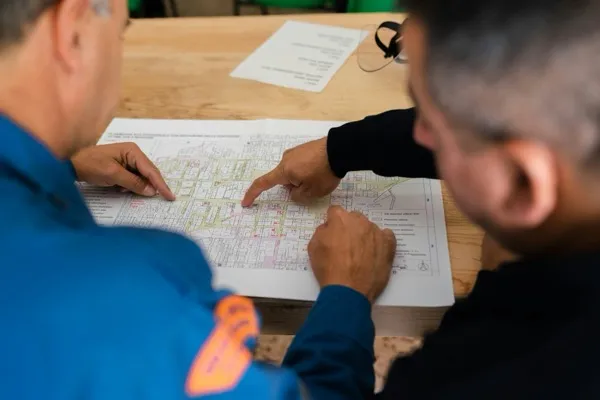

Converting a paper inspection form into an AI-ready digital workflow is a two-step problem: first, your data needs to be structured (not just scanned); second, it needs to connect to a platform that AI tools can read. Most AEC firms who think they've gone digital have only done half of step one.
Here's the gap. According to Bluebeam's 2025 AEC AI Adoption Report1, 52% of AEC firms still use paper during the design phase, and only 11% are fully digital. Meanwhile, 68% of early AI adopters in AEC saved at least $50,000— the same report shows1. That gap is not an accident. The firms getting results have done something specific with their data. This article shows what that is.
McKinsey research2 puts the cost of paper-based inefficiency in US construction at $177 billion or more annually— rework, data search, communication breakdowns. Going digital doesn't automatically fix that. But going AI-ready does. Before diving into the conversion process, it's worth understanding the difference between "digital" and "AI-ready"— because confusing the two is exactly what keeps most firms stuck.
Digital ≠ AI-Ready: What Your Forms Need to Do
A digitized inspection form and an AI-ready inspection form are not the same thing. A PDF on an iPad is digitized. A structured form with dropdown fields, conditional logic (fields that change based on prior answers), and a database connection is AI-ready. AI can read a PDF— but it can't aggregate, trend, or act on it the way it can with structured data.
The PDF trap is real. Scanning a paper form to PDF moves paper to device, but it doesn't change the data type. AI can parse individual PDFs (extract text, read a field), but it can't query across hundreds of submissions, detect patterns over time, or automatically assign corrective actions. You've improved your filing system. You haven't built a data system.
What "structured" means: dropdowns instead of free text, checkboxes instead of written yes/no, consistent taxonomy (same terms used the same way across all forms), and fields that map to database columns— not paragraphs. AEC Foundry3 puts it plainly: over 80% of AI project effort goes toward collecting, cleaning, and organizing data. The quality of your form design determines whether AI can do anything useful with the data in 12 months.
The choice you make when you build (or convert) a form determines what AI can do with it later. Datagrid4 notes that AI agents can automatically compile inspection reports, assign corrective actions with deadlines, and escalate missed items— but only when fed structured data from digital forms. Inconsistent free-text fields produce noise; structured fields produce signal.
| Digitized (PDF/Scan) | AI-Ready (Structured) | |
|---|---|---|
| Format | Document/image | Database fields |
| AI can read it? | Yes | Yes |
| AI can aggregate across hundreds of forms? | No | Yes |
| Trend analysis possible? | No | Yes |
| Corrective action automation? | No | Yes |
| Works offline? | Depends | Requires platform with offline sync |
So what does a AI-ready inspection form look like in practice?
What Makes an Inspection Form AI-Ready
An AI-ready inspection form has four defining characteristics: structured input types, consistent field taxonomy, offline capability with automatic sync, and integration with your project management platform.
- Structured input types. Dropdowns, radio buttons, checkboxes, date pickers — any field that enforces a controlled vocabulary. If your form accepts "yes," "Yes," "YES," "Y," and "fine" as valid answers to the same question, your data is already inconsistent before AI touches it.
- Consistent taxonomy. Same field names across all related forms; same value sets for recurring categories. "Risk level" should always be Low/Medium/High — not Low/Medium/High in one form and 1/2/3 in another. AEC Foundry3 describes this as the difference between SQL/JSON-compatible data (structured database format) and documents — the former AI agents can query, the latter they can only read.
- Offline capability. Inspections happen in basements, tunnels, remote job sites. The platform must queue responses when offline and sync when connectivity returns. QAsseti5 calls this non-negotiable: inspections occur in areas without connectivity, and data loss at the field level breaks the entire downstream chain.
- Platform integration. The structured data should feed into your existing project management system — Procore, Autodesk Construction Cloud — not sit isolated in a separate forms tool. Microsoft Copilot in Dynamics 365 Field Service6 can now automatically select appropriate input types (date pickers for temporal fields, radio buttons for yes/no questions) when converting a paper form — a preview of where form design is heading.
Before converting every form at once, prioritize the ones with the highest data value and the fastest ROI.
Start Here: The Highest-Value Forms to Digitize First
Start with daily inspection checklists and safety/equipment forms— they have the highest submission volume, the clearest ROI from time savings, and the most direct line to AI-powered corrective action workflows.
Why volume matters: AI improves with more data. A form filled out twice a year gives AI little to learn from. A daily checklist filled out across 20 job sites gives AI enough signal to detect patterns, flag anomalies, and predict problems. High-volume workflows give AI the most data to work from— and the fastest return on your digitization investment4.
The top six to prioritize first:
- Daily inspection checklists (highest volume, fastest AI payoff)
- Safety hazard reports (compliance + corrective action value)
- Equipment maintenance logs (predictive maintenance opportunity)
- Quality control checklists (rework prevention)
- Incident reports (regulatory compliance)
- Daily progress reports (project tracking)
StruxHub7 documents 12 high-priority forms for AEC teams in total— the remaining six (change orders, material delivery records, permit applications, subcontractor agreements, timesheets, client approvals) are lower-volume and lower-AI-value than the first six. Add them in a second wave once your daily checklist is producing clean, structured data. QAsseti's guidance: begin with a single high-volume form. Prove the system works at scale before you expand it— the pilot teaches you what your platform can handle before you're committed to 40 forms5.
With a priority list in hand, here's how the conversion works.
How to Convert Paper Forms to Digital: A 5-Step Process
Converting paper inspection forms to an AI-ready digital workflow takes five steps: audit your existing forms, select a platform with offline capability, digitize one high-volume form first, run both systems in parallel for two weeks, then complete the transition with structured training5.
1. Audit and catalog your existing forms. List every paper form currently in use. Identify who fills it out, how often, and what happens to it afterward. Tag each by volume (daily/weekly/monthly) and data criticality (compliance, operational, informational). This takes half a day. It also prevents you from digitizing forms no one uses— which is more common than you'd think.
2. Select a platform with offline capability. Offline sync is not optional (see above). Evaluate platforms against your existing stack: Procore users should evaluate Procore Forms or Fieldwire; Microsoft ecosystem shops should evaluate Dynamics 365 Field Service; platform-agnostic teams should look at GoCanvas or GoFormz. The goal is native integration with your project management system— not a separate tool that creates a new data silo.
3. Digitize one high-volume form first. Don't try to convert 40 forms at once. Pick your most-used daily checklist. Modern AI tools have made this faster than expected: Microsoft Copilot in Dynamics 365 Field Service6 (launched in preview in April 2025) accepts a PDF or photo upload and generates a draft digital template— selecting question types, converting tables to mobile-friendly fields, mapping yes/no questions to radio buttons automatically. That conversion takes 2–5 minutes5. Without AI assistance, manual form reconstruction averages 30 minutes per form. This is also where AI workflow automation starts showing up in the inspection process— not as a destination, but as a tool for the transition itself.
4. Run paper and digital in parallel for two weeks. Don't cut off paper immediately. Both systems run side by side. This catches edge cases the digital form doesn't handle yet, builds field team confidence, and creates your first set of real digital data before paper disappears. It also surfaces the places where your form design needs adjustment— far better to find that in week two than after full rollout.
5. Full rollout with structured training. Set a hard cutoff date for paper. Train field teams on the why (their data feeds automated reports; they get fewer callback questions afterward) as well as the how. QAsseti5 reports effective training takes approximately 15 minutes per person when the interface is mobile-first and intuitive. Building AI adoption across your team follows the same pattern here— explain the outcome before the tool.
The Full Process at a Glance
| Step | Task | Time Required |
|---|---|---|
| 1 | Audit existing forms | Half a day |
| 2 | Select platform | 1–2 days evaluation |
| 3 | Digitize one form | 2–5 minutes (with AI) / ~30 min (manual) |
| 4 | Parallel operation | 2 weeks |
| 5 | Full rollout with training | ~15 min per person |
| Total ramp time | 2–4 weeks for the first form |
Platform selection in Step 2 is worth its own look.
Which Platform Should AEC Teams Use?
The right inspection form platform depends on your existing project management stack. If you're already on Procore or Autodesk, start there— native integrations beat bolt-on tools. If you're evaluating fresh, prioritize offline capability, mobile UX, and whether the platform exports structured data (not just PDFs).
Paper inspection forms in AEC are being replaced by digital inspection workflows using platforms like Procore, Autodesk Construction Cloud, GoCanvas, and Microsoft Dynamics 365 Field Service— each with a different fit depending on your current ecosystem4. If you're evaluating fresh, the honest answer is: start where your project data already lives. A forms tool disconnected from your PM system just moves the paper problem to a new screen. Avoid the single-tool trap.
| Your Current Stack | Recommended First Look | Why |
|---|---|---|
| Procore | Procore Forms or Fieldwire | Native integration; no data migration |
| Autodesk Construction Cloud | ACC Checklists & Inspections | Same ecosystem |
| Microsoft 365 | Dynamics 365 Field Service | Copilot inspection builder (AI conversion) |
| No existing platform | GoCanvas or GoFormz | Mobile-first, rapid deployment |
Three questions to evaluate any platform:
- Does it work offline with automatic sync?
- Does it export structured data — not just reports?
- Does it integrate with your project management system?
Microsoft Dynamics 365 Field Service is worth noting specifically6: the AI-powered Copilot inspection builder (available to Dynamics 365 Field Service subscribers, in preview as of April 2025) is the first enterprise tool that converts uploaded paper forms to digital templates automatically. It won't be the last. Every major platform in this space will have a similar feature within 18–24 months— this is where the market is heading.
The hidden costs of AI projects often include the data prep work that underpins AI capability. Platform selection is where you either solve that problem or defer it.
Once your forms are structured and connected, this is what becomes possible.
What AI Can Do With Structured Inspection Data
Once your inspection data is structured and connected, AI agents can do things that were simply not possible with paper— or even with PDFs. Automated report generation, predictive maintenance flags, corrective action assignment with deadlines, and trend analysis across all job sites simultaneously4.
What this looks like in practice:
- Automated report generation. AI pulls structured inspection data and generates standardized reports without manual transcription. QAsseti5 puts the time compression at 2+ hours for paper inspection and reporting versus under 15 minutes for the digital equivalent — and AI compresses it further. A 2-hour process becomes a 15-minute review.
- Corrective action automation. When a structured field captures "Hazard identified: framing at grid C3," AI assigns a corrective action to the responsible party, sets a deadline, and escalates if the deadline passes — without a project manager in the loop4. This can't happen with a PDF.
- Trend analysis across projects. With months of structured inspection data, AI can surface patterns: which inspection categories fail most often, which job sites have anomalous incident rates, which equipment consistently generates flags. AEC Foundry3 describes this as the transition from documents (which AI reads) to databases (which AI queries). The difference is the ability to ask questions across your entire dataset.
- Predictive maintenance. Equipment maintenance logs in structured format enable AI to flag assets approaching failure based on patterns in inspection history. Platforms like QAsseti and Datagrid54 already offer this capability.
People are the answer here— not AI. What AI agents can do is handle the administrative burden of aggregating, routing, and surfacing patterns. What field inspectors do is apply judgment that no structured field can fully capture. The combination is what produces results.
What ROI Looks Like — and How to Measure It
ROI from inspection form digitization comes from three sources: labor savings (transcription eliminated), time reclaimed by field teams, and rework reduction from better data. Third-party research puts the magnitude at $50,000+ for most firms that make the transition1.
Third-party benchmarks:
- Bluebeam 20251: 68% of early AI adopters in AEC saved at least $50,000; 46% reclaimed 500–1,000 hours
- Autodesk 2025 State of Design & Make8: most firms pursuing digital transformation report more than 50% ROI
- McKinsey2: digital tools can improve construction productivity by up to 15% and reduce project costs by up to 6%
As an illustrative example of what this looks like at the team level: QAsseti5 reports that a 5-person inspection team can reclaim 625 hours per year in transcription and reduce labor costs by $78,125 annually. That's vendor-reported data— not an industry standard— but the order of magnitude is consistent with what independent research supports.
Your own calculation is straightforward: [hours per inspection on paper] × [inspections per week] × [team size] × [52 weeks] = annual hours in inspection overhead. Digital equivalent: subtract 80–90%. That's the opportunity.
What not to count: don't attribute ROI from AI capabilities you haven't yet deployed. Count what digitization itself delivers first. Then count AI as the next layer. Measuring ROI from your AI investment is a separate discipline— and worth treating seriously once the data infrastructure is in place.
FAQ
What is an AI-ready inspection form?
An AI-ready inspection form captures data in structured fields— dropdowns, checkboxes, date pickers, and standardized categories— rather than free text or PDF format. This allows AI systems to aggregate responses, detect trends, and trigger corrective actions without human transcription. The distinction from a basic digital form is the data type: structured database fields versus documents34.
Why isn't a scanned PDF good enough?
A PDF is an image of data, not data itself. AI can read a PDF, but it can't query across hundreds of submissions, aggregate trends, or trigger automated actions. AEC Foundry3 describes this precisely: over 80% of AI project effort goes toward collecting and organizing data, which means a PDF-based workflow pushes that burden onto humans indefinitely. Structured database fields are what AI agents work from.
How long does it take to convert paper forms to digital?
With AI tools like Microsoft Copilot in Dynamics 365 Field Service6, converting an uploaded PDF to a draft digital template takes 2–5 minutes5. Without AI assistance, manual form reconstruction averages 30 minutes per form. The full five-step migration— audit through rollout— typically runs two to four weeks depending on the number of forms and team size.
What's the ROI of digitizing inspection forms?
68% of early AEC AI adopters saved at least $50,000; 46% reclaimed 500–1,000 hours according to Bluebeam's 2025 report1. Autodesk's 2025 research8 found most firms pursuing digital transformation report more than 50% ROI on their investment. ROI comes from three sources: transcription labor eliminated, time reclaimed by field teams, and rework reduction from better data quality.
Which construction inspection forms should I digitize first?
Start with daily inspection checklists and safety/equipment forms— they have the highest submission volume and the most direct value for AI trend analysis and corrective action workflows57. After those, prioritize equipment maintenance logs, quality control checklists, incident reports, and daily progress reports. Volume matters: AI improves with more data, and high-volume forms get you there faster.
Can AI convert my existing paper forms automatically?
Yes. Microsoft Copilot in Dynamics 365 Field Service6 (launched in preview in April 2025) allows you to upload a PDF or photo of a paper form and generates an editable digital template— automatically selecting question types, converting tables to mobile-friendly fields, and mapping yes/no questions to radio buttons. This requires a Dynamics 365 Field Service subscription. Every major platform is building toward similar capability.
The biggest barrier to AEC technology adoption isn't cost. According to the American Society of Civil Engineers9, it's complexity, culture, and system connectivity. The five-step process in this article addresses all three: auditing your forms removes ambiguity, platform selection addresses connectivity, and the parallel-operation week builds culture by giving field teams a low-stakes path to the new workflow.
The design choices you make on day one of digitization determine what AI can do for you in year two. Start with one high-volume form. Get the data structured. Then let AI show you what structured data enables.
Evaluating platforms, prioritizing your form catalog, and mapping inspection data to AI workflows is real work— especially alongside active projects. That's the kind of work we do at Dan Cumberland Labs. AI implementation services for AEC firms: we identify the highest-value digitization opportunities and map them to the right tools and workflows, so your data infrastructure connects from day one— not after a year of cleanup.
References
- Bluebeam, "New Bluebeam Report Shows Early AI Adopters in AEC Seeing Significant ROI Despite Uneven Adoption" (2025) — https://press.bluebeam.com/2025/10/new-bluebeam-report-shows-early-ai-adopters-in-aec-seeing-significant-roi-despite-uneven-adoption/
- McKinsey & Company, "A smarter way to digitize maintenance and reliability" (2024) — https://www.mckinsey.com/capabilities/operations/our-insights/a-smarter-way-to-digitize-maintenance-and-reliability
- AEC Foundry, "Making AEC Data Work for AI: A Practical Playbook for Search, Agentic Workflows, and Governance" (2025) — https://www.aecfoundry.com/blog/making-aec-data-work-for-ai-a-practical-playbook-for-search-agentic-workflows-and-governance
- Datagrid, "How AI Automates Safety Reports & Inspections in Construction" (2025) — https://datagrid.com/blog/automate-safety-reports-inspections-construction
- QAsseti, "Paper to Digital Inspections: Step-by-Step Migration Guide" (2024) — https://qasseti.com/blog/paper-to-digital-inspections
- Microsoft, "Introducing the AI-powered inspection builder for Field Service" (2025) — https://www.microsoft.com/en-us/dynamics-365/blog/it-professional/2025/04/15/inspection-builder-digital-transformation-made-easy-with-ai/
- StruxHub, "Digital Construction Forms: How to Digitize Construction Paper Forms and Streamline Inspections and Safety Hazards" (2024) — https://struxhub.com/blog/how-to-digitize-construction-paper-forms-and-streamline-inspections-and-safety-hazards/
- Autodesk / aec+tech, "Practical AI in AEC: How to Start, What to Measure, and What to Avoid" (2025) — https://www.aecplustech.com/blog/practical-ai-in-aec-how-to-start-what-to-measure-and-what-to-avoid
- American Society of Civil Engineers, "Architecture, engineering, construction sector slow to adopt AI, survey shows" (December 2025) — https://www.asce.org/publications-and-news/civil-engineering-source/article/2025/12/18/architecture-engineering-construction-sector-slow-to-adapt-ai-survey-shows