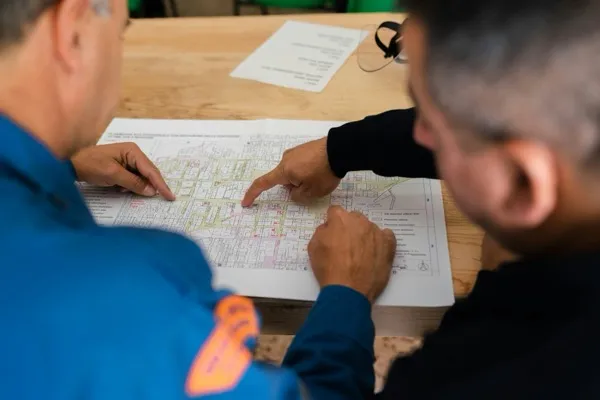

A BIM coordinator opens Monday's federated model clash report. The number reads 1,200. Roughly half are noise. Sorting which is which will eat the next two days. That triage is where AI in Revit-based building information modeling pays off this fiscal year, ahead of generative modeling.
The vendor demos this year are heavy on AI generating buildings overnight. The Monday-morning reality is heavier on coordinators scrolling through Navisworks reports separating relevant conflicts from clearance margins and duct trims their teams will never resolve. Peer-reviewed research now puts a number on the gap: approximately half of clashes flagged by automated tools are not truly relevant1. That is the AI opportunity hiding in plain sight.
The investment in AI that pays back this fiscal year isn't upstream of Revit. It's downstream, in the clash triage layer your firm already owns. To see why, look at where Revit sits in the BIM workflow.
BIM in Revit: How the Workflow Runs Today
Building information modeling in Revit is the discipline where architects, structural engineers, and MEP engineers each build their portion of a project's 3D model in Autodesk Revit, then federate those models together— typically in Navisworks or Autodesk Construction Cloud Model Coordination— to detect and resolve geometric conflicts between disciplines. Revit is the authoring environment. Navisworks, Autodesk Construction Cloud Model Coordination, and Revizto are the coordination environments. Clashes happen between disciplines, which means they happen downstream of Revit.
The federated model is the project's source of truth. Clash triage is the workflow that protects it.
Most $20M–$100M AEC firms run some version of this chain every project:
| Layer | Tool | Function |
|---|---|---|
| Authoring | Revit | One discipline per file— architecture, structure, MEP |
| Federation | Navisworks | Combines discipline models for clash testing |
| Cloud federation | Autodesk Construction Cloud Model Coordination | Cloud-based clash detection across multi-format models2 |
| Third-party coordination | Revizto, BIMcollab, Solibri | BCF-based coordination across mixed-tool teams3 |
Clashes come in three flavors, and the distinction matters for triage:
- Hard clashes— geometric collision, two solids occupying the same space.
- Soft clashes— clearance or access violations within a tolerance buffer.
- Workflow clashes— sequencing or constructability conflicts that don't show as geometry.
BCF (BIM Collaboration Format) is the open standard that lets third-party tools talk to Revit and Navisworks. BIMcollab, Solibri, and Revizto all use it3. With the workflow grounded, the question of where AI pays off becomes a question of which step in this chain has the most waste.
Where AI Hype Meets Production Reality
Most AI-in-Revit marketing focuses on generative modeling— buildings designed overnight, MEP runs auto-routed, agentic systems sketching options at scale. In production, that's still a three-to-five-year horizon for most firms. The AI capability shipping today lives in a less glamorous place: filtering the noise out of clash reports.
The market context backs this up. Only 27% of AEC firms currently use AI for automation, problem-solving, or decision-making, and 94% of those that do plan to expand their use in 20264. Eighty-four percent of firms plan to increase overall technology investment in the year ahead5. Demand exists. Production-ready tools for the modeling layer don't, yet.
The structural reason is worth naming. AI-generated Dynamo scripts often look plausible but reference nonexistent Revit API nodes— the hallucination problem that defines today's generative AI ceiling inside Revit6. And Revit itself was designed for document production, not as an execution substrate for autonomous AI systems that continuously recompute design against multiple constraints7. This isn't a software flaw. It's an architectural choice from a tool built before agentic systems existed.
That leaves three tiers where AI in Revit workflows is realistic right now:
- Clash triage in the coordination layer— mature research, production tooling shipping.
- Documentation automation inside Revit— sheet sets, schedules, annotation cleanup.
- Narrow agentic systems that export into Revit— upstream tools doing discipline-complete work.
Of those three tiers, one has both mature peer-reviewed research and an existing toolchain in nearly every AEC firm. That's where the clash triage thesis lands.
The Real AI Use Case in Revit Workflows Is Clash Triage
The highest-ROI AI deployment in Revit-based workflows today is clash triage in the coordination layer— filtering relevant clashes from noise inside Navisworks, Autodesk Construction Cloud Model Coordination, or Revizto. Peer-reviewed research finds that approximately 50% of detected clashes are not truly relevant, and machine learning models can replicate the BIM coordinator's relevance judgment with over 80% accuracy and F1 score1.
"In testbed projects, approximately 50% of detected clashes were found to be truly relevant and required resolution."1
That figure has independent corroboration. A 2019 MDPI paper first established the irrelevant-clash filtering problem and demonstrated a hybrid approach combining rule-based reasoning with supervised machine learning8. The 2024 ASCE work pushed accuracy past 80% F19. The 2025 ScienceDirect study shipped an actual Navisworks plug-in1. This isn't a research direction. It's a research finding with a deployable expression.
In practical terms, what makes this a strategic bet rather than a technical curiosity is where the work happens. The AI sits downstream of Revit, in tools the firm already owns— Navisworks licenses every BIM shop pays for, Autodesk Construction Cloud subscriptions already on the books, third-party platforms most firms have evaluated. Nothing has to be ripped out. Nothing has to be retrained from scratch. The deployment surface is the existing coordination stack.
And the framing matters: AI in the clash triage layer is intellectual augmentation of the BIM coordinator. The coordinator still makes the resolution call. The AI just stops them from spending two days deciding which 600 of 1,200 clashes deserve attention. Coordinators stay the protagonists of the workflow; the model is a filter, not a replacement. Both are true— the AI does real work and the human stays in the loop— and that's why the deployment is realistic instead of theoretical.
The economics behind that figure explain why coordinator hours are the wrong thing to keep burning.
The Economics— Why Coordinator Hours Are the Wrong Thing to Burn
U.S. construction loses approximately $177 billion per year in labor costs to non-productive activities, with $31.3 billion of that tied specifically to poor project data and miscommunication10. Clash triage noise sits squarely inside that figure. The headline number is from FMI/Autodesk's 2018 Construction Disconnected report; figures likely understate today's cost given construction inflation since 2018, but the structural finding hasn't changed.
| Category | Annual U.S. cost | Share of rework |
|---|---|---|
| Total non-productive labor | ~$177B | — |
| Poor data + miscommunication | $31.3B | combined |
| Poor communication | $17B | 26% of rework |
| Inadequate project data | $14.3B | 22% of rework |
That cost shows up in time. Construction professionals report spending roughly 14 hours per week on non-productive activities11. Per the FMI breakdown:
- 5.5 hours searching for project data
- 5 hours managing stakeholder disagreements
- 4 hours assessing rework costs and causes
Not all 14 hours are clash triage. Be honest with the number: it covers the full non-productive bucket, not just coordination. But every category in that breakdown compounds when a coordinator can't trust their clash report. Searching for data, managing disagreements, assessing rework— all of it gets worse when half the conflicts on the screen are noise.
The other side of the ledger is starting to fill in. Of AEC firms that have invested in AI, 68% report saving at least $50,000, and 46% have reclaimed 500 to 1,000 hours from AI tools4. That's not a future projection. That's early-adopter performance today. The math justifies the investment. The research justifies the specific bet.
The Research Is Mature; The Tooling Is Just Shipping
Peer-reviewed machine learning research on clash relevance prediction is mature. Artificial neural networks and support vector machines have achieved greater than 80% accuracy and F1 score on the task, with precision up to 88%9. Production-grade plug-ins are just beginning to ship. The strategic move for AEC firms is to be ready to deploy when they arrive.
| Year | Source | Approach | Headline result |
|---|---|---|---|
| 2019 | MDPI Applied Sciences8 | Hybrid rule-based + supervised ML | First framing of irrelevant-clash filtering problem |
| 2024 | ASCE9 | ANN and SVM | >80% accuracy and F1; precision up to 88% |
| 2025 | ScienceDirect (Automation in Construction)1 | Ensemble of three ML models (MLP, Random Forest, XGBoost) | Navisworks plug-in for clash classification and prioritization |
This is a research line that's been building toward deployable tooling for six years. The 2025 ScienceDirect paper isn't just a model; it's a plug-in that operates inside the coordination environment most firms already use.
The concession matters as much as the research.
These are still primarily academic testbeds. Production-grade Navisworks plug-ins from major vendors are early. The firms that win when those tools mature in 12 to 18 months are the firms that built clean clash classification data discipline today— not the firms that buy the first plug-in. The data that gets a firm ready is unglamorous: clean, consistent records of how your coordinators classified past clashes. Relevant vs. irrelevant. Resolved vs. ignored. Most firms have this scattered across PMs in inconsistent formats. Fixing that is the prep work the next 18 months reward.
The strongest counter-example is worth meeting head-on.
What About Generative AI? The Augmenta Exception
Augmenta's agentic design platform automated electrical raceway routing on Mt. Hope Elementary School in Lansing, Michigan, delivering 25% faster design, 15% less material waste, and over 100 hours saved in the design phase12. This is real generative AI producing measurable AEC results. And it does not contradict the clash triage thesis, because Augmenta operates outside Revit and exports into Revit workflows.
"We witnessed remarkable time savings of over 100 hours in the design phase, and our prefabrication-ready drawing time was cut down by a full month." — Kyle Sponseller, President, C&R Electric (Mt. Hope Elementary project)12
Augmenta's Construction Platform is a fully agentic design environment that automates electrical raceway routing and coordination, generates clash-free routes that account for spacing rules, clearances, and code requirements, and integrates with Revit workflows13. Critically, it doesn't run inside Revit's modeling environment. It solves a discipline-complete problem upstream and pushes the result into the Revit pipeline.
That's the distinction worth holding. Clash triage AI lives in the coordination layer your firm already owns and works cross-discipline. Augmenta-style agentic AI lives upstream, solves narrow discipline-specific problems, and exports. Both are real. Both ship today. They're different deployments on different time horizons, and the AI implementation strategy for an operations-heavy AEC firm has room for both. The 2026 budget question isn't pick one. It's sequence them correctly.
For a $20M–$100M AEC firm trying to make a 2026 budget decision, the question becomes: how do you deploy without burning trust?
A Deployment Playbook for $20M–$100M AEC Firms
For a $20M–$100M AEC firm, deploying AI in Revit workflows in 2026 means three sequential moves: clean up your clash classification data discipline before buying any AI tooling, pilot AI in the coordination layer rather than the modeling layer, and measure coordinator hours recovered as the headline KPI.
Better thinking on the data layer is what makes the AI layer work. Tool selection is the easy part. Data discipline is the moat.
1. Data discipline first. Standardize how your firm classifies clashes— relevant vs. irrelevant, resolved vs. ignored, hard vs. soft vs. workflow. This is the training data the ML models will need. Most firms have it scattered across PMs in project-specific spreadsheets, BCF exports, and tribal knowledge. Centralize it. Make the schema consistent across projects. This is the work that nobody markets and that determines whether your AI deployment lands in 2027.
2. Pilot in coordination, not modeling. Pick one project with heavy MEP coordination. Deploy a clash-relevance approach in Navisworks or Autodesk Construction Cloud Model Coordination2— rule-based filters first, then ML as production plug-ins ship. Keep the coordinator in the resolution loop. AI ranks; human decides. This isn't a research project; it's a workflow change with a small footprint and a clear pre/post measurement window.
3. Measure coordinator hours recovered. Headline KPI: hours of triage work avoided per clash report. Secondary KPIs: resolution cycle time, RFI volume during construction. Avoid vanity metrics like "clashes detected." More clashes detected isn't the goal. Fewer hours spent triaging is. Treat this like any other operational metric: baseline first, deploy second, measure quarterly. See our guide to measuring AI success for the broader KPI framework.
What not to do:
- Don't bet the 2026 budget on generative modeling inside Revit— high hallucination risk, low ROI.
- Don't deploy AI inside Revit's modeling environment as a first move— the substrate isn't ready7.
- Don't chase the "60% time reduction" claim that circulates without a primary source— use the peer-reviewed >80% F1 figure instead.
- Don't buy a tool before the data is clean. The first plug-in only works if your historical clash records are trustworthy. This is one of the hidden costs of AI projects most firms underestimate.
The $20M–$100M frame matters because it's the sweet spot. Large enough to invest in workflow infrastructure. Small enough that the coordinator team feels the pain personally and adoption isn't a governance project. Larger firms have bottlenecks. Smaller firms don't generate the data volume. Firms in this range can move. For more on the underlying decision framework, see our AI decision framework for founders.
FAQ— Building Information Modeling Revit and AI
What is BIM in Revit, in practice?
Building information modeling in Revit is the practice of authoring a coordinated 3D project model in Autodesk Revit and federating it with other disciplines in Navisworks, Autodesk Construction Cloud Model Coordination, or third-party tools like Revizto. The federated model is the project's source of truth for clash detection and coordination across architecture, structure, and MEP23.
What percentage of clashes in a Revit/Navisworks report are false positives?
Peer-reviewed research finds approximately 50% of clashes detected by automated BIM coordination tools are not truly relevant and do not require resolution1. Practitioner blogs often cite higher figures (60% or more) without primary sources— the academic figure is the better-sourced version of the same insight, established in the 2019 MDPI literature and replicated in 2024 and 2025 work8.
Can AI generate Revit models reliably today?
Not yet at production scale inside Revit's modeling environment. AI-generated Dynamo scripts have been documented to reference nonexistent Revit API nodes6, and Revit was designed for document production rather than as a substrate for autonomous agents7. Narrow agentic systems like Augmenta produce real results in specific disciplines (electrical raceway routing, for example) but they operate outside Revit and export into it13. For more on what narrow agentic systems do, see what is an AI agent.
What tools support AI-assisted clash detection in Revit workflows?
Autodesk Construction Cloud Model Coordination provides automated clash detection and classification across multi-discipline models2. Navisworks supports research-grade ML plug-ins, including the 2025 ScienceDirect ensemble plug-in1. Revizto and BIMcollab integrate via BCF for federated coordination3. Augmenta operates upstream as a generative agentic platform that exports to Revit13.
How accurate is machine learning at predicting clash relevance?
Peer-reviewed research has shown artificial neural network and support vector machine models achieving greater than 80% accuracy and F1 score on clash relevance prediction, with precision up to 88%9. A 2025 study using an ensemble of MLP, Random Forest, and XGBoost models shipped a Navisworks plug-in implementing this approach1.
What is the rework cost at stake in BIM coordination?
The U.S. construction industry loses approximately $177 billion per year in non-productive activity labor cost, with $31.3 billion specifically attributable to poor project data and miscommunication, according to FMI and Autodesk's Construction Disconnected research10. That data is 2018; figures likely understate today's cost given construction inflation, but the structural finding holds— improvements in clash triage directly address the data and communication portion of that figure.
AI in Revit ≠ AI for Revit Workflows
AI in Revit and AI for Revit workflows are different problems. The first is hard and unsolved at production scale. The second is where AI is shipping today— in the coordination layer downstream of Revit, in tools your firm already owns, on a problem (clash triage) that costs your coordinators days every month.
"The disruption from AI isn't the software; it's the shift toward project autonomy... driven by the owner's internal requirements." — Brett Goodchild, Target (cited in AEC Magazine)14
Firms that build clean clash classification data discipline today are positioned to deploy when production tools mature in 12 to 18 months. Firms that wait for the perfect plug-in will spend 2027 catching up. The bet isn't on which vendor wins. It's on whether your historical clash records can train whatever wins.
If your firm is sizing up where to invest AI budget in 2026 without betting on a generative-modeling demo, that's exactly the conversation Dan Cumberland Labs is built for. We help AEC operations leaders map AI investments to the workflow steps that pay back— starting with the ones already inside your stack.
References
- Automation in Construction (Elsevier / ScienceDirect), "Automating clash relevance filtering in BIM-based multidisciplinary coordination using machine learning" (2025)— https://www.sciencedirect.com/science/article/pii/S0926580525006843
- Autodesk, "Clash Detection Software | Autodesk Construction Cloud / Forma" (2026)— https://construction.autodesk.com/tools/clash-detection/
- BIMcollab, "Clash Detection for BIM Coordination & Model Quality" (2026)— https://www.bimcollab.com/en/clash-detection-in-bim/
- Bluebeam (Nemetschek Group), "New Bluebeam Report Shows Early AI Adopters in AEC Seeing Significant ROI Despite Uneven Adoption (Building the Future: Bluebeam AEC Technology Outlook 2026)" (2025)— https://press.bluebeam.com/2025/10/new-bluebeam-report-shows-early-ai-adopters-in-aec-seeing-significant-roi-despite-uneven-adoption/
- Bluebeam (Nemetschek Group), "Building the Future: Bluebeam AEC Technology Outlook 2026" (2025)— https://press.bluebeam.com/2025/10/new-bluebeam-report-shows-early-ai-adopters-in-aec-seeing-significant-roi-despite-uneven-adoption/
- Archilabs, "What AI Can and Can't Do in Revit Today: A Clear Guide" (2026)— https://archilabs.ai/posts/what-ai-can-and-cant-do-in-revit-today-a-clear-guide
- AEC Magazine (Martyn Day), "The agentic future of BIM" (2026)— https://aecmag.com/features/the-agentic-future-of-bim/
- MDPI Applied Sciences, "Filtering of Irrelevant Clashes Detected by BIM Software Using a Hybrid Method of Rule-Based Reasoning and Supervised Machine Learning" (2019)— https://www.mdpi.com/2076-3417/9/24/5324
- American Society of Civil Engineers (ASCE), "Clash Relevance Prediction in BIM Model Coordination Using Artificial Neural Network" (2024)— https://ascelibrary.org/doi/10.1061/9780784485262.014
- Autodesk / FMI Corporation / PlanGrid, "Construction Disconnected: The High Cost of Poor Data and Miscommunication" (2018)— https://www.autodesk.com/blogs/construction/construction-disconnected-fmi-report/
- Construction Dive (citing FMI / PlanGrid), "Industry could be overspending $177B per year, study finds" (2018)— https://www.constructiondive.com/news/industry-could-be-overspending-177b-per-year-study-finds/529450/
- AEC Magazine, "Agentic AI accelerates electrical design" (2025)— https://aecmag.com/mep/agentic-ai-accelerates-electrical-design/
- AEC Magazine, "Agentic AI accelerates electrical design"— Augmenta Construction Platform description (2025)— https://aecmag.com/mep/agentic-ai-accelerates-electrical-design/
- AEC Magazine, "The agentic future of BIM"— Brett Goodchild (Target) quote (2026)— https://aecmag.com/features/the-agentic-future-of-bim/