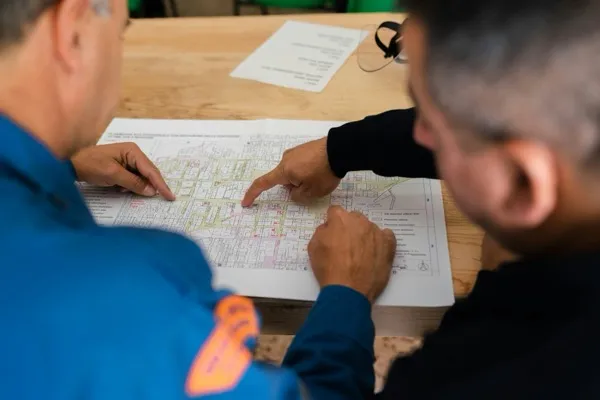

Building construction engineering is one of the most practical branches of the engineering world, and one of the most frequently confused with its neighbors. This guide explains what the discipline is, what a construction engineer does day to day, how it differs from civil engineering and construction management, what the path and pay look like, and how digital tools are beginning to reshape the work. If you're choosing a major, changing careers, or just trying to make sense of the title, you'll leave with a clear answer.
What Is Building Construction Engineering?
Building construction engineering is a professional sub-discipline of civil engineering focused on the planning, methods, cost, scheduling, and on-site management of constructing buildings and infrastructure.1 It pairs the engineering design knowledge of civil engineering with the practical, project-focused work of construction management— the job of getting a real structure built on time and on budget.3
Put plainly, construction engineering is where engineering design meets the realities of the job site. If civil engineering asks "will it stand?", construction engineering asks "how do we actually build it— on time and on budget?"
The "infrastructure" a construction engineer helps create covers far more than office towers and apartment blocks. The discipline spans a wide range of projects:
- Buildings and facilities
- Roads, highways, and bridges
- Tunnels, railroads, and airports
- Dams, utilities, and other large infrastructure
That breadth is part of the appeal. A construction engineer might spend one phase of a career on a hospital and the next on a transit line.
And the work itself is changing. Projects that once ran on paper drawings and spreadsheets are increasingly planned with digital models and generative design tools— a shift this guide returns to in detail later on. Definition in hand, here's what that looks like day to day.
What Does a Construction Engineer Do?
A construction engineer oversees the on-site execution of a project— keeping it on schedule, within budget, and to specification— while applying the engineering design knowledge a pure project manager typically lacks.2 Their top priority, in the words of one university engineering program, is to complete the job "on time, on budget, and to the highest possible standard."2
The role lives at the intersection of the drafting table and the dirt. A construction engineer's job is to turn a design on paper into a finished structure, managing methods, cost, schedule, and people along the way.1
Day to day, that work tends to cover:
- Construction methods— choosing how a structure gets built
- Cost estimation— pricing materials, labor, and equipment, then holding the budget
- Scheduling— sequencing the work so trades don't collide and deadlines hold
- Staffing and personnel— coordinating crews, subcontractors, and site teams
- Quality and safety— making sure what gets built matches the design and code
Construction engineers do this work on building sites, large infrastructure projects, and facilities of every kind. The role demands a specific blend: technical engineering knowledge, real project-coordination skill, and the communication to keep a crowded job site moving. Strong on the math but unable to talk to a foreman? You won't last.
That description sounds a lot like several other job titles— which is exactly why the field gets confused with its neighbors. Here's how to tell them apart.
Construction Engineering vs Civil Engineering vs Construction Management vs Architectural Engineering
Construction engineering is one of several closely related disciplines, and the differences are real. In short: civil engineers focus on analytical design, construction engineers focus on building it, construction managers focus on coordinating the build, and architectural engineers focus on a building's internal systems.
Here's the cleaner breakdown.
Civil engineering— the parent discipline. Primary focus is analysis, design, and planning of infrastructure. Civil engineering students concentrate on analytical design; construction engineering is one sub-discipline beneath that broad umbrella.2 Key difference: a civil engineer answers whether a structure will work; a construction engineer makes it happen.
Construction engineering— building it. Primary focus is on-site execution and management. Construction engineers receive training in techniques, methods, costs, scheduling, and staff management, and they carry engineering design knowledge into the field.2 Key difference: the engineering depth, applied to the act of construction itself.
Construction management— coordinating the build. Primary focus is coordination and execution: budgets, timelines, contracts, and crews. Construction engineering merges the technical foundation of civil engineering with the project-focused skills of construction management, and the engineer holds technical design knowledge a manager typically does not.3 Key difference: a construction manager doesn't necessarily hold a Professional Engineer license; a construction engineer often pursues one.1
Architectural engineering— the building's internal systems. Primary focus is the systems inside a structure: heating and cooling, electrical, plumbing, lighting, and fire protection. Key difference: architectural engineers make a building work for the people inside it, rather than directing the construction of the whole.
One more thing worth clearing up. It's common to see "construction engineering," "building engineering," and "construction management" used as if they're synonyms. They overlap, and they aren't interchangeable. The clearest dividing line is engineering design depth: the construction engineer carries technical knowledge the construction manager generally does not.3 If construction engineering is the discipline you want, here's the path to practicing it.
How to Become a Construction Engineer: Education and Licensure
Becoming a construction engineer in the U.S. typically means earning an ABET-accredited engineering bachelor's degree, passing the Fundamentals of Engineering (FE) exam, gaining supervised work experience, and— for senior roles— earning a Professional Engineer (PE) license. An ABET-accredited engineering degree is the standard on-ramp to PE licensure in U.S. states.5
ABET, the Accreditation Board for Engineering and Technology, recognizes construction engineering as a distinct accredited engineering discipline, and the program name must include the word "engineering."5 That accreditation matters because it's what makes you eligible for licensure down the line.
The pathway looks like this:
- Earn an ABET-accredited engineering bachelor's degree in construction engineering or a closely related field.5
- Pass the Fundamentals of Engineering (FE) exam, usually taken near graduation— the first formal step toward licensure.
- Gain supervised work experience (commonly around four years) under a licensed Professional Engineer.
- Pass the Principles and Practice of Engineering (PE) exam to earn the Professional Engineer (PE) license. Construction engineering is a recognized PE practice area with its own licensure path.6
Here's the honest nuance most program pages skip: not every construction engineering role requires a PE. Plenty of capable engineers work for years without one. But signing off on designs does require it— a PE is needed for senior responsibilities like stamping temporary-structure designs.1 A construction engineering degree gets you in the door; the PE is what lets you take final responsibility. Path mapped. Now the question every prospective engineer wants answered: what does it pay, and is demand growing?
Construction Engineer Salary and Job Outlook
Construction engineers in the U.S. fall under the Bureau of Labor Statistics "Civil Engineers" category, which reported a median annual wage of $99,590 in May 2024.4 Employment in that category is projected to grow 5 percent from 2024 to 2034— faster than the average for all occupations— with about 23,600 openings each year over the decade.4
The headline numbers, at a glance:
- Median pay: $99,590 per year (Civil Engineers, May 2024)4
- Projected growth: 5% from 2024 to 2034 (faster than average)4
- Annual openings: about 23,600 per year over the decade4
A note on the numbers, because it trips people up. "Construction engineer" is not a separate occupational code at the BLS— the field maps to the broader Civil Engineers category. Job-board figures for the specific "construction engineer" title often run lower than the BLS median, and the reason is structural: those self-reported figures track a narrower job title, not the full Civil Engineers occupational code. When two salary numbers disagree, the BLS figure is the authoritative anchor.
The takeaway is simple. It's a stable, well-compensated field with steady demand, much of it tied to ongoing infrastructure investment.
Salary and outlook tell you the field is stable. What they don't capture is how fast the actual work is changing.
How AI and Digital Tools Are Reshaping Construction Engineering
Construction engineering is being reshaped by digital tools— building information modeling (BIM), digital twins, and generative design— though adoption is real, early, and uneven. The technology is changing how engineers plan and coordinate work, and it amplifies the judgment of the engineers who direct it.
Why is the field ripe for change? A 2017 McKinsey Global Institute analysis7 found that global labor-productivity growth in construction had averaged only about 1 percent a year over the previous two decades, compared with 2.8 percent for the total world economy and 3.6 percent in manufacturing.7 There's a lot of room to improve.
Three tools are doing most of the early work:
- BIM (building information modeling)— a shared 3D digital model of a project that lets teams catch clashes and coordinate before anyone breaks ground.
- Digital twins— a living digital replica of a structure, fed by design and sensor data, used to monitor and predict how it performs over time.
- Generative design— software that proposes and tests many design options against set constraints, narrowing the field for the engineer to decide.
The wins are concrete. A 2024 Caltrans pilot that used BIM for a landslide-stabilization project saved $520,000 through digital modeling efficiency, according to the American Society of Civil Engineers (ASCE).8 AI is starting to sit on top of this work, too— one University of Illinois researcher described AI as becoming "the co-pilot for digital twins."8
The friction is just as real, and it's worth being honest about. The hard part of digital twins is the data: integrating design models, sensors, and decades-old records without losing any of it— and getting a workforce ready to use them. Adoption stays uneven for exactly these reasons. Even so, one market report projects the construction design software market growing from $9.9 billion in 2024 to $15.4 billion by 2030, a 7.7% annual growth rate driven by BIM, AI, and cloud collaboration.9
So will automation reduce demand for construction engineers? The honest read is that AI here is intellectual augmentation— it amplifies an engineer's judgment. Clash detection, scheduling, and workflow automation handle the repetitive coordination; deciding what to build, and how to build it safely, still belongs to people. For firms working out how to put these tools to work, the gap between owning the software and changing how teams operate is the real project.
Frequently Asked Questions
Is construction engineering the same as civil engineering?
No. Construction engineering is a sub-discipline of civil engineering focused on building and executing projects on site, whereas civil engineering more broadly covers analysis and design.1 Civil engineers tend to concentrate on analytical design; construction engineers concentrate on on-site management and execution.2
Do you need a PE license to be a construction engineer?
Not for every role. A Professional Engineer (PE) license— earned via an ABET-accredited degree, the FE exam, supervised experience, and the PE exam— is required for senior responsibilities like signing off on designs.5 Plenty of construction engineers work without one, but a PE is what lets you take final responsibility for a design.1
How much do construction engineers make?
Under the BLS Civil Engineers category, median pay was $99,590 in May 2024.4 Job-board figures for the specific "construction engineer" title often run lower, because they track a narrower job title rather than the full occupational code the BLS uses.
Is a construction engineering degree worth it?
For most people considering it, yes. The field offers above-average pay and steady projected growth of 5 percent from 2024 to 2034, with demand tied to ongoing infrastructure investment.4 It's a stable career with clear advancement once you add a PE license.
How is AI changing construction engineering?
Through BIM, digital twins, and generative design. Early results are promising— a 2024 Caltrans BIM pilot saved $520,000— but adoption is uneven due to data-integration and workforce-readiness challenges.8 The technology is changing how engineers plan and coordinate, and it amplifies the engineer rather than replacing them.
Conclusion
Building construction engineering is the discipline that turns engineering design into finished structures— a stable, well-paid field that's being reshaped by digital tools. For someone choosing a major or a career, it offers above-average pay, steady demand, and work that's getting more interesting as BIM and AI move into the day-to-day.
The engineers who thrive over the next decade will be the ones who learn to direct these tools. And for the smaller group reading this who run AEC firms— firms weighing how to adopt BIM, digital twins, or AI without a year of false starts— that learning curve is exactly the kind of thing an implementation partner for founder-led firms can help shorten.
References
- Wikipedia, "Construction engineering" (last edited Feb 2026) — https://en.wikipedia.org/wiki/Construction_engineering
- Ohio University, "What is Construction Engineering?" (2023) — https://www.ohio.edu/engineering/civil/graduate/master-science-civil-engineering-online/resources/what-construction-engineering
- LSU Online, "What is Construction Engineering?" (2026) — https://online.lsu.edu/newsroom/articles/what-is-construction-engineering/
- U.S. Bureau of Labor Statistics, "Civil Engineers," Occupational Outlook Handbook (data as of May 2024) — https://www.bls.gov/ooh/architecture-and-engineering/civil-engineers.htm
- ABET, "What Programs Does ABET Accredit?" (2025–2026) — https://www.abet.org/accreditation/what-is-accreditation/what-programs-does-abet-accredit/
- American Society of Civil Engineers, "Construction Engineering PE Guide" (PDF) — https://www.asce.org/-/media/asce-images-and-files/communities/institutes-and-technical-groups/construction/documents/construction-engineering-pe-guide.pdf
- McKinsey Global Institute, "Reinventing Construction: A Route to Higher Productivity" (February 2017) — https://www.mckinsey.com/capabilities/operations/our-insights/reinventing-construction-through-a-productivity-revolution
- American Society of Civil Engineers, "Digital twins show great promise in civil engineering. But what's next?" (November 10, 2025) — https://www.asce.org/publications-and-news/civil-engineering-source/article/2025/11/10/digital-twins-show-great-promise-in-civil-engineering-but-whats-next
- ResearchAndMarkets.com via BusinessWire, "Construction Design Software Global Strategic Research Report 2025–2030" (October 7, 2025) — https://www.businesswire.com/news/home/20251007637986/en/Construction-Design-Software-Global-Strategic-Research-Report-2025-2030-BIM-Adoption-AI-Integration-Digital-Twins-and-Cloud-Collaboration-Drive-Global-Growth---ResearchAndMarkets.com