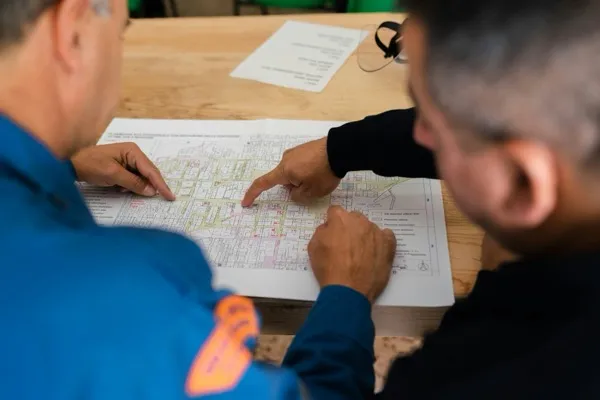

As-built documentation is the drawings and data showing how a building was constructed rather than how it was designed, and it's one of the most error-prone, time-consuming handoffs in construction. Rework and conflict resolution cost the U.S. construction industry more than $177 billion annually3, and a significant share of that traces back to documentation that doesn't match reality.
If you run a construction firm, you already know the frustration. Red-lined drawings that missed half the field changes. Closeout binders that arrive incomplete. Facility managers calling six months later because the MEP routing doesn't match what was documented. That frustration isn't a workflow problem. It's a data problem.
AI is changing this— not someday, but now. Laser scanning, computer vision, and automated scan-to-BIM workflows are making it possible to capture what was built with a level of accuracy and speed that manual processes can't touch. And the firms adopting these tools early aren't just saving time. They're building a competitive advantage while the rest of the industry is still red-lining.
This article covers what's broken, what's changing, what the ROI looks like, and how to start.
What Is As-Built Documentation?
As-built documentation is a set of drawings or 3D data showing exactly how a building was constructed— every modification, deviation, and change order that happened between the original design and final delivery1. No project gets built exactly as planned. Budget constraints, scheduling conflicts, and unforeseen site conditions create a gap between design intent and built reality1. As-built documentation captures that gap.
Several groups depend on accurate as-builts:
- Facility managers need them for maintenance planning and operations
- General contractors need them for compliance and legal protection
- Building owners need them for asset records and insurance
- Future service providers need them for renovations, repairs, and retrofits2
The industry standard is LOD 500 (Level of Development 500), defined by the AIA and BIM Forum as the as-built benchmark— the point where a BIM model reflects actual construction, not just design intent56. On BIM-mandated projects, contractors are typically required to deliver at this level as part of closeout5.
Traditionally, this meant red-lining 2D CAD drawings by hand. Increasingly, it means delivering a 3D BIM model. But regardless of format, the challenge remains the same: capturing reality accurately when the people doing the capturing are already stretched thin.
The Real Cost of Getting As-Built Documentation Wrong
Rework costs the U.S. construction industry more than $177 billion annually3. That's not a typo. And inaccurate documentation is a primary driver— responsible for roughly 22% of all rework, or approximately $31 billion per year4.
The numbers break down like this:
| Rework Cause | % of All Rework | Estimated Annual Cost |
|---|---|---|
| Miscommunication | 26% | ~$46B |
| Inaccurate/inaccessible information | 22% | ~$31B |
| Bad data quality | 14-22% | ~$25-39B |
Source: PlanRadar / Construction Industry Institute1
According to the Construction Industry Institute, rework accounts for 2-20% of total project costs, with an industry average around 12%4. And it's not just money. Rework consumes up to 20% of total project time4.
Meanwhile, 60% of general contractors identify coordination and communication problems as key contributors to decreased labor productivity15. The pattern is clear: bad documentation creates bad communication, which creates rework, which burns budget and schedule.
And the downstream impact compounds. Facility management teams receive "outdated, erroneous, incomplete, and irrelevant data in inconsistent formats"14. Many companies don't even have their assets inventoried in an organized database14. When the FM team inherits bad as-builts, they inherit the problems for the life of the building.
How AI Is Transforming As-Built Documentation
AI is automating the three most labor-intensive parts of as-built documentation: capturing physical reality, detecting defects and deviations, and converting raw scan data into usable BIM models. Here's how each layer works.
Laser Scanning and Drone Capture
Laser scanners create 3D point clouds by recording millions of measurements positioned on X, Y, and Z axes2. The result is a precise digital replica of the built environment— accurate to the centimeter and free from the manual measurement errors that plague traditional documentation2. And unlike a tape measure, it doesn't depend on who's holding it.
Drones take this further. With LiDAR and RTK GPS, drones deliver data precise to 1-2 centimeters of accuracy2. According to DroneDeploy, a single drone can capture a 100-acre site in under an hour8. That's the kind of speed and coverage that wasn't possible five years ago.
For firms exploring how AI connects to broader workflow automation, this is a clear example of the pattern: AI handles capture and processing, humans handle interpretation and judgment.
Computer Vision for Defect Detection
Computer vision can analyze thousands of construction site images in minutes, detecting structural problems like cracks, corrosion, and misalignment that human inspectors might miss10. For firms running multiple active projects, this means catching issues at the speed of documentation— not the speed of site walkthroughs.
But the technology isn't theoretical. Automated defect detection during active construction is already being deployed on projects— catching issues before they become expensive rework10.
Automated Scan-to-BIM Workflows
Scan-to-BIM is the process of digitally capturing a physical space using laser scanning, then converting that point cloud data into a Building Information Model2. Traditionally, this conversion required significant manual modeling work.
But AI is changing the equation. Machine learning algorithms are demonstrating strong accuracy in identifying common building elements within point clouds2— walls, columns, pipes, ducts— reducing the manual modeling that used to take weeks.
In practical terms, that means your team spends less time building models from scratch and more time verifying the model reflects what's on site. Early evidence suggests this kind of automation can reduce project duration by 15% and cut rework costs by 20%13.
This is the core of the transformation: scan reality, let AI process the data, deliver a usable BIM model at LOD 500.
AI Tools Leading the As-Built Documentation Transformation
Several AI-powered platforms are actively transforming as-built documentation workflows, each with a different approach. Here's what's available right now.
| Tool | Approach | Key Feature | Best For |
|---|---|---|---|
| OpenSpace | 360° hard hat cameras | AI maps photos to plans in real-time | Progress tracking, site documentation |
| Buildots | 360° site capture | AI compares images to BIM models | BIM compliance, discrepancy detection |
| DroneDeploy | Drone mapping | Orthomosaic maps, AI progress tracking | Large-site surveys, aerial documentation |
| Reconstruct | Point cloud alignment | Sub-inch accuracy overlay on design | Precision verification, stakeholder reporting |
| HoloBuilder | 360° photos + robotics | SpotWalk robot (Boston Dynamics) | Autonomous site capture, 3D archives |
OpenSpace, valued at $902 million7, uses a 360° camera fitted on hard hats with photos captured every half-second, automatically tied to project plans using AI7. Workers just walk the site. The system does the rest.
Buildots takes a different approach— using AI to compare captured images against BIM models and project schedules, automatically detecting discrepancies and tracking work completion7. Think of it as automated BIM compliance checking.
DroneDeploy brings domain-specific AI to drone mapping, automating site monitoring by analyzing visual data from routine flights8. Reconstruct offers a Visual Command Center with sub-inch accuracy by aligning reality on top of design9. And HoloBuilder partnered with Boston Dynamics to create SpotWalk, a robotic site capture solution using the Spot robot7.
The construction documentation AI market has matured past the pilot stage— multiple proven platforms exist, each addressing a different part of the workflow from site capture to BIM compliance. The question for leadership is which workflow pain point to solve first, not whether the technology works.
Why Most Construction Firms Haven't Made the Switch Yet
Despite clear benefits, only 27% of architecture, engineering, and construction professionals currently use AI in their operations12. Less than 1% report fully embedded, organization-wide adoption11. The barriers are real.
| Barrier | % of Firms Citing | Source |
|---|---|---|
| Lack of skilled personnel | 46% | RICS 2025 |
| Data-sharing security | 42% | Bluebeam |
| Cost and complexity | 33% | Bluebeam |
| Data privacy concerns | 25.7% | Bluebeam |
| Rapidly changing technology | 23% | RICS 2025 |
| Lack of integration with existing tools | 22.8% | Bluebeam |
Source: RICS 2025 AI in Construction Report2, Bluebeam survey
The skills gap is the biggest factor. Nearly half of all firms (46%) cite lack of skilled personnel as their primary barrier to AI adoption11. And 69% say uncertainty around potential AI regulations has affected their implementation plans11. When you understand the hidden costs of AI projects and the reality of building an AI-ready culture, the slow adoption makes sense.
But here's the counter-signal worth paying attention to: 94% of construction professionals already using AI plan to increase their usage in 202612. The early movers aren't looking back.
Both things are true. The barriers are real, AND the technology works. Adoption is slow, AND the firms that have started are doubling down. The question for leadership isn't whether AI will change documentation. It's whether you want to explore it on your terms or scramble to catch up later.
How to Start Implementing AI-Powered As-Built Documentation
Start with a focused pilot, not a firm-wide overhaul. The firms that succeed with AI implementation follow a clear pattern: audit, quantify, test, then scale.
- Audit your current process. How are as-builts created today? Red-lining? 2D CAD? Where do errors enter the workflow? You can't fix what you haven't examined.
- Quantify the pain. Calculate your actual rework costs. Use the 12% industry benchmark against your project budgets as a starting point. What would a 20% reduction mean to your bottom line?
- Evaluate 2-3 vendors. Talk to platforms like OpenSpace, Buildots, or DroneDeploy. Use the comparison table above to narrow your shortlist based on your specific needs.
- Run a pilot on one project. Pick a project where documentation errors have historically been expensive. Measure time savings, error reduction, and team feedback.
- Scale if the ROI justifies it. Don't commit to firm-wide deployment until the pilot proves the math.
The skills gap— the #1 barrier— is addressable. Budget for training. Over half of firms with consistent QA/QC processes keep rework costs under 5% of project budget, compared to just 37% of firms without structured quality practices4.
This is where strategy matters more than technology. Picking the right tool is important, but thinking through how it fits your workflows, your team, and your project types is what determines whether the investment pays off. An AI decision framework can help structure that thinking.
If mapping AI solutions to your specific documentation workflows feels overwhelming on top of everything else on your plate, a technology implementation partner can help you evaluate options, design a pilot, and build a plan that fits your firm.
The firms that get documentation right build a compounding advantage— fewer disputes, faster closeouts, and facility management teams that trust the data they inherit. Whether you start with a drone survey or a 360° camera pilot, the first step is the same: understand what your current process is costing you.
Frequently Asked Questions About As-Built Documentation
What is the difference between as-built documentation and original design drawings?
As-built documentation shows how a building was constructed, including all changes from the original design. Design drawings show the intended plan before construction begins. Differences arise from budget changes, scheduling constraints, and unforeseen site conditions1.
Who needs as-built documentation?
Facility managers need it for maintenance and operations. General contractors need it for compliance and legal protection. Building owners need it for asset records. Future service providers need it for renovations and repairs2.
How much does construction rework cost?
Rework accounts for 2-20% of total project costs, with the Construction Industry Institute reporting an average of 12%4. Across the U.S. construction industry, rework and conflict resolution costs exceed $177 billion annually3.
What is scan-to-BIM?
Scan-to-BIM is the process of digitally capturing a physical space using laser scanning to create point clouds, which are then converted into Building Information Models. AI is increasingly automating the element detection within this process2.
What AI tools are available for as-built documentation?
Major platforms include OpenSpace (360° hard hat cameras), Buildots (AI-powered BIM comparison), DroneDeploy (drone mapping), Reconstruct (point cloud precision), and HoloBuilder (360° capture with robotic integration)789. Each serves different aspects of the documentation workflow.
References
- Revizto, "As-Built Documentation: Definition, Meaning and Use Cases" (2026) — https://revizto.com/resources/blog/as-built-documentation
- NavVis, "Everything You Need to Know About As-Built Documentation" (2026) — https://www.navvis.com/blog/everything-you-need-to-know-about-as-built-documentation
- Trimble Research Center, "How Poor Design Drives $177B in Construction Rework" (2026) — https://www.trimble.com/blog/construction/en-US/article/collaborative-design-sketchup-cut-construction-rework-costs
- PlanRadar, "Cost of Rework in Construction" (2025) — https://www.planradar.com/us/cost-of-rework-construction/
- AIA Contract Documents, "Introducing AIA Contract Documents' 2022 BIM Documents" (2022) — https://learn.aiacontracts.com/articles/6523765-introducing-aia-contract-documents-2022-bim-documents/
- BIM Forum, "Level of Development (LOD) Specification" — https://bimforum.org/resource/lod-level-of-development-lod-specification/
- CB Insights, "OpenSpace Competitors Research" (2026) — https://www.cbinsights.com/research/openspace-competitors-structionsite-matterport-holobuilder-buildots-avvir-ai-clearing/
- DroneDeploy, "Construction Drone Mapping & Inspection" (2026) — https://www.dronedeploy.com/solutions/construction
- Reconstruct Inc, "Key Benefits of As-Built Documentation in Construction" (2026) — https://blog.reconstructinc.com/key-benefits-of-as-built-documentation-in-construction
- Altersquare, "AI-Powered Quality Control: How Computer Vision is Revolutionizing Construction Inspections" (2026) — https://altersquare.io/ai-powered-quality-control-how-computer-vision-is-revolutionizing-construction-inspections/
- RICS, "Artificial Intelligence in Construction Report" (2025) — https://www.rics.org/news-insights/artificial-intelligence-in-construction-report
- ASCE, "Architecture, Engineering, Construction Sector Slow to Adapt to AI" (2025) — https://www.asce.org/publications-and-news/civil-engineering-source/article/2025/12/18/architecture-engineering-construction-sector-slow-to-adapt-ai-survey-shows
- iField Smart, "As-Built Documentation: A Deep Dive Into Digital Transformation" (2026) — https://www.ifieldsmart.com/blogs/as-built-documentation-a-deep-dive-into-the-digital-transformation-of-construction/
- QUICX, "Facility Management Documents Management for Better BIM and CAFM" (2026) — https://quicx.net/facility-documentation/
- OpenAsset, "Construction Industry Challenges" (2025) — https://openasset.com/resources/construction-industry-challenges/