Your senior partner makes the same correction for the eighth time this year, in red pen, on a wall section detail she's seen before. That redline costs your firm more than the CE seminar your associates attend in March, and it's training data almost every firm is throwing away.
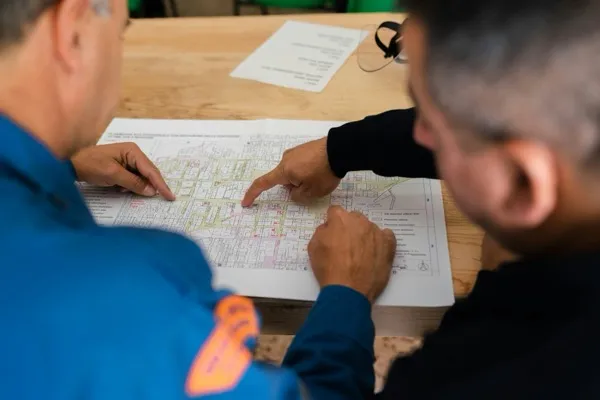
Walk into any $20M–$100M practice on a Thursday afternoon and you'll find the scene. A principal at a light table, marking up a junior's drawing. The columns are an inch off the grid. The detail at the parapet doesn't show the air barrier returning. The stair callout points to the wrong sheet. She's made the same corrections, on the same drawing types, for years.
"The red pen your principal uses every Thursday is the most valuable AI training data your firm will ever own."
The profession already knows redlines are a teaching tool. Bob Borson, the architect behind Life of an Architect, has written that "fixing redline drawings is a fantastic way for an architectural emerging professional to really tap into the knowledge, experience, and expertise of more senior-level members in the firm... they really should be used as a tool for teaching the next generation of architects."1
We've recognized the asset. We just haven't named what it is. Architecture training stops compounding the moment a correction lives only on a PDF and in one person's head. And the cost of throwing this away isn't just operational. It's actuarial.
Why Architecture Training Stops Compounding
Architecture training fails to compound for two reasons most principals haven't connected: AEC firms have the lowest AI adoption-to-opportunity ratio of any major industry, and the people who hold the firm's tacit knowledge are walking out the door faster than the next generation can absorb it.
Look at the integration gap. Three reputable surveys, three different cuts of the same problem:
| Source | Year | Finding |
|---|---|---|
| AIA | 2025 | Only 8% of firm leaders have integrated AI into their practices; 78% want to learn more2 |
| Bluebeam | 2025 | 27% of AEC firms currently use AI in some form3 |
| Chaos / Architizer | 2026 | 64% of architects have experimented with AI; only 20% have fully embraced it in their workflow4 |
Read those three numbers together. Curiosity is everywhere. Adoption is shallow. Integration is rare. The gap between "we tried it once" and "it's part of how we work" is exactly the gap a focused pilot can close.
Now layer the second problem. APQC research5 found that organizations expect 51% of their workforce to retire or leave within five years, with roughly 61 million baby boomers exiting the workforce by 2030. And 41% of employees report starting a job essentially from scratch because the person who left didn't transfer what they knew6.
In architecture, that "what they knew" is tacit knowledge— the unwritten judgment a senior partner applies when she chooses one detail over another. Peer-reviewed AEC research has documented for two decades that firms in this industry are good at collecting and storing explicit information, and poor at retrieving and exchanging it7. The hard drives are full. The wisdom isn't on them.
The biggest barriers to AEC technology adoption aren't cost. They're complexity, culture, and connection.8
If the closing window is real, the next question is: what's the asset most firms are sitting on without naming it?
Redlines Are Training Data (The Reframe)
An AI training pair has a simple structure: an input (a draft) and an expected output (the corrected version). Every redline a senior architect produces is exactly that— a junior's draft as input, the senior's corrected drawing as expected output. The artifact your firm has been producing for fifty years is the artifact AI vendors charge six figures to generate.
Here's the structural identity:
Draft (input): Junior's wall section, columns misaligned to grid, parapet detail missing air barrier return. Redline (output): Senior's corrections in red, with a one-line margin note on why— code condition, climate zone, firm standard.
That pair, multiplied across a quarter of weekly reviews on a single drawing type, is a labeled dataset. IBM's own technical documentation on enterprise AI9 describes the input/output pair as the foundational structure of supervised learning— the exact thing your senior partners produce every week and file in a project folder nobody opens again.
A redline is a labeled training example. A junior's draft plus a senior's corrections equals one input-output pair. Multiply by a quarter of weekly reviews, and you have a dataset.
This is where Dan's framing matters. AI is intellectual augmentation, not artificial intelligence. The augmentation only works if the model has been taught what your firm specifically considers right. A general-purpose AI model (an LLM trained on the public internet) doesn't know your firm's preferred parapet detail. It doesn't know your standard for stair callouts. It doesn't know which code condition you treat as belt-and-suspenders and which you treat as case-by-case. Your redlines do.
Borson's framing of redlines as a teaching tool was prescient1. He named the artifact's pedagogical function. Naming it as AI training data is the next step the profession hasn't taken yet— and the one that turns a firm's most repetitive expense into a compounding asset.
One honest caveat. The redline itself captures what changed, not always why. A senior architect's judgment— the reasoning behind the correction— often lives in her head, or in a sentence she says aloud during the review and nobody writes down. Closing that gap is what separates a useful pilot from a checkbox exercise: margin notes, voice memos after the markup, a one-paragraph "why this matters" field in your review template. Capturing the reasoning is the work.
If redlines are the asset, the next question is technical: how do you feed that asset to an AI? And here the industry collapses two different answers into one fuzzy word.
RAG vs Fine-Tuning, Plainly
Most architecture firms should start with retrieval-augmented generation (RAG), not fine-tuning. RAG lets the AI reference your firm's documents at query time without retraining the model— current data, lower lift, faster path to value. Fine-tuning embeds patterns deeper but requires more labeled data, more discipline, and a stable definition of "right."
If the difference between what generative AI is and what RAG layers on top of it feels fuzzy, here's the cleanest distinction. Both patterns are described in IBM's enterprise AI documentation9.
| RAG | Fine-Tuning | |
|---|---|---|
| What it does | Looks up your firm's documents at query time, then answers | Retrains the model itself on labeled examples |
| Data freshness | Always current— pulls latest documents | Frozen at training time |
| Lift | Lower— no model retraining | Higher— requires curated dataset and ML expertise |
| When to use | Now. Start here. | When firm standards are stable and labeled data is plentiful |
| First step for AEC | Load redacted redlines into a Custom GPT or Claude Project | Year two— after you've validated what "right" looks like at scale |
RAG retrieves. Fine-tuning rewires. Most mid-size architecture firms should retrieve first.
Why? Because RAG keeps the data current. Mistakes are visible— you can see exactly which document the AI cited. And when a senior architect updates a standard, the AI sees the update tomorrow, not after the next training cycle.
Start with RAG over your last quarter of redacted reviews. Fine-tune later— when your standards are stable enough to bet on.
Which raises the operational question every principal eventually asks: what does this look like Monday morning, in a firm that doesn't have a CTO?
What a $20M–$100M Firm Does Monday Morning
A $20M–$100M architecture firm can run a meaningful redline-as-training-data pilot this quarter, with no new headcount, on tools the firm likely already pays for. The pilot has four steps, is structured to run under $50,000 in direct costs end-to-end, and produces a measurable result by month three: fewer repeated corrections.
You don't need Cove's $25 million R&D budget. You need one drawing type, one quarter of redacted reviews, and a Custom GPT or Claude Project. If your principals find that this maps awkwardly to current production timelines, the AI decision framework that fits a principal's actual calendar is the right pre-read.
Step 1: Pick one drawing type. Wall sections. Stair details. RCPs. One bounded category where the same corrections repeat. Resist the urge to "do this for everything." The whole point of the pilot is to make the corpus small enough to be honest about.
Step 2: Capture 12 weeks of redacted before/after pairs. Strip client-identifying information at intake. For each pair, save three artifacts: the junior's draft, the senior's redlined version, and a one-paragraph "why" from the senior. The AIA's 2025 sentiment work shows 93% of architects are concerned about privacy and security10— that's why redaction is step one, not an afterthought.
Step 3: Load the corpus into a Custom GPT (ChatGPT Team) or Claude Project. The AI side requires no code. Start with RAG over the corpus. Test the model by feeding it new junior drafts and reading what it flags. This is the moment the pilot earns or loses credibility— if the AI flags the same things your seniors flag, you have signal. If it flags everything or nothing, your inputs need more discipline.
Step 4: Measure repeat-mistake reduction across two quarters. The metric isn't "AI accuracy." It's how many times this quarter your senior corrected the same thing she corrected last quarter. That number is the compounding asset, expressed as recovered hours.
Industry precedent matters. Knowledge Architecture's Synthesis platform has made years of valuable knowledge buried in town halls, learning sessions, and firmwide meetings searchable for firms like Shepley Bulfinch and MBH Architects11. The pattern works at AEC firms. Bluebeam's 2025 report12 found that among AEC firms that adopted AI, 68% saved at least $50,000 and 46% reclaimed 500 to 1,000 hours on tasks like scheduling, planning, and document analysis. The ROI isn't speculative.
The principal who starts this pilot in May has a compounding asset by November that her competitors can't copy.
Before any principal greenlights a pilot like this, three honest questions deserve direct answers.
What This Is Not (and the Risks, Honestly Stated)
This pilot is not Cove. It is not a replacement for mentorship. It is not a path around licensure. And it carries three real risks that need to be designed against from day one: confidentiality, bad-data contamination, and over-reliance.
Let's take each piece on directly.
- Not Cove. Cove Architecture represents more than $25 million in R&D over more than a decade13. Mid-market firms shouldn't try to replicate that. The pilot above is sub-$50K, not seven-figure. Cove is a benchmark to learn from, not a benchmark to copy.
- Not a replacement for mentorship. A redline-trained AI frees the senior architect from repeating herself on the same wall section so she can teach the interesting edge cases— the ones that need her judgment, not her muscle memory.
- Not a path around licensure. AI doesn't carry the stamp. Junior architects are still required by law, by liability, and by professional standards. This is augmentation, not substitution.
Then the three risks.
Confidentiality. Separate firm-standards corrections from client-specific content at intake. The AIA's privacy concern10 is legitimate, and Bluebeam's barrier data14 shows 42% of AEC firms cite data security as their top adoption obstacle. Redaction is a workflow, not a checkbox. Design it before you collect anything.
Garbage in, garbage out. As one of Dan's signature lines goes: just because it's easy doesn't mean it's good. The quality of your training pairs determines the quality of the model. This is a senior architect's job to QC, not a junior's, because the whole point is encoding senior judgment. If your redlines are sloppy, your AI will be sloppy. That's not a feature. That's a forcing function— the discipline of capturing the data is what forces the firm to articulate what its standards are.
Over-reliance. Junior staff still need to do the work of being wrong and learning from it. The AI is a second-pass check, not a first-pass crutch. This is where building an AI-ready culture matters more than the technology. ASCE's 2025 work8 reminded the profession that the barriers here are culture and connection, not cost.
And the cost question is real on its own terms. Even a $50K pilot has hidden costs in AI projects— staff time, redaction work, the cycles your senior architects spend reviewing model outputs. Plan for them. They're worth it, but they're not free.
A few more questions principals consistently ask before they greenlight this kind of work:
FAQ— Architecture Training in 2026
What is architecture training in 2026?
Architecture training in 2026 means two things: license-required continuing education for individual architects, and— increasingly— firm-level capture of senior-architect corrections as AI training data. The second is the higher-leverage practice and the one most $20M–$100M firms have not yet started. CE keeps your license valid. Capturing the red pen keeps the firm's expertise from walking out the door.
What are redline drawings?
Redline drawings are architectural drawings marked up (typically in red ink) by a senior architect to flag errors, omissions, or design changes on a junior architect's draft. Bob Borson has described them as the profession's most established peer-to-peer teaching tool1. They are also, structurally, labeled input/output pairs— the foundation of any supervised AI training dataset.
Can architecture firms train their own AI?
Yes. Most firms should start with retrieval-augmented generation (RAG) using their existing document library— drawings, redlines, project memoranda, design standards9. Fine-tuning becomes appropriate later, once firm standards are stable enough to encode at the model-weights level. Start small, on one drawing type, with redacted data.
How many architecture firms currently use AI?
About 27% of AEC firms use AI in some form, according to Bluebeam's 2025 report3. Only 8% of architecture firm leaders report having fully integrated AI into their practices, per the AIA's 2025 survey2. The gap between experimentation and integration is the competitive opening— and it's wider than most principals realize.
Will AI replace architects?
No. Licensure, liability, and the requirement that a stamped architect take responsibility for the work mean architects remain required by law. AI augments the work— including, increasingly, by capturing senior expertise so it survives the next round of retirements. APQC's research5 on workforce turnover makes the case for capturing knowledge urgent, not optional.
Which leaves one decision for the principal reading this:
The Quiet Compounding
The principal who starts capturing redline data this quarter will have an asset in 18 months that her competitors cannot copy. Not because she bought the better software, but because she named the data she was already producing and put it somewhere structured.
Architecture training compounds when the corrections that used to die in PDF stacks become a structured asset the firm can teach from for the next decade. Think of it as building an iceberg from the bottom up— the visible work is one quarter of redacted reviews, but what accumulates underneath is a firm's institutional judgment, encoded.
If mapping this pilot to your specific drawing types, quality standards, and partner mix is where the work bottlenecks, that's the conversation Dan Cumberland Labs has with founder-led AEC firms. Our AI strategy for founder-led firms starts exactly here— one drawing type, one quarter, real measurement, no vendor lock-in.
The red pen has always been the training data. The firms that name it first will own the next decade of compounding.
References
- Bob Borson, AIA, Life of an Architect, "Architectural Redlines" (2020) — https://www.lifeofanarchitect.com/architectural-redlines/
- American Institute of Architects, "Architects are excited about the potential of AI, but concerns abound" (March 2025) — https://www.aia.org/aia-architect/article/architects-are-excited-about-potential-ai-concerns-abound
- Bluebeam, "Building the Future: AEC Technology Outlook 2026" (October 2025) — https://press.bluebeam.com/2025/10/new-bluebeam-report-shows-early-ai-adopters-in-aec-seeing-significant-roi-despite-uneven-adoption/
- Chaos & Architizer, "The state of AI in architecture: how AI is reshaping architectural design & visualization in 2026" (March 2026) — https://blog.chaos.com/the-state-of-ai-in-architecture-survey-insights
- APQC / Tektome, "APQC's 'Great Retirement' Findings: What Teams Can Do About Knowledge Loss" (2024) — https://tektome.com/expertise-center/blog/great-retirement-findings
- APQC / Tektome, "APQC's 'Great Retirement' Findings: What Teams Can Do About Knowledge Loss" (2024) — https://tektome.com/expertise-center/blog/great-retirement-findings
- ScienceDirect, "Dynamic Knowledge Map: reusing experts' tacit knowledge in the AEC industry" (2003) — https://www.sciencedirect.com/science/article/abs/pii/S0926580503001067
- American Society of Civil Engineers, "Architecture, engineering, construction sector slow to adopt AI, survey shows" (December 2025) — https://www.asce.org/publications-and-news/civil-engineering-source/article/2025/12/18/architecture-engineering-construction-sector-slow-to-adapt-ai-survey-shows
- IBM, "RAG vs. Fine-tuning" (2024) — https://www.ibm.com/think/topics/rag-vs-fine-tuning
- American Institute of Architects, "Architects are excited about the potential of AI, but concerns abound" (March 2025) — https://www.aia.org/aia-architect/article/architects-are-excited-about-potential-ai-concerns-abound
- Knowledge Architecture, "Synthesis AI Search for AEC Firms" (2025) — https://www.knowledge-architecture.com/synthesis-ai-search
- Bluebeam, "Building the Future: AEC Technology Outlook 2026" (October 2025) — https://press.bluebeam.com/2025/10/new-bluebeam-report-shows-early-ai-adopters-in-aec-seeing-significant-roi-despite-uneven-adoption/
- Multi-Housing News, "Meet the Architecture Firm That Runs on AI" (2024) — https://www.multihousingnews.com/meet-the-architecture-firm-that-runs-on-ai/
- Bluebeam, "Building the Future: AEC Technology Outlook 2026" (October 2025) — https://press.bluebeam.com/2025/10/new-bluebeam-report-shows-early-ai-adopters-in-aec-seeing-significant-roi-despite-uneven-adoption/