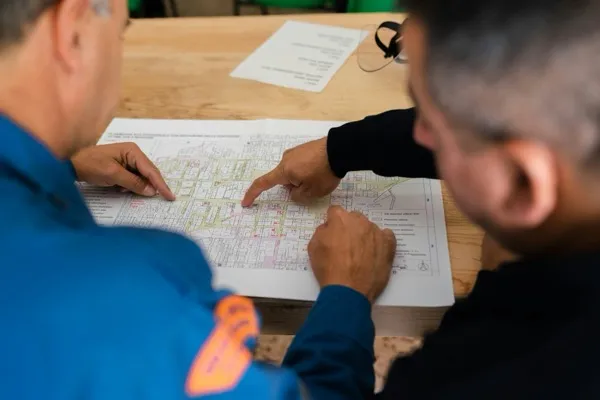

Why does a hospital make oncologists meet every week to discuss cancer cases together, but your architecture practice has never institutionalized the equivalent for buildings?
Healthcare built the answer to your knowledge-retention problem twenty years ago, and it's called a Community of Practice— a model with a research base and a set of operating rituals you can pilot inside thirty days. Firms that adopt it capture what their senior people know before those people retire or leave.
Every senior detail architect who retires walks out with knowledge no junior on your team can re-derive without making the same expensive mistake twice. Before we name the answer, name the problem at its actual size.
The Architecture Practice Is Losing Decades of Expertise — Fast
Roughly half of the US workforce is expected to retire or change roles within five years, and 41% of organizations rarely or never attempt to capture what those people knew, per APQC1. Architecture practice sits in the path of that wave. An estimated 61 million baby boomers will exit the US workforce by 20301— a generation of senior practitioners whose institutional knowledge most firms never bothered to write down.
The barriers are predictable, and APQC1 names them in order:
- Time and deadlines: 52% of organizations name this as the top barrier to knowledge capture
- Resource constraints: 45% cite this as a blocking factor
- Culture: 35% acknowledge their company culture actively discourages knowledge sharing
Time is the brutal one. The same billable-hours pressure that makes architecture practice profitable is what's bleeding it dry. AEC-specific outcome data on this is sparse, but the demographic wave doesn't discriminate by industry— and the senior people who built your firm's competence around healthcare casework, curtain wall detailing, or federal procurement aren't getting any younger.
Healthcare faced the same demographic problem, with higher stakes, and built an answer worth borrowing.
What Healthcare Built — The Community of Practice
A Community of Practice is a group of practitioners who share a domain of work, engage as a community over time, and build a shared practice of tools, methods, and stories, per Wenger-Trayner2. The model was originally developed as a learning theory by Etienne Wenger and Jean Lave in the 1990s2. Healthcare adopted it at scale because it gave clinicians a structured way to translate what they collectively knew into what each of them did on Monday.
The Wenger-Trayner definition2 is precise. A Community of Practice requires three elements:
- A domain — a shared area of work the group cares about
- A community — practitioners who engage with each other regularly
- A practice — the tools, methods, stories, and artifacts the group builds together
Notice what's missing from that list. Mentorship. A Community of Practice is not one senior pulling one junior up a ladder. It's many-to-many, anchored in the work itself, and it produces shared artifacts the firm owns regardless of who stays. The Community of Practice is the upstream act of creating the knowledge that any software later retrieves— it is not "knowledge management software with extra steps."
This is not exotic in architecture practice. It's just underadopted. Knowledge Architecture3 documents formal communities of practice already running at BWBR, AEI, Shepley Bulfinch, LMN Architects, and KieranTimberlake. You can't read the label from inside the bottle— and healthcare provides the external mirror your firm has been missing.
Wenger gave healthcare a theory. Healthcare turned the theory into three weekly rituals any architecture firm could borrow tomorrow.
The Three Rituals Healthcare Runs (and the Architecture Practice Equivalents)
Three operating rituals carry most of healthcare's institutional learning: the tumor board (multidisciplinary case review), the morbidity and mortality conference (blame-free post-incident analysis), and the broader Community of Practice itself (ongoing domain-based learning group). Each has a direct architecture practice equivalent— and the value of naming them is that you can finally schedule one.
| Healthcare Ritual | What It Is | Cadence | Architecture Practice Equivalent |
|---|---|---|---|
| Tumor Board | Multidisciplinary review of a single hard case | Weekly | Cross-studio design review on one live project |
| M&M Conference | Blame-free root-cause analysis of an error | Monthly–Quarterly | Project post-mortem on a sideways project (RFIs, change orders, constructability) |
| Community of Practice | Domain-anchored learning group, ongoing | Monthly | Practice group by building type or discipline (e.g., the healthcare-studio CoP) |
The tumor board. A tumor board is a multidisciplinary weekly meeting where oncologists, radiologists, pathologists, and surgeons review individual cancer cases together. The outcomes are not subtle. Per Specchia 20204, tumor boards alter the treatment plan in 23 to 41.7 percent of cases reviewed, change the underlying diagnosis in another 4 to 35 percent of cases, and 90 to 100 percent of those decisions get implemented. Architecture's equivalent already exists in fragments: it's the design review you run on your hardest project, scheduled monthly and opened to your other studios. The novelty is making it a standing ritual rather than a firefight.
The M&M conference. A morbidity and mortality conference is a structured, blame-free review of clinical errors, used to identify systemic root causes rather than individual fault. It's required for all US medical residency programs under ACGME accreditation, per Lai 20235. Mayo Clinic's program reports 100% of attendees finding moderate-to-extreme educational value, 93% reporting moderate-to-extreme engagement, and 85% reporting enhanced ability to prevent or manage similar future complications5. The architecture equivalent is the blame-free post-mortem on a project that went sideways— submittal cycle problems, change order patterns, constructability issues. The anchor quote belongs on a wall in your conference room: "Most errors are the result of bad systems, not bad people."5
The Community of Practice itself. Beyond the case-by-case rituals, healthcare runs domain-anchored learning groups on regular cadence. A 2024 study of 16 Canadian healthcare communities of practice by Brooks et al.6 characterized how they work— and how often they fail. In architecture, the equivalent is a standing practice group organized by building type (healthcare studio, K-12, mixed-use) or by discipline (specifications, sustainability, BIM coordination).
The mechanics are clear. The harder question is whether they work.
What the Evidence Says (Honestly)
Communities of Practice reliably raise practitioner knowledge, tool usage, and engagement— and they do not, on their own, change practice. The honest framing matters because it tells an architecture firm where to spend its time.
A 12-month randomized controlled trial by Barwick et al.7 found practitioners supported by a Community of Practice conducted 152 evidence-based assessments compared to 65 in the control group— 2.3 times the usage. The same trial7 showed CoP practitioners scored significantly higher on content knowledge (14.1 vs. 10.8, p=0.002) and reported significantly higher satisfaction with implementation support (20.18 vs. 11.38, p=0.01). Mayo Clinic's M&M program5 reports comparable engagement gains.
What the evidence does not say is that a CoP, on its own, changes what people do at the drafting board. Brooks 20246 found that 8 of 16 healthcare CoPs conducted no formal evaluations, and 9 of 16 were run entirely by volunteers— and the volunteer-only ones died. Specchia 20204 notes that tumor boards clearly change treatment plans, but survival evidence across studies is mixed— some show a 3.2 to 6.6 month median survival improvement, others show no overall association.
Two things are reliable, and one is not:
- What CoPs reliably do: raise practitioner knowledge, tool usage, engagement
- What CoPs do not do on their own: change downstream practice unless the CoP output is coupled to an existing workflow gate
Engagement is highest when membership addresses job-required work, not optional learning, per Brooks 20246. Translate that to architecture: a healthcare-studio CoP that reviews live project decisions will fill the room. A "lessons learned" email distribution list will not.
The evidence base is healthcare's. The translation to an architecture practice has real limits— and pretending otherwise is the surest way to launch a CoP that nobody attends.
Where the Healthcare Analogy Breaks
Three things in healthcare's model don't fully transfer to an architecture practice: the stakes are asymmetric, the regulatory mandate is missing, and the senior-practitioner time being spent is more expensive per hour. The fix is to scale down— not skip— the borrowed model.
- Liability asymmetry. A bad surgery kills someone; a bad detail costs the firm money on the next change order. That asymmetry is real— and it argues for a proportionally smaller version of the same operating model, not a different one.
- No regulatory mandate. The architecture practice has no ACGME5. No regulator requires your firm to hold M&M conferences. That makes leadership sponsorship the deciding variable. If the principal isn't on the calendar invite, the meeting will not happen for long.
- Time cost. Senior practitioners' billable time is the most expensive resource a firm has, and the opportunity cost of a four-hour-per-week facilitator role is real. Acknowledge it in the math. The investment is real; so is the cost of doing nothing.
There's a fourth issue that deserves naming. Post-occupancy evaluation is the architecture practice equivalent of healthcare's outcomes-feedback loop— and adoption is "low across the profession" per the only good peer-reviewed evidence on this, Hay et al.8. The structural feedback loop that would close the learning cycle is itself underdeveloped. Acknowledge the limits, then run the pilot anyway. The first thirty days don't require anyone's permission but your own.
The 30-Day Pilot: Starting a Community of Practice in Your Architecture Firm
An architecture firm can pilot a Community of Practice in thirty days with one designated facilitator, one domain, one monthly meeting, and one captured artifact. The model is not free— it requires four hours per week of protected time from someone senior enough to be heard— but it is the smallest workable version of what healthcare proves works.
The single biggest failure mode is running the CoP on volunteer time. Brooks 20246 found that 9 of 16 healthcare CoPs had no paid facilitator and the volunteer ones died. Pick one domain— healthcare studio, curtain wall detailing, K-12, federal— and start there. A CoP that tries to be everything for the whole firm becomes nothing for anyone.
For founders weighing this against the alternative— buying an AI knowledge-search platform— the decision framework founders use to time AI investments gives a useful frame: the pilot is decision-light and low-stakes; the software purchase is neither.
Here is the seven-step pilot:
- Designate a facilitator with 4 protected hours per week. Senior practitioner one step below principal. This is non-negotiable per Brooks 20246— volunteer CoPs fail.
- Pick one domain, not five. Building type (healthcare studio, K-12) or discipline (specifications, sustainability)— whichever has the most pain and the most senior-staff retirement risk.
- Schedule a monthly two-hour meeting on a fixed cadence. Calendar invitation goes out 90 days in advance. Standing on the principal's calendar — that's what makes it "need-to-do" instead of "nice-to-do," per Brooks 20246.
- Run a tumor-board-style case review. Bring one live, hard project to the room. Cross-studio or cross-disciplinary participation (whichever the firm's structure supports). Decisions captured in a shared document.
- Once per quarter, run an M&M-style retrospective on a project that went sideways. Blame-free5. Submittal cycle problems, change order patterns, RFI volume— whichever signal is the loudest.
- Capture one artifact per meeting. A detail. A spec note. A QA/QC checklist update. The artifact is what the firm will own when the senior practitioner eventually retires.
- Tie one artifact to a workflow gate. A design review checkpoint, a QA/QC sign-off, a post-occupancy follow-up. This is the structural coupling that turns knowledge into practice change, and it's what Knowledge Architecture9 calls "recording knowledge in workflow moments."
Once the pilot is running, the next question is the one every AEC software vendor wants you to ask first: where does AI fit?
The AI Question — Why Knowledge-Search Tools Don't Replace the Practice
AI-powered knowledge search tools— Synthesis (Knowledge Architecture), KnowledgeBuilder, custom retrieval systems built on top of an architecture practice's intranet— retrieve what people have already written down. The Community of Practice is the upstream activity that produces what AI later retrieves. The two are complementary, not substitutes.
No matter the question, people are the answer. AI search tools retrieve what humans wrote down. The Community of Practice is what gets the knowledge written down in the first place.
Knowledge Architecture's 2025 trends report9 names "recording knowledge in workflow moments" and "orchestrating the learning organization" as leading AEC knowledge-management practices— both are CoP-adjacent, not CoP-replacement. The architecture practice that builds a CoP first will have searchable knowledge worth retrieving. The architecture practice that buys AI search first will have AI retrieving thin gruel. For firms thinking about building AI culture in a professional services firm, the sequencing is the whole game. Before that purchase order goes out, it's worth weighing the hidden costs of AI projects worth weighing before any platform purchase.
Whether you start the pilot or not, the demographic clock keeps running.
The Compounding Move
The firms that institutionalize this in the next five years will compound their senior expertise into something that survives any one architect's retirement. The firms that don't will lose half their workforce wisdom and never recover it1— because the people who knew the answer left without anyone writing it down. And no AI search tool will retrieve what no one took the time to write down.
Knowledge management is not a software purchase. It's a Tuesday morning meeting with one facilitator, one domain, and one captured artifact— repeated for thirty days, then for thirty months, then for thirty years.
If the gap between "we should have a Community of Practice" and "we run one" feels wide, an implementation partner can help map the right pilot to your firm's actual project mix and studio structure. Dan Cumberland Labs works for founder-led firms navigating exactly this kind of operational decision. Start at dancumberlandlabs.com.
Frequently Asked Questions
What is a Community of Practice?
A Community of Practice is a group of practitioners who share a domain of work, engage as a community over time, and build a shared practice of tools and methods— a model defined by Etienne Wenger and Jean Lave in the 1990s2. The three required elements are a domain of inquiry, a community of practitioners, and a shared practice the group builds together.
What is a tumor board, and how does it apply to architecture practice?
A tumor board is a multidisciplinary weekly meeting where specialists review individual cancer cases together; treatment plans are altered in 23 to 41.7 percent of cases reviewed, per Specchia 20204. The architecture practice equivalent is a cross-studio design review on one live, hard project— same multidisciplinary structure, same case-based learning, same standing cadence.
What is an M&M conference?
A morbidity and mortality conference is a structured, blame-free review of clinical errors used to identify systemic root causes; it is required for all US medical residency programs under ACGME accreditation, per Lai 20235. Mayo Clinic's program reports 100% educational value and 93% engagement from attendees5.
Do Communities of Practice work?
The peer-reviewed evidence shows CoPs reliably increase practitioner knowledge, tool usage, and engagement— a 12-month randomized controlled trial by Barwick et al.7 showed CoP practitioners conducted 2.3 times more evidence-based assessments than controls. Practice change, though, requires coupling the CoP to existing workflows like design review gates or QA/QC sign-offs6.
How does an architecture firm start a Community of Practice?
Designate one facilitator with four protected hours per week, pick a single domain (a building type or a discipline), schedule a monthly two-hour case review, and capture one artifact per meeting tied to your firm's QA/QC process. The Brooks 2024 study6 of healthcare CoPs found that the volunteer-only ones died— paid facilitator time is the variable that decides.
References
- APQC (American Productivity & Quality Center), "The Great Retirement: Knowledge Loss, AI and the Workforce Shift" (2024) — https://www.apqc.org/resource-library/resource-listing/great-retirement-knowledge-loss-ai-and-workforce-shift
- Wenger-Trayner, "Introduction to communities of practice" — https://www.wenger-trayner.com/introduction-to-communities-of-practice/
- Knowledge Architecture, "Best Practices: Communities of Practice in Architecture and Engineering Firms" — https://www.knowledge-architecture.com/aec-communities-of-practice
- Specchia et al., "The impact of tumor board on cancer care: evidence from an umbrella review," BMC Health Services Research (2020) — https://pmc.ncbi.nlm.nih.gov/articles/PMC6995197/
- Lai et al., "Using Morbidity and Mortality Conferences to Drive Quality Improvement and Reduce Errors," American Academy of Family Physicians (March 2023) — https://www.aafp.org/pubs/fpm/issues/2023/0300/morbidity-mortality-conferences.html
- Brooks et al., "How to use communities of practice to support change in learning health systems," Learning Health Systems / Wiley (2024) — https://pmc.ncbi.nlm.nih.gov/articles/PMC11257050/
- Barwick et al., "Getting to Uptake: Do Communities of Practice Support the Implementation of Evidence-Based Practice?" Worldviews on Evidence-Based Nursing (2009) — https://pmc.ncbi.nlm.nih.gov/articles/PMC2651208/
- Hay et al., "Post-occupancy evaluation in architecture: experiences and perspectives from UK practice," Building Research & Information / Taylor & Francis (2017) — https://centaur.reading.ac.uk/69649/3/RBRI_A_1314692.pdf
- Knowledge Architecture, "How Leading AEC Knowledge Management Teams Are Evolving to Thrive in the AI Era | 12 Trends" (July 23, 2025) — https://www.knowledge-architecture.com/blog/how-leading-aec-knowledge-management-teams-are-evolving-to-thrive-in-the-ai-era-12-trends