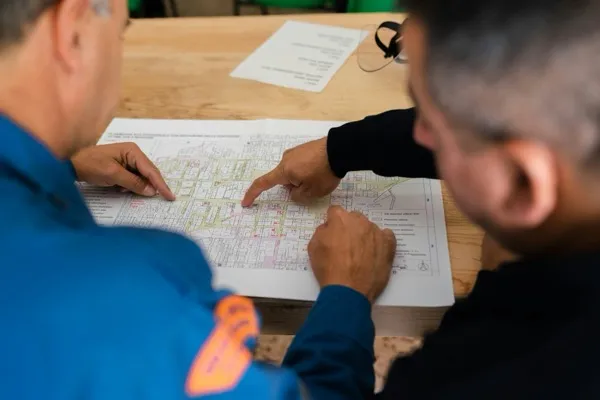

Every mid-sized architecture firm has a version of the same Friday-night scene. A project architect is rewriting the structural engineer's response to comment #14, the MEP engineer is on Slack asking which version of the corrections letter is current, and a senior principal is reformatting it all into a single PDF because the city wants the response back by Monday. Nobody planned this. It just happens, project after project.
Permit response drafting is one of the highest-friction, lowest-leverage workflows inside a mid-sized AEC firm. The fragmentation is a workflow problem dressed up as a tool problem.
Here's the five-part workflow that fixes it— and the legal firewall that keeps it defensible. Before laying it out, name the parts.
What "Architecture Disciplines" Means in a Permit Set
Architecture disciplines, in the permit-set context, refers to the licensed design professions that together produce the construction documents an Authority Having Jurisdiction (AHJ) reviews. That set typically includes architectural, structural, mechanical, electrical, plumbing, civil, and fire/life safety, plus landscape and interiors depending on scope. Each discipline is led by a separate licensed professional in responsible charge for that scope of work.
The roles, briefly:
- Architectural— design intent, code-path planning, life safety, coordination
- Structural— gravity and lateral systems, calculations, stamped drawings
- Mechanical / Electrical / Plumbing (MEP)— building systems, often a single consultant or three separate ones
- Civil— site, grading, drainage, utilities
- Fire / Life Safety— egress, sprinkler design, alarm systems
- Landscape, Interiors— scope-dependent, often consultant-led
The AIA C401-2017 standard architect-consultant agreement formalizes this relationship. Consultants are required to coordinate their services with the architect and the architect's other consultants to avoid unreasonable delay1. Most of these documents are designed against the International Code Council's I-Codes, the model construction code framework most U.S. jurisdictions adopt with local amendments2.
Knowing what the disciplines are doesn't explain why responses fragment when they hit the corrections letter.
Why Permit Responses Fragment Across Disciplines
Permit responses fragment because each licensed professional owns their discipline's content, but nothing standardizes how those responses combine into a single submittal package. The AIA framework names the architect as coordinator under both B101 and C401-2017, but most firms translate "coordinate" as "the project architect rewrites everyone's response on a Friday night."
Each discipline owns its content. Nobody owns the wrapper.
Under AIA Document B101, the architect is responsible for the coordination of all drawings and design documents prepared by the architect or the architect's consultants3. That's the contract language. In daily practice it usually means one senior person reformatting everyone's input by hand, with no written rules for how it happens. Coordination, in practice, means the project architect becomes a human router. In our experience, that breaks down somewhere between 25 and 50 active projects, depending on senior-staff capacity.
As firms grow past $20M, the unowned connective tissue becomes the constraint. The biggest problem is rarely a lack of work— it's the buildup of operational friction between quoting, delivery, time capture, invoicing and reporting, especially when operational data lives across spreadsheets and disconnected tools4. Permit responses sit squarely in that friction zone, which is exactly where AI workflow automation earns its keep.
Where the coordination breaks down:
- The cross-discipline comment— a single review note that touches two disciplines (the classic example is a beam penetration that's both structural and MEP)— has no defined owner
- Version control across email, Slack, and shared drives is informal
- The format of the response letter varies project to project, even inside the same firm
The AHJ defines what the response looks like when it lands, regardless of how you coordinated internally.
What AHJs Require in a Plan Check Response
A plan check response letter must be itemized comment-by-comment, must indicate the specific location on the drawings, specifications, or calculations where each correction was made, and must be signed by the licensed professional in responsible charge for the discipline that addressed the comment. When responses come from multiple licensed professionals, separate response letters per responsible party are required.
That formula converges across major U.S. jurisdictions. The Town of Danville Building Division states the requirement directly: an itemized list which clearly indicates how each review comment is addressed and the specific location on the plans, specifications or calculations where the correction is provided5. Seattle SDCI and San Leandro publish substantively similar language in their own submittal guidelines.
What every AHJ-compliant response letter needs:
| Requirement | What it means | Why it matters |
|---|---|---|
| Itemization | Numbered response to each comment, no exceptions | Plan checker can verify completeness at a glance |
| Location-on-drawing | Each response points to a sheet, spec section, or calc page | Reviewer doesn't have to hunt for the change |
| Responsible-party signature | Stamped by the licensed professional who designed the component | Establishes legal accountability for the design decision |
| Separate letters per party | Each discipline's responsible professional submits their own letter | No single firm-wide consolidation of stamps |
The responsible-charge rule is the legally binding one. Sonoma County's Permit and Resource Management Department puts it in writing in Technical Bulletin B-36: responses to plan check comments related to components designed by an architect or engineer shall be made by that design professional in responsible charge6. The architect cannot answer a structural comment. The MEP engineer cannot answer a civil one.
And jurisdictions enforce a clock. Danville's guideline includes a 90-day inactivity window:
Projects may be closed for inactivity where responses are not received within 90 calendar days after the date of return of checked construction drawings.7
That's a jurisdictional clock that punishes slow internal workflows. A firm that takes six weeks to assemble a multi-discipline response loses runway on every project where the AHJ is the gating party.
The architect's role under AIA B101 is to coordinate the submission package to the authority having jurisdiction. Not to sign for the engineer's discipline3.
The format rules are the easy part. Building the workflow that meets them— across disciplines, across projects, every time— is the hard part. Here's a five-part framework.
The Five-Part Workflow for Standardizing Across Disciplines
A standardized permit response workflow has five components: a centralized comment intake, discipline routing rules, a shared response-letter template, AI-assisted first-pass drafting reviewed by the responsible professional, and a single-source QA gate before resubmittal. Standardize the format and the routing. Leave the discipline-specific reasoning alone.
This is the part that respects the licensed professional's responsibility while removing the discretionary chaos in between. Rolling it out also benefits from treating it as a change-management project rather than a tool install— building an AI culture inside a firm is what makes the workflow stick after the first month.
1. Centralized Comment Intake
One person, or one system (Newforma, Bluebeam Studio Sessions, Procore), ingests the AHJ's corrections letter and creates a single working document with the original comment numbering preserved. No one drafts responses until intake is complete. The Newforma Project Center connector with Bluebeam Studio Sessions, for example, allows project teams to review, mark up, and update the same documents collaboratively while maintaining a detailed audit trail of session markup8. Whatever tool you pick, the principle is the same: one source, one numbering scheme, one start time.
2. Discipline Routing Rules
A written rule set assigns each comment number to a discipline lead within 24 hours of intake. Cross-discipline comments— the beam-penetration case— get co-assigned with a primary owner explicitly named. This step kills the daily Slack thread of "who's handling #14?" Each licensed professional responsible for the affected design must respond to their portion. The architect's role is to coordinate the routing, not to sign the engineer's response.
3. A Shared Response-Letter Template
Every discipline drafts in the same template: comment number, comment text verbatim, response narrative, drawing/spec/calc location reference, responsible-professional name and license number. The architect's package then wraps each discipline's signed letter without rewriting it— separate letters per responsible party, per the Danville rule9. Scout Services makes the point that streamlining permit compliance starts with clear documentation expectations at project kickoff and distribution of the correct municipal checklists to all consultants10. Setting the template before the corrections letter arrives is the version of that rule that pays off.
4. AI-Assisted First-Pass Drafting (Reviewed, Not Final)
AI drafts the initial response narrative from the comment and the relevant drawing or spec reference. The responsible professional then reviews, modifies, and certifies the response. AI is good at parsing comment language, suggesting code citations, and checking for missed comments. It cannot carry responsible charge. The firewall logic— what AI does and what stays with the licensed professional— deserves its own section. That's next.
5. A Single-Source QA Gate
One person— usually the project architect or a designated coordinator— reviews the assembled package against a checklist before resubmittal. The checklist is short: every comment answered, every response signed by the right professional, every drawing reference verifiable, separate letters bundled correctly. This is the architect's coordination role from AIA B101 made operational3. It's the one job that doesn't belong to a discipline lead.
Step four— the AI-assisted draft— deserves more space. That's where the legal firewall sits.
Where AI Fits, and Where the Licensed Professional Stays in Charge
AI can draft a first-pass response narrative. It cannot assume responsible charge for the design. Every jurisdictional and contractual framework— Permit Sonoma's B-36 Technical Bulletin, AIA C401-2017, AIA B101— places the responsibility for design and for response to plan check comments on a named licensed professional. AI is the drafting accelerator. The licensed professional is the certifier.
The frame that fits this work: intellectual augmentation, not artificial intelligence. The augmentation belongs to the professional whose stamp is on the drawing.
AI Does / AI Does Not:
| AI does | AI does not |
|---|---|
| Parse comment language for missed items | Sign as the professional in responsible charge |
| Draft plain-English response narratives | Replace the engineer's stamped review |
| Pull relevant code citations from the I-Codes | Certify the design |
| Check that every numbered comment got a response | Carry liability for design decisions |
AI is the drafting accelerator. The signature stays with the licensed professional.
There's symmetry on the AHJ side. City building departments are running automated pre-checks on construction plans and flagging obvious issues before staff review11. CivCheck offers automated tools that simplify code research and compliance for both city staff and applicants— two-sided adoption inside the same workflow12. Spacial's CEO Maor Greenberg has said the residential construction process has been stuck in the same slow, manual loop for decades13. That framing is directionally true for residential, and commercial multi-discipline response drafting is a different animal. The firewall logic matters more as the discipline count climbs, not less.
The firm's defensible posture is a documented workflow in which AI-drafted text is always reviewed and modified by the responsible professional before signature. That's also where the hidden costs of AI projects get avoided: undocumented AI use in a regulated workflow is the kind of exposure that doesn't show up until a project gets audited.
Cities are already running AI on the review side. Firms that don't run AI on the response side are competing with one hand tied.
What does this look like when it works?
What Changes When You Get This Right
Firms that standardize permit response drafting recover senior-staff time, reduce resubmittal cycles, and create a defensible audit trail of who certified what. The industry baseline gives a sense of scale. Miscommunication and poor project data account for 48% of all rework on U.S. construction jobsites14. Time spent on non-optimal activities such as fixing mistakes, looking for project data, and managing conflict resolution accounts for $177.5 billion in labor costs per year in the U.S. (FMI/PlanGrid, 2018)15.
A standardized workflow promises predictable response cycles. Predictable is what you bill against.
What changes:
- Recovered senior-staff time. Project architects stop being Friday-night reformatters
- Fewer resubmittal cycles. Responses meet AHJ format on first submission
- Defensible audit trail. Every response traced to a responsible professional and a timestamped review
- Cleaner outcomes data. When measuring AI success in firm operations, per-project response time is one of the cleanest metrics a firm can track
This article doesn't promise specific time savings for your firm. Those depend on firm size and current process maturity. What the framework does promise is that when the workflow is documented, the audit trail is automatic.
Frequently Asked Questions
What are the architecture disciplines in a permit set?
Architectural, structural, mechanical, electrical, plumbing (MEP), civil, and fire/life safety design, plus landscape and interiors depending on scope. Each discipline is led by a separate licensed professional in responsible charge for that scope of work, per the AIA C401-2017 architect-consultant framework1.
Who writes the response to a plan check comment?
The licensed professional in responsible charge for the discipline that designed the component the comment addresses. Per jurisdictional rules such as Permit Sonoma's B-36 Technical Bulletin, responses to comments on architect- or engineer-designed components must be made by that design professional6.
Can one response letter cover all disciplines?
No. Jurisdictions such as the Town of Danville Building Division require separate response letters when responses are provided by different responsible licensed professionals9. The architect coordinates the package. Each professional signs their own letter.
What format does a response letter need?
Itemized comment-by-comment, with each response indicating the specific location on the plans, specifications, or calculations where the correction was made5. Most major U.S. jurisdictions converge on this format.
Can AI draft a response letter?
AI can produce a first-pass narrative that the responsible licensed professional reviews, modifies, and certifies. The licensed professional remains in responsible charge. AI is the drafting accelerator. The signature stays with the professional.
What to Do This Week
Three steps make this workable without a six-month rollout. Pick one pilot project, draft a one-page response-letter template, and centralize the next corrections letter intake.
- Pick one pilot project. Ideally a mid-complexity one currently in plan review, with at least two disciplines responding. The point is proof that the workflow holds across disciplines. Perfection comes later.
- Draft a one-page response-letter template. Comment number, verbatim comment, response narrative, drawing/spec/calc location, responsible-professional signature block. Circulate it to every discipline lead before the next corrections letter arrives.
- Centralize the next corrections letter intake. Name the person responsible for first-touch. Give them 24 hours to route comments to discipline leads. Track the routing decisions in writing.
The connective tissue is the template, the routing, and the QA gate. Build those three and the disciplines coordinate around them— without anyone reformatting on a Friday night.
If mapping this workflow against your firm's actual project mix feels like the kind of project where outside eyes help, our AI implementation services work with mid-sized AEC firms on exactly these implementations. Peer-to-peer, no pitch deck.
References
- American Institute of Architects, "AIA Document C401-2017 — Standard Form of Agreement Between Architect and Consultant" (2017) — https://designbuildlaw.com/aia-contracts/c401-2017/
- International Code Council, "The International Building Code" — https://www.iccsafe.org/products-and-services/i-codes/ibc/
- American Institute of Architects, "AIA Document B101 — Standard Form of Agreement Between Owner and Architect" (2007) — https://www.clemson.edu/giving/cufoundations/structure/culsf/documents/AIA%20Document%20B101.pdf
- WorkflowMax (Xero), "Operational Bottlenecks That Appear as Architecture Firms Grow" — https://workflowmax.com/blog/operational-bottlenecks-that-appear-as-architecture-firms-grow
- Town of Danville Building Division, "Responding to Plan Check Comments from Building Division — Submittal Guideline" — https://www.danville.ca.gov/DocumentCenter/View/4352/Response-to-Comment-Letter-Guideline-PDF
- Sonoma County Permit and Resource Management Department, "B-36 2020-Current: Plans Requiring Design by Licensed Architect or Engineer" (2020) — https://permitsonoma.org/divisions/engineeringandconstruction/building/technicalbulletins/b-362020plansrequiringdesignbylicensedarchitectorengineer
- Town of Danville Building Division, "Responding to Plan Check Comments from Building Division — Submittal Guideline" — https://www.danville.ca.gov/DocumentCenter/View/4352/Response-to-Comment-Letter-Guideline-PDF
- Newforma, "Bluebeam Connector for Newforma Project Center" — https://www.newforma.com/app_market/bluebeam/bluebeam-newforma-project-center/
- Town of Danville Building Division, "Responding to Plan Check Comments from Building Division — Submittal Guideline" — https://www.danville.ca.gov/DocumentCenter/View/4352/Response-to-Comment-Letter-Guideline-PDF
- Scout Services, "Solutions Architects Can Use to Streamline Permit Compliance During the Design Phase" (2024) — https://www.scoutservices.com/resources/blog/what-solutions-are-available-for-architects-to-streamline-permit-compliance-during-the-design-phase/
- Spacial, "Cities Are Quietly Using AI on Permits. Here Is What That Means for Your Drawings." (2025) — https://spacial.io/blueprint/cities-are-quietly-using-ai-on-permits
- CivCheck, "CivCheck: Reduce Building Permit Times with AI" — https://www.civcheck.ai/
- Spacial / PR Newswire, "Spacial Raises $10M Seed Round to Automate Engineering & Permits in Residential Construction with AI" (2025) — https://www.prnewswire.com/news-releases/spacial-raises-10m-seed-round-to-automate-engineering--permits-in-residential-construction-with-ai-302596457.html
- FMI Corp / PlanGrid / Autodesk, "Construction Disconnected: The High Cost of Poor Data and Miscommunication in Construction" (2018) — https://www.autodesk.com/blogs/construction/construction-disconnected-fmi-report/
- FMI Corp / PlanGrid / Autodesk, "Construction Disconnected: The High Cost of Poor Data and Miscommunication in Construction" (2018) — https://www.autodesk.com/blogs/construction/construction-disconnected-fmi-report/