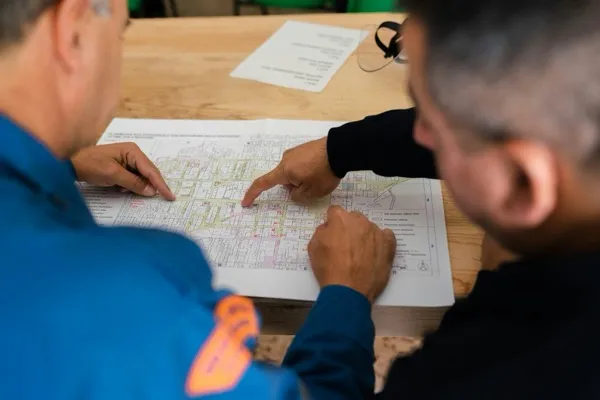

You've seen the vendor demos. Sixty percent faster. Eighty-seven percent faster. The tool reads the shop drawings against your project specs, flags the non-conformances, and hands your project admin a review queue instead of a stack of PDFs.
What the demos skip is the part that matters most to your firm. Who holds the liability when the AI misses something. What the January 2026 insurance exclusions mean for your errors and omissions (E&O) coverage. And whether the workflow your team adopts actually keeps the Engineer of Record in charge— or only appears to.
AI submittal review is an automated system that compares construction submittals— shop drawings, product data sheets, cut sheets— against project specifications to flag non-conformances before they reach the design team. Per Nomic's documented cases1, it reduces review time by 60–87%. The engineer of record makes every final call. A solid AI implementation strategy for submittal review starts with understanding exactly what that means in practice. This article covers what the tools actually do, how professional responsibility works with AI in the loop, and which platforms established AEC firms are deploying right now.
What AI Submittal Review Does (and Doesn't Do)
AI submittal review compares contractor-submitted shop drawings and product data against your project specifications and flags discrepancies for engineer review. No current tool issues a final response without that human review step1.
In practical terms, this is a spec parsing and comparison engine. The tool ingests your project specs by CSI division and the contractor's submittal package, then runs a comparison pass to identify items that don't match— discrepancies in dimensions, material substitutions, and detail modifications that previously required a human to find line by line9. The result is a flagged queue, not a decision. Every item in that queue still needs a licensed professional to review it, verify it against the contract documents, and issue a response.
Submittal review is one of the most time-intensive parts of construction project management8— and historically, it runs on spreadsheets, email chains, and good intentions7. The cost of getting it wrong is measurable. Per Nomic's data1, the average rejected submittal costs $805 and delays the project two to four weeks. For a project with 50 submittals across multiple CSI divisions, that's a meaningful exposure on every project cycle.
The time savings are real. Per Nomic's documented cases1, AI reduces submittal review from 20–30 minutes per submittal to 3–5 minutes— a 60–87% reduction. The part they don't lead with is what the AI cannot do.
What AI catches:
- Dimension differences between submitted drawings and specified dimensions
- Material substitutions that don't match spec section requirements
- Detail modifications that deviate from specified construction details
- Spec section mismatches where submitted product data doesn't align with the applicable section9
What AI does not do:
- Exercise engineering judgment about whether a deviation is acceptable
- Certify compliance with the contract documents
- Hold a professional registration or carry any indemnity
As ERTAS.AI notes in their governance framework6, an AI model holds no registration, no professional indemnity, and no accountability— it can't be the author of record or the responsible professional. The spec comparison is the tool's job. The engineering judgment is yours.
| Manual Review | AI-Assisted Review | |
|---|---|---|
| Time per submittal | 20–30 minutes | 3–5 minutes |
| Non-conformances flagged | Depends on reviewer attention | Systematic comparison across all spec items |
| Documentation trail | Email threads, markups, spreadsheets | Timestamped flag log + PE review record |
| EoR involvement | Full review from scratch | Review of flagged items only |
The documentation trail column is where the liability protection lives. A timestamped flag log with a PE review record demonstrates that proper oversight was maintained— email threads and spreadsheet markups do not.
Professional Responsibility Hasn't Changed. Your Workflow Needs To.
The engineer of record retains full professional and legal responsibility for the work, regardless of AI involvement. The PE stamp certifies the engineer's judgment— not the AI's output2.
There's no ambiguity here. According to SGH and Donovan Hatem, NSPE's engineering counsel2, the engineer of record carries statutory responsibility for the structural design, and that responsibility cannot be delegated to software. State PE licensing boards expect that AI tools don't change the PE's professional responsibility. Using AI without understanding its outputs, limitations, and failure modes may itself be below the standard of care2. Dan Cumberland Labs has documented this position directly: when a PE seals the work, they certify their own professional judgment— not the AI's output— and accept full professional responsibility17.
The question most AEC firms haven't answered before they buy an AI submittal review tool: who owns the call when the tool misses something? Governance isn't a feature. It's a decision your firm makes before the first submittal goes through the system.
The three-layer control model keeps that decision explicit:
Layer 1— AI as first-pass filter, not final answer. The tool compares submittals against specs and returns a prioritized queue of flagged items. Nothing in that queue is a decision. The queue is the starting point for the engineer's review— not a substitute for it.
Layer 2— PE review of the AI's output. This is not a rubber-stamp step. The engineer of record reviews each flagged item, verifies it independently against the contract documents, and exercises professional judgment about whether the deviation is acceptable, requires an RFI, or is a clear rejection. If the PE simply approves whatever the AI flags without independent review, practical control hasn't been maintained— regardless of what the contract says. According to ERTAS.AI6, AI tools create liability, safety risk, or professional responsibility exposure if the human oversight layer isn't designed correctly.
Layer 3— Documentation. Per HCR Law4, professional engineers should document what AI tool was used, what version, what inputs were provided, and what the PE review process was. This documentation protects the firm if the AI's contribution is questioned later— whether by a client, a contractor, or a licensing board.
For a deeper look at building a defensible framework, our guide on an AI governance framework for your firm covers the decision-making structure that makes AI tools defensible in regulated professional contexts.
The Insurance Situation: What to Confirm Before You Deploy
As of January 1, 2026, major insurance carriers added AI exclusions to professional liability (E&O) policies for design professionals. If your firm uses AI in any design work, your errors and omissions coverage may no longer protect you without a policy update.3
This is not limited to generative AI writing tools. The exclusion applies to AI-assisted review work— which means AI submittal review is in scope. Contact your broker now. Ask specifically about an AI endorsement or rider. The carrier landscape is still evolving in late 2026— some carriers are now offering AI endorsements, though availability varies— but don't assume your current policy covers AI-assisted work without confirming it explicitly.
The Hartford's guidance3 and Baker Donelson's analysis5 both confirm this is an active, carrier-wide shift. The time to update your policy is before the first submittal goes through the system— not after a claim.
Contract Terms to Address
Per Baker Donelson5, incorporating AI tools in a meaningful way requires new contract terms and reallocation of risks. Work with your construction attorney before your next project. Four items to address at minimum:
- Who is responsible if AI misses an item that later causes a defect or claim
- Whether the vendor provides any indemnification for AI errors in the review output
- What happens to liability if the tool goes down during a critical phase of construction administration
- What the dispute or audit process looks like for decisions made with AI assistance
Standard construction contracts don't address any of these yet. The time to add them is before the project starts— not after a claim.
The Tools Design Firms Are Using
Three tools dominate AI submittal review in established AEC firms right now: Procore AI (if you're already on Procore), Bluebeam Max with Firmus AI (if your workflow lives in Revu), and Nomic (for spec-based comparison independent of your construction management platform). Choose based on where your workflow already is— not which features look best in a demo.
Being tool-agnostic with good processes is more valuable than mastering specific AI tools. The governance model from the previous section is the same regardless of which platform you choose. What differs is how each tool fits into the workflow you already have.
Procore AI + Datagrid (for Procore shops)
Procore's AI-Powered Submittal Builder, launched March 2026, auto-generates submittals from specifications using AI-predicted fields, reducing creation time from days to hours12. Datagrid (an AI workflow automation platform integrated with Procore) provides the agent-based review workflow that keeps the entire submittal process within Procore12. The AI layer accelerates review without changing how your team manages submittals.
Per Procore12, Procore AI is built on 20+ years of construction data and understands the drawings, RFIs, submittals, and workflows that projects actually run on. Haskell demonstrated the workflow in practice: their project management team used the agent to compare trade partner submittals against design specs and surface potential variances for team review13.
Best for: Firms where the GC and design team are both already on Procore. The audit trail lives inside Procore, satisfying the Layer 3 documentation requirement without an additional system.
Bluebeam Max + Firmus AI (for Revu-native workflows)
Bluebeam acquired Firmus AI in September 2025 to integrate AI drawing review directly into its construction platform10. The resulting Smart Review feature automatically scans construction documents for missing tags, design issues, and scope gaps, returning AI-generated markups and dashboards11.
Best for: Firms that live in Bluebeam Revu for PDF markup. The AI layer extends the existing workflow without requiring a new platform, and the markup record doubles as the PE review documentation Layer 3 requires.
Nomic (for spec-based, platform-independent comparison)
Nomic processes both shop drawings and specs for multimodal comparison (visual drawings evaluated against text specifications)— coordination checks that previously required flipping between multiple documents can be automated16. It operates independently of the GC's platform choice, so the design firm controls the tool regardless of what the contractor uses.
Level 10 Construction accelerated its submittal reviews using Datagrid AI14, and Gilbane deployed TrunkSubmittal enterprise-wide across its jobsites15. Both show that measurable results are achievable within a standard project cycle. (Actual timelines vary by firm maturity and tool integration; cite these as case studies, not guarantees.)
Best for: Design firms that want to own the review process regardless of GC platform choice, especially those with high spec complexity across multiple CSI divisions. Running the review tool independently of the GC's platform maintains design firm control over the Layer 1 output— the AI's flagged queue— before it reaches the PE.
How to choose
| Procore AI | Bluebeam + Firmus | Nomic | |
|---|---|---|---|
| Best for | Procore shops | Revu-native teams | Platform-independent |
| Integration | Native Procore | Revu extension | Standalone |
| Audit trail | Within Procore | Within Bluebeam | Standalone log |
| Status | Launched March 2026 | Rolling out late 2026 | Active |
Four questions to answer before committing:
- Does it integrate with your current CMS— Procore, Bluebeam, or other?
- Does it maintain an audit trail of what AI flagged vs. what the PE decided?
- Does it support version control and change notification when specs are revised?
- Can you export documentation to satisfy insurance and contract requirements?
Choose the tool that fits your existing workflow. Features come second; process integration and documentation capability come first. Governance holds regardless of which platform you choose. If you're working through an AI decision framework for your firm, these criteria are where the tool evaluation starts.
How to Get Started: A 30-Day Pilot Framework
Start with a single active project. Pick the tool that integrates with your existing workflow, run one project through AI-assisted review, and update your E&O insurance before the first submittal goes through the system.
That last step belongs at the top of the list. Update the policy before running a single review.
1. Pre-work (Week 1) Map your current submittal review workflow manually. Which CSI divisions generate the most submittals? Where do non-conformances typically surface? Identify your highest-volume, highest-risk submittal types before touching any software. Update your E&O policy— confirm AI endorsement coverage before running a single review. The hidden costs of AI projects in professional services firms show up as liability exposure, not tool costs, when this step gets skipped.
2. Pilot setup (Week 2) Select one active project. Configure the tool with your project specs. Train your PM and the reviewing engineer— and be specific about what "PE review of AI output" means in practice. It means independent verification of flagged items against the contract documents. It doesn't mean clicking approve on the AI's queue.
3. Run the pilot (Weeks 3–4) Use AI for first-pass review on all submittals of one CSI division. Measure three things: time per submittal (manual baseline vs. AI-assisted), non-conformances caught per pass, and documentation completeness at the end. The baseline matters— you can't evaluate improvement without it.
4. Evaluate and expand After four weeks, compare against your baseline. If there's measurable improvement— and the documented cases show it materializes on time per review in the first project— define the governance protocol for broader rollout. If there are gaps in documentation or process, diagnose before expanding. In documented implementation cases, firms reported results within 4–8 weeks; actual timeline depends on firm maturity, tool integration, and submittal volume.
The pilot works because it measures against your own baseline— not vendor benchmarks. Four weeks of structured measurement gives you real data to defend tool adoption to clients, insurers, or licensing boards if ever questioned.
The culture of AI adoption in your firm is the other side of this. Technical rollout is half the work; the other half is your team understanding what their role in the loop actually is.
Frequently Asked Questions
How do we handle contracts when using AI for submittal review?
Standard construction contracts don't currently address AI tool use. Per Baker Donelson5, incorporating AI meaningfully requires new contract terms. Minimum items to address with your construction attorney: who is responsible if AI misses an item and it causes a defect; whether the vendor provides any indemnification for AI errors; what happens to liability if the tool goes down during a critical construction phase; and what the dispute or audit process looks like for AI-assisted decisions. Do this before your next project, not after a claim.
Does AI work for all submittal types?
Current tools work best on shop drawings and product data sheets with clear spec sections to compare against. Performance degrades on highly custom or proprietary submittals with limited spec specificity, or on submittals that fall outside standard CSI divisions. Edge cases and unusual specifications are precisely where the PE's judgment is most critical— and where Layer 2 of the control model earns its keep.
What if the AI misses a non-conformance?
This is the professional negligence exposure. If the PE failed to verify the AI's output, failed to understand its limitations, or failed to document the review process, the standard of care may not be met. Per SGH and Donovan Hatem2, state boards expect no change to PE responsibility from AI use— which means the analysis of whether care was exercised looks at the PE's review process, not the AI's accuracy rate. Two defenses matter: proper documentation of tool version, inputs, and review checkpoints4, and an updated AI endorsement on your E&O policy3. Both need to be in place before the first submittal goes through.
How much does it cost?
Procore AI is bundled with Procore subscriptions; Nomic uses custom pricing. Frame cost against the $805 per-rejection baseline1: if your firm processes 50+ submittals per project and your PE time is billed at $150+ per hour, the math on a 60–87% time reduction favors the tool within the first project. Request pricing from vendors directly. Don't commit before piloting.
Conclusion
The firms deploying AI submittal review successfully have one thing in common: they built the governance layer before they touched the tool. Clear PE oversight, updated insurance, documented review process, contracts that address AI use. That sequence matters.
Speed is the easy part. The firms getting this right are the ones where licensed expertise drives the workflow— the AI surfaces the discrepancies, and the Engineer of Record resolves them. No matter the question, people are the answer— and in construction administration, the person with the stamp is still the one who decides.
If you're working through where AI fits in your construction administration workflow— tooling, governance, insurance, contracts— Dan Cumberland Labs works with established AEC firms on this.
References
- Nomic AI, "Automated Submittal Review" (2026)— https://www.nomic.ai/glossary/automated-submittal-review
- SGH + Donovan Hatem, "Seven Questions on AI" (2024)— https://files.engineers.org/file/SGH-And-Donovan-Hatem-Seven-Questions-On-AI-2-26-24.pdf
- The Hartford, "AI Risk Mitigation for Architects and Engineers" (2026)— https://assets.thehartford.com/image/upload/architect-engineer-ai-risk-mitigation-design.pdf
- HCR Law, "AI and Professional Negligence" (2026)— https://www.hcrlaw.com/news-and-insights/ai-and-professional-negligence-the-new-risk-for-professionals/
- Baker Donelson LLP, "Automation and Artificial Intelligence in Construction Risk Mitigation" (2026)— https://www.bakerdonelson.com/automation-and-artificial-intelligence-in-construction-how-to-capitalize-on-technological-advancements-while-mitigating-your-risk
- ERTAS.AI, "AI Governance Framework for Construction and Engineering" (2026)— https://www.ertas.ai/blog/ai-governance-framework-construction-engineering
- Zipboard, "Shop Drawing Review Best Practices" (2026)— https://zipboard.co/blog/aec/how-to-set-up-a-shop-drawing-review-process-a-comprehensive-guide-with-free-template
- Nomic AI, "AI to Review Shop Drawings" (2026)— https://www.nomic.ai/glossary/ai-to-review-shop-drawings
- Nomic AI, "AI Shop Drawing Review Against Specs" (2026)— https://www.nomic.ai/use-cases/submittal-review/ai-shop-drawing-review-against-specs-drawings
- Bluebeam, "Bluebeam Acquires Firmus AI" (2025)— https://press.bluebeam.com/2025/09/bluebeam-acquires-firmus-ai-to-accelerate-intelligence-for-drawing-reviews-and-financial-risk-mitigation/
- Bluebeam, "AI Drawing Reviews" (2025)— https://www.bluebeam.com/?p=61192
- Procore, "What's New in Submittals 2026" (2026)— https://www.procore.com/blog/whats-new-in-submittals-2026
- Procore, "Haskell Submittal Review Case Study" (2026)— https://www.procore.com/advantage/haskell-cut-submittal-reviews
- Datagrid, "Level 10 Construction Case Study" (2026)— https://datagrid.com/costumer-stories/level-10-construction-accelerates-submittal-reviews-with-datagrid-ai
- Engineering News-Record, "Gilbane Rolls Out Trunk Tools AI Agents" (2026)— https://www.enr.com/articles/61435-gilbane-rolls-out-trunk-tools-ai-agents-across-its-jobsites
- Nomic AI, "AI Agents Reshaping Submittal Review" (2026)— https://nomic.ai/blog/ai-agents-reshaping-submittal-review
- Dan Cumberland Labs, "PE Stamp and AI Liability" (2026)— https://dancumberlandlabs.com/blog/pe-stamp-ai-liability/