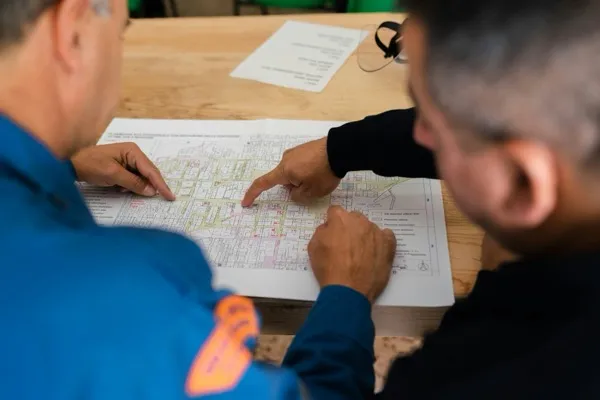
You're looking at the drawings. AI drafted the window schedule, summarized the egress code analysis, and generated portions of the specifications narrative. Your firm uses AI tools now— like 27% of AEC professionals already do.3 The output looks finished. The question sitting in front of you: what do you owe this work before you pick up the stamp?
That question doesn't change because AI generated portions of the deliverable. AIA Code of Ethics Rule 4.102 is direct: members "shall not sign or seal drawings, specifications, reports, or other professional work for which they do not have responsible control."1 The liability attaches at the moment of the seal— not when you prompted the tool, not when you reviewed the output, not when the project manager signed off.
"Whatever AI produces, an architect signs. You must understand what AI did, not just that it worked."— AIA AI Firm Toolkit2
That framing lands hard— and it should. Ninety-four percent of AEC professionals who currently use AI plan to increase their usage in 2026.3 The tools are arriving faster than the verification protocols. As Zweig Group wrote in April 2026: "In AEC, we do not move fast and break things. We sign and seal them."4
This checklist is organized by deliverable component— because that's how you'll use it. You're not looking for "AI error type 3." You're looking at the specifications on page 47.
Why Standard QA/QC Doesn't Catch AI Errors
Standard QA/QC processes were designed to catch human errors— missed dimensions, calculation slips, coordination gaps. AI introduces a structurally different class of failure: fabricated citations that look authentic, plausible-but-wrong reasoning, and outdated standards presented as current. These defeat typical review because they aren't random errors. They're coherent mistakes. The goal isn't to avoid AI— it's to build verification that matches how AI actually fails.
Infomineo's taxonomy identifies four AI error types that consistently reach deliverables5:
- Fabricated Citations— plausible but non-existent references
- Statistical Hallucinations— precise, unsupported numbers
- Plausible-but-Wrong Synthesis— accurate data with flawed reasoning
- Outdated Data as Current— old information presented as contemporary
The AIA AI Firm Toolkit confirms the structural nature of the problem: "Hallucinations are a structural feature of current AI models."6 The control mechanism isn't disabling hallucinations— it's building verification steps before reliance.
The volume problem compounds everything. AI expands output dramatically while review bandwidth stays fixed— and reviewers assume research layers are reliable when AI output looks finished and polished.7 That cognitive bias is exactly why errors survive review. The analogy isn't comfortable: in 2025, lawyers were sanctioned for submitting AI-generated court citations that didn't exist.8 Architects and engineers face an identical risk with code compliance documentation.
A firm-level AI governance framework addresses the upstream policies. This checklist addresses what happens when those policies reach the individual principal's desk.
"A shortcut that cannot be clearly explained under scrutiny is not an advantage. It is a liability."— Zweig Group9
The Pre-Seal Checklist— By Deliverable Component
For each component of the deliverable that AI produced or contributed to, verify the specific items below. Not all components apply to every project— use the risk-tier calibration in the next section to determine depth.
"AI is exploratory only. Final work must be independently re-verified."— AIA AI Firm Toolkit10
Code Citations and Regulatory References
The AIA Firm Toolkit's code research verification checklist is specific here11:
- Verify each citation against the actual jurisdiction source— not AI's description of the source
- Confirm the correct code edition and amendment cycle (AI frequently cites superseded versions)
- Independently validate any compliance interpretation AI provided
- Flag fabricated references: if a code section "sounds right" but can't be located in the actual document, treat it as non-existent
"Sounds plausible" is not "is accurate." These are different standards, and the seal commits to the second one.
Specifications
AI is prone to inventing plausible-sounding product references and citing outdated standards editions.12 Before sealing:
- Confirm product names and model numbers are accurate and current
- Validate installation procedures against manufacturer documentation— not AI's summary of it
- Verify that standards editions cited (ASTM, ANSI, NFPA, and similar) are current, not superseded
- Check system coordination across specification sections
An AI-generated specification citing a discontinued product or a superseded standard is a liability, not a time-saver.
Data, Statistics, and Calculations
Trace every numeric claim to its primary source. Never rely on AI's citation for a number.5
- Re-verify any calculation AI performed independently
- Check that all data is current— AI training data has a cutoff date, and regulations change after that cutoff
- Independently confirm statistical claims before including them in a sealed report
The consequences are real. Infomineo documented a case where a major professional services firm delivered a government report containing fabricated quotes and invented sources— content that passed multiple internal reviews. The result: a $290,000 partial refund and significant reputational damage.13 That firm was not AEC. But the failure mode is identical.
Renderings and Visual Content
AI-generated visual content requires verification that goes beyond "does this look right."14
- Verify buildability: does the rendering show something that can actually be constructed per the drawings?
- Check material accuracy— AI visual output may not match specified products
- Verify scale accuracy and site orientation
- Check for embedded bias in design elements: AI learns from historical training data, and that data can perpetuate stereotypes in form or use15
Copyright risk is present here, too. AI-generated designs can incorporate elements of copyrighted architectural works— and until courts fully resolve AI copyright liability, the firm using the tool should treat itself as potentially responsible for the output.16
Narrative Content (Reports, Code Analysis Summaries, Specification Narratives)
Don't review AI narratives for fluency. Review them for accuracy.
Independently confirm every factual claim, not just the overall structure. NSPE Board of Ethical Review Case 24-2 draws a useful distinction: an engineer's AI-assisted report was largely defensible; the AI-assisted design documents were not.17 The difference was review quality and documentation. Narrative content can be defensible— but only when each factual claim has been independently verified.
Confidentiality Verification
Before sealing, confirm no confidential client data was entered into unvetted AI platforms.18
- Review tool EULAs for data retention policies before using any AI tool on sensitive projects
- AI tool agreements often grant providers rights to submitted data— uploading confidential building specifications or client site details may allow providers to train on proprietary information19
- The AIA AI Firm Toolkit identifies uploading project-specific data into unvetted AI platforms as a high-risk scenario in current practice
| Component | Primary Verification | Source |
|---|---|---|
| Code Citations | Verify against actual jurisdiction source | AIA Firm Toolkit |
| Specifications | Confirm product names and standards editions | AIA Firm Toolkit |
| Data/Statistics | Trace to primary source; re-verify calculations | Infomineo |
| Renderings | Verify buildability, materials, scale accuracy | AIA Firm Toolkit |
| Narratives | Verify each factual claim independently | NSPE Case 24-2 |
| Confidentiality | Check EULA; confirm no client data in unvetted tools | AIA AI Firm Toolkit |
Risk-Tiered Calibration— How Much Review Is Enough
The AIA AI Firm Toolkit divides AI-assisted work into three risk tiers.20 Match your review depth to the tier— not everything requires full independent re-verification, but sealed documents always do.
| Tier | Examples | Review Standard | Who Reviews |
|---|---|---|---|
| Low | Meeting notes, early ideation, draft internal summaries | Quick reasonableness check | Any staff member |
| Medium | Code summaries, narratives, early client-facing work | Verify against sources, document AI use, PM approval | Project team member |
| High | Life-safety analysis, code compliance, sealed documents, accessibility reviews | Full independent re-verification | Licensed design professional |
High-risk is non-negotiable. Stamped documents sit in this tier regardless of how much review happened upstream. That's the AIA Toolkit's position, and the Graitec governance framework reinforces it: require documented review and signoff for all compliance-related AI suggestions.21
The tiering also answers the bandwidth question. Zweig Group documented the gap directly: most AEC firms mandate human review but lack operational clarity on sampling protocols and bandwidth allocation.22 The tier framework addresses that— it tells reviewers how much depth is actually required, not just that review is required.
The judgment call remains yours. The framework provides structure; the classification is professional judgment. Firms that get this right— that build verification into their AI workflows rather than bolting it on after— tend to find both better deliverables and faster review cycles. If calibrating that judgment across a growing portfolio of AI-assisted projects feels like a larger challenge than a single checklist covers, that's worth building into your broader approach to building an AI-ready team culture.
What the Project Record Must Show
When a claim arises on an AI-assisted project, defense attorneys request signed, dated QA/QC checklists immediately. Process failures— not engineering judgment disputes— generated most claims in Berkley Design Professional's claim library.23 The documentation question has shifted.
"The 2026 question on the application is no longer 'Do you have a QA/QC process.' It is 'Show us the QA/QC file.'"— PFTN A&E24
Underwriters now look for four specific documentation elements in AI-assisted project records24:
- Who used the AI tool— name and role
- Who reviewed the output— name and role; not the same person who generated it
- Signed-and-stamped check records showing what was verified
- QA/QC log entries for the review session itself
This isn't administrative overhead. It's the artifact that makes the claim defensible.
The insurance stakes are specific. ISO implemented three AI-related exclusions effective January 1, 2026: CG 40 47, CG 40 48, and CG 35 08.25 These exclusions apply where firms cannot document human-in-the-loop review of AI-assisted deliverables. Verify specific requirements with your carrier— specialty markets may have additional conditions beyond ISO filings. But the direction is clear: documentation is now a coverage condition, not a best practice.
The Graitec framework adds one practical item worth building in from the start: version control and audit trails for AI-driven design elements.21 If AI generated it, the record should show that— and show what happened after.
The AI governance policies a firm writes don't protect the principal at the moment that matters. Only the engineer or architect who personally reviews the output before stamping does. The documentation proves the review happened.
Consider incorporating the AI governance and risk decisions framework into your firm's existing QA/QC procedures— it provides a strategic frame for where human review points should sit in your workflows.
FAQ
These questions come up most often when AEC principals start applying the pre-seal protocol in practice.
Do I have to disclose AI use to clients before I seal?
Yes, when AI involvement is substantive. The AIA Firm Toolkit requires disclosure of significant AI use, confirmation that the architect remains responsible, and verification that outputs have been independently checked.26 The standard of care doesn't lower because AI generated a section of the deliverable. Your obligation to the client includes transparency about how the work was produced when that production method is substantive.
Does my E&O insurance cover AI-assisted work?
Verify with your carrier. ISO added three AI-related exclusions effective January 1, 2026— CG 40 47, CG 40 48, and CG 35 08— that exclude claims where documented human-in-the-loop review cannot be demonstrated.25 Coverage depends on your specific policy and documented workflow. Don't assume your existing policy covers AI-assisted work without confirming it directly with your carrier.
How is using AI different from relying on a junior staff member's work?
The error patterns are structurally different— that's the key distinction. A junior staff member makes random errors; AI makes coherent ones. NSPE's Responsible Charge standard (PS 10-1778) requires active personal engagement from conception to completion— and ASCE Policy Statement 573 is direct: "AI cannot serve as a replacement for the professional judgment of a licensed Professional Engineer."2728
The Pre-Seal Moment Is Yours
The pre-seal moment is where professional judgment is irreplaceable. AI handles the generation; the principal's review is the gate.
The checklist doesn't replace that judgment— it gives judgment a structure. Responsible charge has always required active engagement. AI adds new categories of failure to check for: fabricated citations, outdated standards, plausible-but-wrong synthesis. The list is concrete; the obligation isn't new.
"Just because it's easy doesn't mean it's good." The ease of AI generation is precisely why a deliberate verification protocol is needed before sealing. Speed in output doesn't reduce the standard of care at the stamp.
NSPE's ruling from Fall 2025 is worth keeping in view as AI tools become more capable: misuse of AI without Responsible Charge is unethical.29 The tools will keep improving. The obligation won't change.
If building the workflows, documentation systems, and review protocols that make AI-assisted practice both productive and defensible feels like a larger design challenge than a single checklist covers, that's a governance question worth addressing at the firm level. AI implementation services can help your firm build those systems without starting from scratch.
References
- American Institute of Architects, "2025 Annual Business Meeting Addresses AI Usage in Architecture, Fellowship Qualifications" (June 2025)— https://www.aia.org/article/2025-annual-business-meeting-addresses-ai-usage-architecture-fellowship-qualifications
- American Institute of Architects, "AIA AI Firm Toolkit" (2025)— https://aifirmtoolkit.aia.org/
- Bluebeam (reported by ASCE), "Architecture, Engineering, Construction Sector Slow to Adopt AI, Survey Shows" (December 2025)— https://www.asce.org/publications-and-news/civil-engineering-source/article/2025/12/18/architecture-engineering-construction-sector-slow-to-adapt-ai-survey-shows
- Zweig Group, "AI Governance and Trust in AEC Firms" (April 2026)— https://zweiggroup.com/blogs/the-zweig-letter/ai-governance-and-trust-in-aec-firms
- Infomineo, "AI Hallucinations in Consulting: How Errors Reach Client Deliverables and How to Stop Them" (2025)— https://infomineo.com/artificial-intelligence/ai-hallucinations-consulting-research-errors/
- American Institute of Architects, "AIA AI Firm Toolkit" (2025)— https://aifirmtoolkit.aia.org/
- Infomineo, "AI Hallucinations in Consulting: How Errors Reach Client Deliverables and How to Stop Them" (2025)— https://infomineo.com/artificial-intelligence/ai-hallucinations-consulting-research-errors/
- Proving Ground, "Code and Conduct: Five Areas Where AI Confronts the Architect's Ethics" (October 2025)— https://provingground.io/2025/10/22/code-and-conduct-five-areas-where-ai-confronts-the-architects-ethics/
- Zweig Group, "AI Governance and Trust in AEC Firms" (April 2026)— https://zweiggroup.com/blogs/the-zweig-letter/ai-governance-and-trust-in-aec-firms
- American Institute of Architects, "AIA AI Firm Toolkit" (2025)— https://aifirmtoolkit.aia.org/
- American Institute of Architects, "AIA AI Firm Toolkit" (2025)— https://aifirmtoolkit.aia.org/
- American Institute of Architects, "AIA AI Firm Toolkit" (2025)— https://aifirmtoolkit.aia.org/
- Infomineo, "AI Hallucinations in Consulting: How Errors Reach Client Deliverables and How to Stop Them" (2025)— https://infomineo.com/artificial-intelligence/ai-hallucinations-consulting-research-errors/
- American Institute of Architects, "AIA AI Firm Toolkit" (2025)— https://aifirmtoolkit.aia.org/
- Proving Ground, "Code and Conduct: Five Areas Where AI Confronts the Architect's Ethics" (October 2025)— https://provingground.io/2025/10/22/code-and-conduct-five-areas-where-ai-confronts-the-architects-ethics/
- Proving Ground, "Code and Conduct: Five Areas Where AI Confronts the Architect's Ethics" (October 2025)— https://provingground.io/2025/10/22/code-and-conduct-five-areas-where-ai-confronts-the-architects-ethics/
- National Society of Professional Engineers, "Use of Artificial Intelligence in Engineering Practice" (2025)— https://www.nspe.org/career-growth/ethics/board-ethical-review-cases/use-artificial-intelligence-engineering-practice
- American Institute of Architects, "AIA AI Firm Toolkit" (2025)— https://aifirmtoolkit.aia.org/
- Proving Ground, "Code and Conduct: Five Areas Where AI Confronts the Architect's Ethics" (October 2025)— https://provingground.io/2025/10/22/code-and-conduct-five-areas-where-ai-confronts-the-architects-ethics/
- American Institute of Architects, "AIA AI Firm Toolkit" (2025)— https://aifirmtoolkit.aia.org/
- Graitec North America, "Governing AI: 10-Point Expert Checklist For AEC Firms" (2025)— https://graitec.com/us/blog/governing-ai-10-point-checklist-aec-firms/
- Zweig Group, "AI Governance and Trust in AEC Firms" (April 2026)— https://zweiggroup.com/blogs/the-zweig-letter/ai-governance-and-trust-in-aec-firms
- PFTN A&E Professional Liability, "The QA/QC File the Professional Liability Underwriter Is Now Reading" (2026)— https://aepftn.com/blog/qa-qc-file-underwriter-reads-first
- PFTN A&E Professional Liability, "The QA/QC File the Professional Liability Underwriter Is Now Reading" (2026)— https://aepftn.com/blog/qa-qc-file-underwriter-reads-first
- PFTN A&E Professional Liability, "The QA/QC File the Professional Liability Underwriter Is Now Reading" (2026)— https://aepftn.com/blog/qa-qc-file-underwriter-reads-first
- American Institute of Architects, "AIA AI Firm Toolkit" (2025)— https://aifirmtoolkit.aia.org/
- National Society of Professional Engineers, "Artificial Intelligence— NSPE Advocacy Issues" (2025)— https://www.nspe.org/nspe-advocacy/explore-issues/professional-policies-and-position-statements/artificial-intelligence
- American Society of Civil Engineers, "Architecture, Engineering, Construction Sector Slow to Adopt AI, Survey Shows" (December 2025)— https://www.asce.org/publications-and-news/civil-engineering-source/article/2025/12/18/architecture-engineering-construction-sector-slow-to-adapt-ai-survey-shows
- National Society of Professional Engineers, "Board of Ethical Review: Fall 2025 Case Review and Discussion" (Fall 2025)— https://pdh.nspe.org/products/board-of-ethical-review-fall-2025-case-review-and-discussion